- What the product does (core value proposition in objective terms)
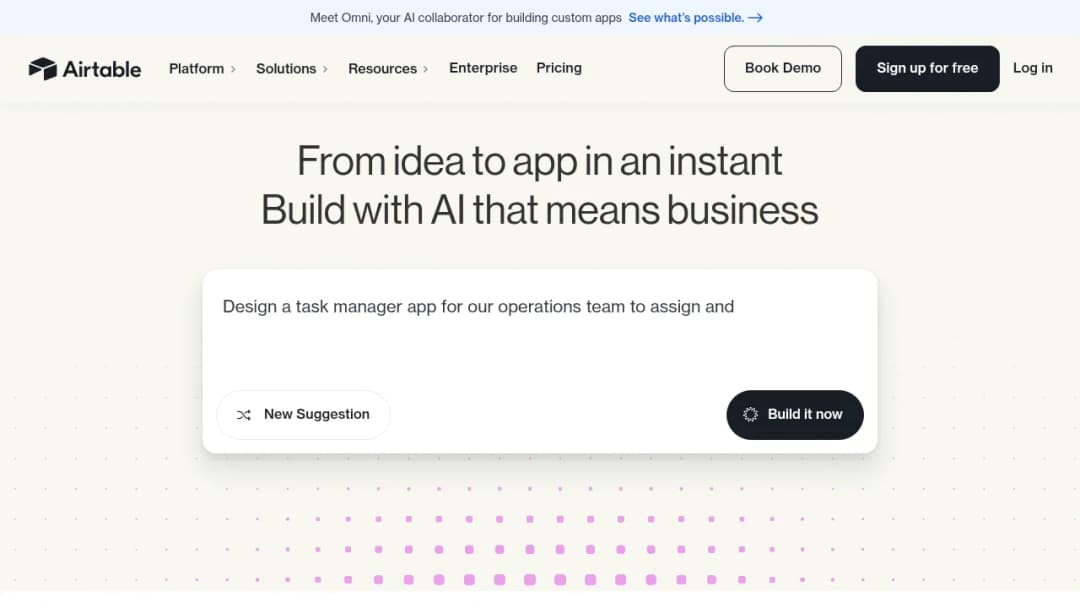
- Airtable is a cloud-based “no-code / low-code app platform” that combines spreadsheet-like UX with relational database concepts (linked records), views (grid/kanban/calendar, etc.), forms, automations, integrations, and app-like interfaces to support operational workflows across teams.
- Target market and market positioning
- Positioned as a “citizen development” platform for business teams (ops, marketing ops, product ops, PMO, HR, etc.) to build internal tools without full software engineering support.
- Common positioning tension in the market: Airtable can behave like a lightweight database + workflow layer, but teams sometimes experience “tool sprawl” and governance challenges as usage scales (especially when multiple bases proliferate).
- Company background (founding year, HQ, key leadership)
- Founded: 2012; HQ: San Francisco, United States (per Gartner Peer Insights vendor profile).
- Leadership details (CEO/founder) are widely reported elsewhere, but the most accessible authoritative source in this research set is Gartner’s company profile (leadership specifics not fully enumerated on that page in the accessible snippet).
- Funding and growth: investment rounds, acquisitions, estimated customer count/revenue if public
- Airtable has raised significant venture funding; TechCrunch reported a $185M raise (Sep 2020) tied to low-code/automation expansion.
- Airtable has continued product expansion into AI/agent workflows; TechCrunch (Jan 2026) covered “Superagent” positioning and use of premium data sources.
- Public, independently verified revenue/customer counts are not consistently disclosed in accessible primary sources; treat vendor claims and some secondary estimates cautiously.
- Pricing model with specific tiers and costs where available
- Airtable pricing page (as crawled ~June 2026) indicates:
- Team: $20/user/month billed annually
- Business: $45/user/month billed annually
- Enterprise Scale: custom pricing
- Many buyers also focus on paid seat definitions (Editor/Creator equivalents) and the fact that read-only sharing is typically not charged, which can be a meaningful cost lever for broad stakeholders.
- Total cost of ownership considerations (implementation, training, hidden costs)
- Implementation is often “fast to start” but can become “costly to scale” when teams require:
- Better data modeling, governance, and admin standards
- More advanced automations/integrations (potentially requiring iPaaS tools or custom scripting)
- Enterprise controls (SSO/audit logs/BAA for HIPAA)
- Reddit discussions frequently highlight confusion about seat billing across multiple workspaces and why costs rise unexpectedly as more editors are invited.
- Key competitors in the space (list 4-6 direct alternatives)
- Smartsheet
- Asana
- monday.com
- Notion
- Open-source/self-hostable “Airtable-like” options (e.g., Baserow) exist for teams prioritizing self-hosting/data control, though feature parity differs.