The Developer AI that deeply understands your codebase and how your team builds software.
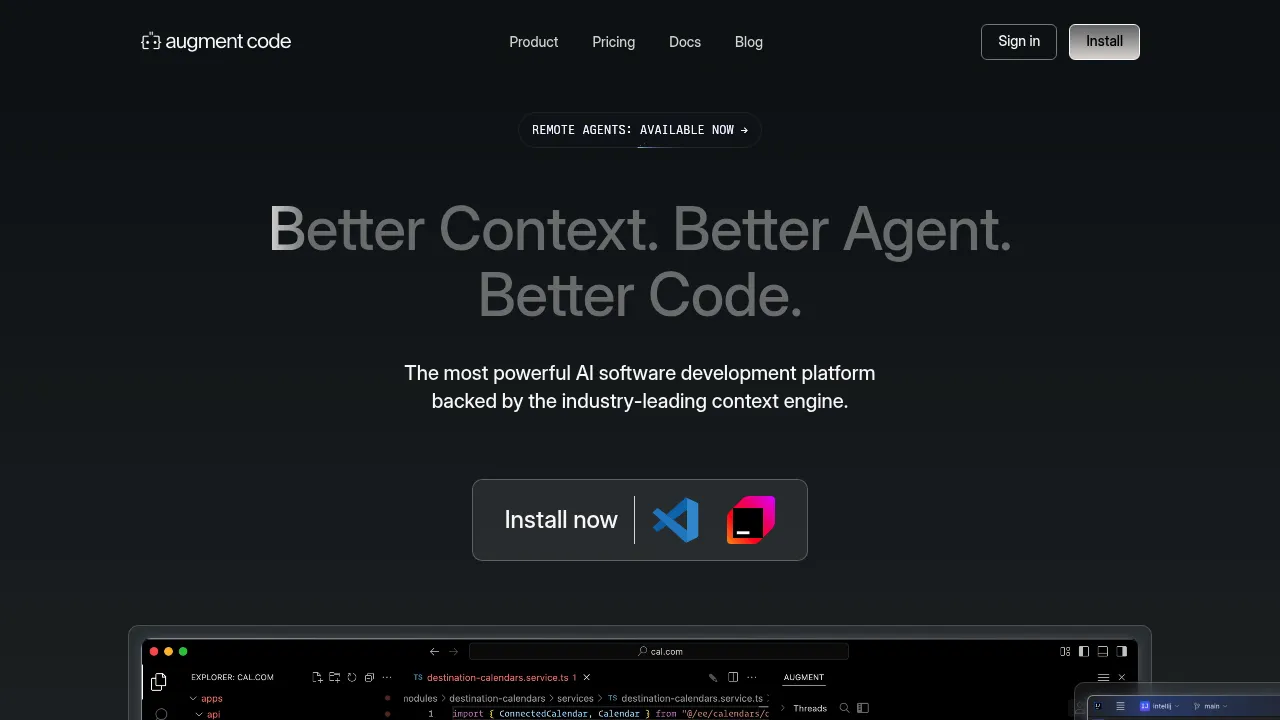
The Developer AI that deeply understands your codebase and how your team builds software.
Published Oct 23, 2026
This section summarizes both positive and negative feedback from publicly available review platforms and community sources.
Common themes observed on public community forums:
Recurring positive themes across reviewers and discussions:
Frequent negative themes across platforms and community sources:
Augment publishes a Code Review F-score benchmark showing its system above several competitors in their table.
Critical evaluation:
Few verifiable, quantified customer case studies with third-party confirmation were located in the sources reviewed. Most reported outcomes are qualitative (e.g., increased productivity or better understanding of a codebase).
Recommendation: request reference customers in the same industry and obtain measurable outcome metrics and the methodology used to calculate them.
Get a comprehensive analysis of Augment Code including market position, competitive landscape, adoption trends, and peer benchmarks.
Download full report →Consider alternatives when:
Based on public reviews and community signals:
Vendor-noted limitations and gating:
Roadmap items and future commitments:
G2 (mixed; includes positive and negative reviews):
Capterra:
Trustpilot (sample skewed negative):
Augment Code is an AI coding assistant built around software agents that operate across the developer workflow (IDE, CLI, and pull request code review). The vendor describes a Context Engine that maintains an index and representation of an organization’s codebase (code, dependencies, architecture, and history) so agents can generate edits and reviews that incorporate repository-wide context rather than relying only on an open file or a single diff.
Key product surfaces identified:
Vendor claim under scrutiny: Augment argues that many vendors broker access to similar large models and that context quality is the primary differentiator. That assertion is directionally plausible, but implementations differ in user experience, retrieval/indexing design, guardrails, speed/latency, and enterprise controls; therefore the underlying model provider is only one input to overall performance. The vendor publishes internal benchmarks; those benchmarks have not been independently audited in the public domain.