Workspace
    • Briefing
    • Ask Airframe
    Transformation
    • Audit
    Your Stack
    • Registry
    • Finance
    • Context
    Discover
    Powered by Airframe
    1. Research
    2. /
    3. Products
    4. /
    5. Basware
    Basware

    Basware

    Leader

    With Basware, now it all just happens.

    Est 1985|Valuation $529.5M|155 Ref Customers
    LinkedIn 56K|Web traffic 23K|FTEs 1,650|HQ Espoo, FI181, FI
    MarketsIntake-to-PaySource-to-PayProcure-to-PayInvoice Data Capture & ProcessingAccounts Payable (AP) Automation
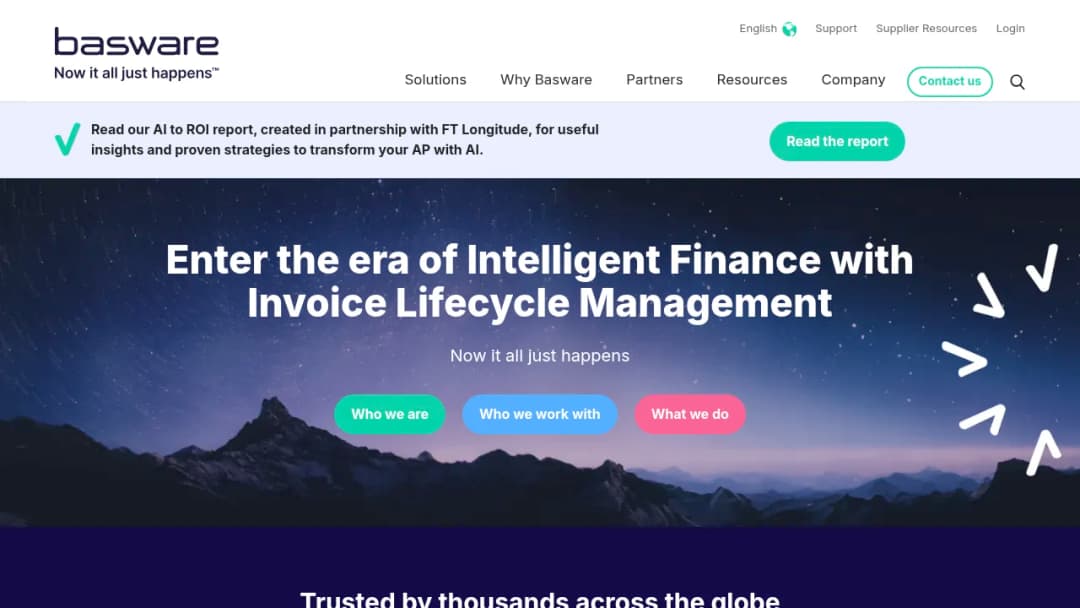
    Basware screenshot
    FirmCompareTractionAnalysisAdvocates

    Insights

    All insightsAccountingFinanceSoftwareCustomer experience

    Benchmarks

    The Software LeaderboardMethodology

    Tools & data

    Market ExplorerStudioRegistry

    Company

    AboutCareers

    Legal

    Privacy PolicyTerms of Service

    © 2026 Airframe, Inc. All rights reserved.

      Published Oct 22, 2026

      01Common complaints

      Basware may be a poor choice when any of the following apply: - You need a lightweight, out-of-the-box AP tool with minimal configuration and a fast rollout—Basware’s value proposition typically requires careful implementation and configuration. - Supplier experience is a primary requirement and the organization cannot tolerate supplier friction: public supplier feedback documents recurring issues in supplier portals and submission processes. - You require transparent, self-service pricing with immediately comparable tiers; Basware is predominantly quote-based. - Procurement and sourcing UX are primary priorities and you require best-in-class sourcing/catalog usability; some user feedback indicates procurement/catalog functionality may be less mature than specialist procurement suites. - Your IT organization has limited capacity to manage complex ERP integrations; integrations can be time-consuming and may require external resources.

      Deal disqualifiers (poor fit)

      • Low invoice volume organizations seeking an out-of-the-box, low-cost AP tool
      • Organizations that cannot staff implementation or governance resources
      • Supplier ecosystems that cannot tolerate stricter invoice submission rules or where supplier friction is unacceptable

      Known limitations from customer feedback

      • Performance issues reported in some customer accounts (slowness and freezing)
      • Reporting flexibility concerns cited in user reviews
      • Supplier portal friction related to invoice submission rules and rejections
      • Procurement/catalog management usability reported as less user-friendly in some implementations

      Roadmap / "not yet available"

      Public roadmap information is limited. The vendor references generative AI initiatives and product features labeled in marketing materials; buyers should validate feature availability, maturity, and contractual commitments through product demonstrations and reference checks.

      Scale limitations

      The product is marketed for enterprise scale. Deployment complexity tends to scale with the number of ERPs, legal entities, and approval paths. Successful large deployments are commonly associated with strong implementation governance and supplier enablement programs.

      02Why they buy

      Unique selling points supported by evidence (neutral phrasing)

      • Enterprise-scale AP automation capability: reviewers and analysts identify invoice automation and exception handling as strengths in configured deployments.
      • Workflow configurability: the platform’s workflow engine enables detailed approval routing and exception handling according to multiple user reports.
      • Regional deployment and API availability: developer documentation indicates API access and regional deployments in EU, US, and AU regions.

      Where competitors have advantages

      • Broader spend management functionality (sourcing and procurement UX) is typically stronger in suites such as Coupa and SAP.
      • Supplier usability and portal experience are areas where some competitors may offer simpler supplier submission mechanisms and lower friction.

      Why customers chose Basware over alternatives (recurring reasons)

      Reviewers and vendor/analyst positioning identify recurring purchase drivers:

      • Advanced workflow and exception handling capability (deep configurability)
      • Multi-ERP integration capability
      • Global tax and e-invoicing compliance focus
      • Potential to increase automation and touchless processing, especially for PO-based invoices

      03Field reports

      Review platform sentiment snapshots

      Capterra: moderately rated on Capterra with limited review volume - Positive themes: faster invoice coding in some implementations, efficient invoice processing where configuration is mature - Negative themes: performance concerns, non-intuitive user experience, support responsiveness issues G2: Reviews include positive notes on automation and compliance and recurring complaints on implementation cost, performance, and reporting flexibility. Common complaints include: - High implementation costs - Complex ERP integrations - Performance lags - Limited reporting flexibility - Interfaces perceived as complex - Slow support resolution in some instances Trustpilot: Several supplier-side reviews are negative, focusing on invoice submission friction and payment delays experienced by suppliers using vendor portals.

      Direct review quotes (positive)

      • "It is easy to use and most importantly, it is possible to code invoices very fast and effective."
      • "Basware is one of the leading purchase-to-pay/invoice processing platforms… the workflow engine allows… an approval process regardless of detail and exceptions."
      • "Basware was originally an AP software and that’s where its strength is… flexible on integrating to many systems."

      Direct review quotes (negative)

      • "It works slow and is not intuitive."
      • "Submitting an invoice is really hard, format rules seem to be impossible to meet, and user guides are contradictory…"
      • "It unnecessarily complicates the process for the issuer to receive their payment. And customer service? What’s that?"
      • "Basware doesn’t care about usability… Don’t get me started on the search… it’s like 1995."

      Why some customers leave or complain (churn drivers)

      Recurring reasons cited in reviews and community feedback include:

      • Implementation complexity and dependence on consultants
      • Performance issues (slow response, freezing)
      • Supplier experience friction around invoice submission and rejections
      • Reporting limitations or lack of flexibility
      • Relative weakness on procurement/catalog UX compared with procurement-first suites

      Vendor-published outcomes (examples)

      Vendor-published case study claims include outcomes framed as cost savings, accelerated ROI timelines, very high automation and compliance rates, and reductions in invoice costs.

      Critical evaluation of these metrics

      - These results are vendor-published and generally lack publicly available methodology, baseline definitions, and independent verification. - Buyers should request supporting information for any vendor-published case study claims, including: - Clear before/after metrics (invoice volumes, exception rates, definitions of "touchless") - Time periods covered by the analysis - Whether reported savings are cash savings or avoided costs - The extent to which results depended on complementary process redesign or third-party services

      Mixed/negative outcomes

      Public case studies rarely document failed deployments. However, review platforms and supplier feedback indicate that outcomes vary and depend on implementation governance, configuration quality, and supplier enablement efforts.

      04Best fit

      Company sizes

      Based on vendor guidance and enterprise references:

      • Midmarket to large enterprises

      Industries

      Relevant where invoice volume and compliance complexity are high, for example:

      • Manufacturing
      • Consumer goods and distribution
      • Logistics
      • Energy
      • Public sector

      Roles and personas

      • CFO / VP Finance
      • AP Director / Shared Services Lead
      • Procurement Operations
      • IT / ERP Integration Architects
      • Compliance and Tax leaders

      Qualification criteria (good fit)

      • Multi-country operations with tax/e-invoicing compliance requirements
      • Multiple ERPs or a complex integration landscape
      • A need for strong automation of PO-based invoices and detailed exception handling
      • Willingness to invest in implementation and process change management

      05The pitch

      What the product does (core value proposition)

      Basware is a B2B finance automation platform focused on accounts payable (AP) automation, invoice processing, e-invoicing, and broader purchase-to-pay (P2P) workflows. The vendor describes the product as an invoice lifecycle platform that ingests invoices from multiple channels, automates matching and approvals, addresses compliance requirements across jurisdictions (for example, VAT and e-invoicing mandates), and integrates with ERPs at enterprise scale. Vendor materials emphasize: - Automation of exception handling in invoice processing - Support for tax and e-invoicing compliance across multiple jurisdictions - Broad ERP connectivity - A supplier connectivity network for e-invoicing

      Target market and market positioning

      Basware primarily targets midmarket-to-large enterprises, especially:

      • Multi-entity / multi-country organizations
      • Shared services finance organizations
      • Companies processing high invoice volumes

      The supplier connectivity / e-invoicing network is relevant for multinational organizations with large supplier bases.

      Get a comprehensive analysis of Basware including market position, competitive landscape, adoption trends, and peer benchmarks.

      Download full report →

      Basware may be a poor choice when any of the following apply:

      • You need a lightweight, out-of-the-box AP tool with minimal configuration and a fast rollout—Basware’s value proposition typically requires careful implementation and configuration.
      • Supplier experience is a primary requirement and the organization cannot tolerate supplier friction: public supplier feedback documents recurring issues in supplier portals and submission processes.
      • You require transparent, self-service pricing with immediately comparable tiers; Basware is predominantly quote-based.
      • Procurement and sourcing UX are primary priorities and you require best-in-class sourcing/catalog usability; some user feedback indicates procurement/catalog functionality may be less mature than specialist procurement suites.
      • Your IT organization has limited capacity to manage complex ERP integrations; integrations can be time-consuming and may require external resources.

      Capterra: moderately rated on Capterra with limited review volume

      • Positive themes: faster invoice coding in some implementations, efficient invoice processing where configuration is mature
      • Negative themes: performance concerns, non-intuitive user experience, support responsiveness issues

      G2: Reviews include positive notes on automation and compliance and recurring complaints on implementation cost, performance, and reporting flexibility. Common complaints include:

      • High implementation costs
      • Complex ERP integrations
      • Performance lags
      • Limited reporting flexibility
      • Interfaces perceived as complex
      • Slow support resolution in some instances

      Trustpilot: Several supplier-side reviews are negative, focusing on invoice submission friction and payment delays experienced by suppliers using vendor portals.

      • These results are vendor-published and generally lack publicly available methodology, baseline definitions, and independent verification.
      • Buyers should request supporting information for any vendor-published case study claims, including:
        • Clear before/after metrics (invoice volumes, exception rates, definitions of "touchless")
        • Time periods covered by the analysis
        • Whether reported savings are cash savings or avoided costs
        • The extent to which results depended on complementary process redesign or third-party services

      Basware is a B2B finance automation platform focused on accounts payable (AP) automation, invoice processing, e-invoicing, and broader purchase-to-pay (P2P) workflows. The vendor describes the product as an invoice lifecycle platform that ingests invoices from multiple channels, automates matching and approvals, addresses compliance requirements across jurisdictions (for example, VAT and e-invoicing mandates), and integrates with ERPs at enterprise scale.

      Vendor materials emphasize:

      • Automation of exception handling in invoice processing
      • Support for tax and e-invoicing compliance across multiple jurisdictions
      • Broad ERP connectivity
      • A supplier connectivity network for e-invoicing

      How it compares

      • AP Automation market report

        Basware is #5 of the top 10 AP Automation vendors by known customers (156 known customers).

        Other top vendors: Coupa, BILL, HighRadius, Tipalti, Ramp.