Workspace
    • Briefing
    • Ask Airframe
    Transformation
    • Audit
    Your Stack
    • Registry
    • Finance
    • Context
    Discover
    Powered by Airframe
    1. Research
    2. /
    3. Products
    4. /
    5. BetterCloud
    BetterCloud

    BetterCloud

    Manage every app, every user, every dollar.

    Est 2011|Valuation $425M|Raised $132.3M|90 Ref Customers
    LinkedIn 18K|Web traffic 16K|FTEs 137|HQ New York, New York, US
    MarketsSaaS Spend ManagementIdentity Provider (IdP) & Single Sign-On (SSO)Productivity & Collaboration Suite
    Platform CoversSaaS ManagementIdentity Governance & Administration (IGA)Workflow Automation
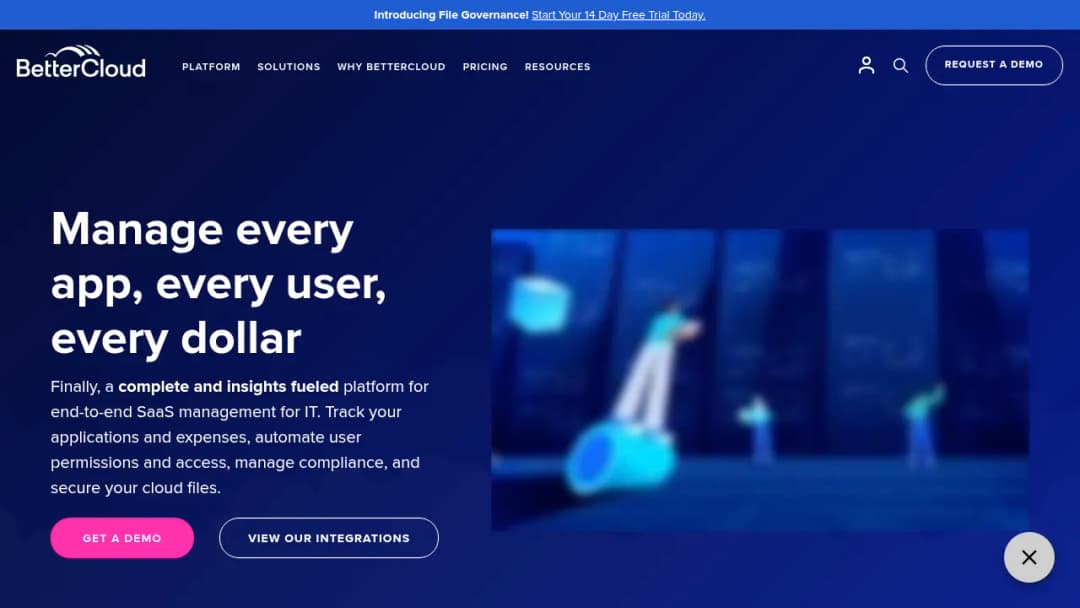
    BetterCloud screenshot
    FirmCompareTractionAnalysisAdvocates

    Insights

    All insightsAccountingFinanceSoftwareCustomer experience

    Benchmarks

    The Software LeaderboardMethodology

    Tools & data

    Market ExplorerStudioRegistry

    Company

    AboutCareers

    Legal

    Privacy PolicyTerms of Service

    © 2026 Airframe, Inc. All rights reserved.

      Published Oct 15, 2026

      01Common complaints

      - Company sizes or stages where this product is overkill or insufficient - Early-stage startups or sub-100 employee orgs that mainly need lightweight lifecycle automation may find BetterCloud cost-prohibitive versus Okta Workflows, native Google/M365 tools, or smaller SMPs. - Industries or use cases where competitors are clearly superior - If the primary initiative is enterprise procurement optimization, renewal negotiation, and spend benchmarking at scale: - Zylo or Productiv may be a better starting point because their positioning and datasets emphasize financial optimization. - Technical requirements that this product cannot meet - If your HRIS integration must support specific username/email generation rules (e.g., first initial + last name) and it does not, you may be forced into manual steps that defeat the point of automation (TrustRadius Workday integration complaint). - Budget constraints that make alternatives more appropriate - If “high price point” is a major concern (a common theme in user sentiment), consider: - Okta Workflows (if you already license Okta) - Torii Basic (published per-employee pricing) - Other SMPs with transparent pricing (community mentions Trelica as price-transparent) - Specific workflows or integrations where the product falls short - Workflows that depend on deep, nuanced HRIS fields and naming conventions - Apps with limited or missing BetterCloud integrations (or limited action depth) - Red flags in the buying process - Lack of public list pricing can complicate early-stage evaluation and ROI modeling - Post-acquisition product direction and roadmap uncertainty is a concern explicitly mentioned by at least one recent reviewer (ownership changes). - Current limitations acknowledged by the vendor - BetterCloud materials emphasize dependence on SaaS APIs; user reviews explicitly cite Google API limitations affecting capabilities (e.g., folder ownership changes) (G2 review). - Features on the roadmap (not yet available) — note estimated dates if available - BetterCloud publishes “Latest product updates” posts (e.g., Spring 2026, Winter 2026) but roadmap commitments beyond release notes are not clearly committed in the sources captured. - Scale limitations (at what volume/size does it break down?) - No clear public scale limits were found. - However, workflow performance issues have been reported anecdotally (“10-15x” longer runs) which could become more acute at scale or during platform issues. - Security or compliance gaps - Publicly accessible excerpts reviewed do not clearly show a list of security certifications (SOC 2/ISO). Buyers with strict compliance needs should request the full security packet and verify independently. - Technical debt or architectural limitations mentioned in reviews - Integration depth and “simple engineering changes” not prioritized are recurring frustrations (TrustRadius Workday complaint). - API limitations or integration constraints - Google/M365 API limitations can cap what BetterCloud can do; users cite constraints.
      Deal disqualifiers: what makes a POOR fit

      • Very small teams needing only basic onboarding/offboarding and highly cost sensitive
      • Heavy dependence on HRIS-driven provisioning with strict naming/identity rules that some user reviews indicate the vendor’s HRIS integration may not accommodate
      • Need for publicly verifiable security certifications and detailed compliance documentation without going through a sales/security review process

      Why some customers left for competitors (churn reasons)

      • Public sources reviewed did not provide clear “we switched to X because…” narratives in enough detail; however, recurring themes that can drive churn/risk include:
        • High cost (community mentions)
        • Integration gaps and insufficient depth in key integrations (especially HRIS-driven lifecycle)
        • Workflow reliability/performance complaints
        • Uncertainty from ownership changes (post-acquisition concerns)

      02Why they buy

      - Competitive advantages validated by customer feedback (not just vendor claims) - Strong workflow automation and time savings in offboarding/onboarding contexts (G2 and TrustRadius reviews). - Admin-friendly UI compared to alternatives (TrustRadius reviewer). - Unique features and capabilities competitors lack - BetterCloud’s differentiation is often framed as “IT operations layer” across SaaS for governance actions plus automation (distinct from pure IdP provisioning and pure spend tools). - Differentiation from competitors based on reviews - Customers praise BetterCloud for operational workflows and governance actions (sharing controls, alerts, automation). - Areas where competitors clearly have advantages (be balanced) - Zylo/Productiv: stronger orientation toward spend benchmarks, procurement, renewal ROI narratives. - Okta Workflows: tighter coupling to identity lifecycle in Okta-first environments.

      Why customers chose this product over alternatives (patterns)

      • Stronger no-code workflow automation for SaaS admin tasks vs manual scripting
      • Operational governance features for Google Workspace / M365 file sharing and admin controls
      • Centralization across multiple SaaS apps via integrations (when available)
      • Support responsiveness is highlighted in some reviews (G2, Gartner snippets)

      03Field reports

      Review landscape snapshots

      - G2 - Rating: well-rated on G2 with a substantial review footprint (as presented on G2). - Common positives in G2’s review summary: automation, ease of use, onboarding/offboarding time savings. - Common negatives: pricing, “limited features” or “missing features,” and “integration issues.” - Gartner Peer Insights - Rating: well-rated on Gartner Peer Insights with a small-to-moderate number of ratings (Gartner page shows ratings and sample review snippets, full text may require login). - TrustRadius - Score: positively scored on TrustRadius with a modest number of reviews and ratings.

      Direct quotes (positive and negative) from accessible sources

      - G2 (positive + concern) - Positive: “Things work well from the admin side and customer support has been responsive in helping and fixing things for us.” (Stu M., IT Officer). - Negative/concern: “I’m a bit nervous about the continual change of ownership. Often this results in product deterioration.” (Stu M.). - G2 (positive + limitation) - Positive: “really powerful tools to automate and build workflows” and alerts for external sharing (Brian B., IT Manager). - Negative: “mainly around integrations… some platforms we use that don’t have an integration… some of the integrations… lack the full functionality we wish was available” (Brian B.). - TrustRadius (negative/critical on integration detail) - Complaint: BetterCloud’s Workday integration “does not include the ability to create a username/email address in the very common first initial, lastname @ domain.com… This seems like a simple engineering change… [BetterCloud has] little interest in doing.” - Mixed assessment: “For deprovisioning users, the product works as expected with some performance hiccups… Workflow automations at this point do not seem like a product worth purchasing… which defeats the purpose of automations.” - TrustRadius (positive) - “Our normal offboarding process would take [tens of minutes] per person if we didn’t have BetterCloud workflows in place… saves our team a ton of time… UI is incredibly easy to use…” - Cons noted in same review: dashboard redesign/customization desired. - Reddit /r/sysadmin (negative reliability/performance) - “an utterly incomprehensible amount of issues with workflows either not being started… or simply taking many times the normal processing time to complete.”

      Specific outcomes customers achieved (with metrics when available)

      • Vendor- and review-claim examples (not independently audited)
        • G2’s aggregated insights suggest a short-to-moderate implementation timeframe and ROI occurring within roughly a year-plus (based on user inputs and G2 aggregation).
        • TrustRadius reviewers cite time savings per offboarding (e.g., tens of minutes per person saved) but these are anecdotal and environment-dependent.

      Deal-breakers and reasons customers didn’t purchase

      • Community feedback frequently frames BetterCloud as “insanely expensive” for some orgs, pushing evaluation toward Okta Workflows or other SMPs.
      • Integration limitations (e.g., HRIS naming conventions and workflow prerequisites) can be a deal-breaker when the intended “source of truth” design depends on HRIS-driven provisioning.

      Vendor case studies referenced on BetterCloud’s site

      • BetterCloud’s homepage highlights customer stories such as Definitive Healthcare, Rentokil Initial, and Pie Insurance, including claims of recovering a substantial number of hours annually for Pie Insurance.

      Critical evaluation of these case studies

      - These success stories are vendor-published marketing materials. - Methodology gaps - The underlying calculation methods (baseline assumptions, measurement windows, counterfactuals) are not provided in the publicly captured excerpts. - Takeaway - Treat these as directional evidence that automation can materially reduce manual IT admin time, but validate with a pilot using your own workflow volume, exception rate, and integration coverage.

      Third-party or partner collateral (supporting but not independent)

      • A Dropbox-hosted integration use-case document describes BetterCloud’s governance/automation positioning for Dropbox Business. This supports integration relevance but remains partner marketing collateral rather than independent validation.

      04Best fit

      Company sizes

      • Mid-market to enterprise is the clearest fit based on review distribution and product positioning:
        • Organizations ranging from lower mid-market to large enterprises; many customer reviews describe deployments at substantial organizations. Smaller deployments are possible but tend to be more price-sensitive.

      Industries and verticals where adoption is strongest (with customer examples)

      • Cross-industry adoption. Vendor-cited examples include insurance and global services contexts (e.g., Pie Insurance, Rentokil Initial) and healthcare data/stack governance narratives (Definitive Healthcare).

      Roles and personas: decision makers AND end users

      • Decision makers
        • Head of IT / IT Operations leadership
        • Security/GRC leadership (for file governance and audit readiness)
        • Procurement/Finance leadership (secondary stakeholder if spend optimization modules are used)
      • End users
        • IT administrators building workflows
        • SaaSOps engineers
        • Security analysts reviewing alerts/policies

      Pain points and challenges the product addresses

      • Manual onboarding/offboarding steps across many SaaS apps
      • Risky file sharing and permission sprawl (Drive/Dropbox/M365 patterns)
      • Admin privilege sprawl and lack of consistent governance actions
      • Lack of centralized automation for SaaS operational tasks

      Qualification criteria: what makes a GREAT fit

      • You have a mature SaaS stack (Google Workspace and/or Microsoft 365 plus many adjacent apps)
      • You can standardize processes and commit time to workflow build-out
      • You have clear governance and lifecycle requirements (role templates, offboarding policy, file sharing policies)

      05The pitch

      What the product does (core value proposition in objective terms)

      - BetterCloud is a SaaS Management Platform (SMP) focused on operational control of SaaS environments, especially: - User lifecycle automation (onboarding, offboarding, role/permission changes) - SaaS governance (admin controls, policy enforcement) - File/content governance and monitoring for common productivity suites (notably Google Workspace and Microsoft 365) - Spend optimization and license reclamation (positioned as SaaS cost control) - BetterCloud emphasizes no-code workflow automation (triggers/actions/templates) across integrated SaaS apps and centralized visibility/controls.

      Target market and market positioning

      - Primary buyers/users - IT Ops / SaaSOps teams - IT Security / GRC teams for SaaS governance and file-sharing risk controls - Secondary stakeholders: Finance/Procurement for spend visibility and renewals support (often via integrations like IdP + finance systems, per reviews) - Typical fit - Mid-market to enterprise organizations running multi-SaaS stacks with Google Workspace and/or Microsoft 365, plus identity providers and ITSM. - Positioning themes (vendor) - “End-to-end” SaaS management across automation, spend, and governance. - ROI-forward messaging, including a written short-term multi-fold ROI guarantee claim (details/methodology not independently verifiable from public materials alone).

      Get a comprehensive analysis of BetterCloud including market position, competitive landscape, adoption trends, and peer benchmarks.

      Download full report →
      • Company sizes or stages where this product is overkill or insufficient

        • Early-stage startups or sub-100 employee orgs that mainly need lightweight lifecycle automation may find BetterCloud cost-prohibitive versus Okta Workflows, native Google/M365 tools, or smaller SMPs.
      • Industries or use cases where competitors are clearly superior

        • If the primary initiative is enterprise procurement optimization, renewal negotiation, and spend benchmarking at scale:
          • Zylo or Productiv may be a better starting point because their positioning and datasets emphasize financial optimization.
      • Technical requirements that this product cannot meet

        • If your HRIS integration must support specific username/email generation rules (e.g., first initial + last name) and it does not, you may be forced into manual steps that defeat the point of automation (TrustRadius Workday integration complaint).
      • Budget constraints that make alternatives more appropriate

        • If “high price point” is a major concern (a common theme in user sentiment), consider:
          • Okta Workflows (if you already license Okta)
          • Torii Basic (published per-employee pricing)
          • Other SMPs with transparent pricing (community mentions Trelica as price-transparent)
      • Specific workflows or integrations where the product falls short

        • Workflows that depend on deep, nuanced HRIS fields and naming conventions
        • Apps with limited or missing BetterCloud integrations (or limited action depth)
      • Red flags in the buying process

        • Lack of public list pricing can complicate early-stage evaluation and ROI modeling
        • Post-acquisition product direction and roadmap uncertainty is a concern explicitly mentioned by at least one recent reviewer (ownership changes).
      • Current limitations acknowledged by the vendor

        • BetterCloud materials emphasize dependence on SaaS APIs; user reviews explicitly cite Google API limitations affecting capabilities (e.g., folder ownership changes) (G2 review).
      • Features on the roadmap (not yet available) — note estimated dates if available

        • BetterCloud publishes “Latest product updates” posts (e.g., Spring 2026, Winter 2026) but roadmap commitments beyond release notes are not clearly committed in the sources captured.
      • Scale limitations (at what volume/size does it break down?)

        • No clear public scale limits were found.
        • However, workflow performance issues have been reported anecdotally (“10-15x” longer runs) which could become more acute at scale or during platform issues.
      • Security or compliance gaps

        • Publicly accessible excerpts reviewed do not clearly show a list of security certifications (SOC 2/ISO). Buyers with strict compliance needs should request the full security packet and verify independently.
      • Technical debt or architectural limitations mentioned in reviews

        • Integration depth and “simple engineering changes” not prioritized are recurring frustrations (TrustRadius Workday complaint).
      • API limitations or integration constraints

        • Google/M365 API limitations can cap what BetterCloud can do; users cite constraints.
      • Competitive advantages validated by customer feedback (not just vendor claims)

        • Strong workflow automation and time savings in offboarding/onboarding contexts (G2 and TrustRadius reviews).
        • Admin-friendly UI compared to alternatives (TrustRadius reviewer).
      • Unique features and capabilities competitors lack

        • BetterCloud’s differentiation is often framed as “IT operations layer” across SaaS for governance actions plus automation (distinct from pure IdP provisioning and pure spend tools).
      • Differentiation from competitors based on reviews

        • Customers praise BetterCloud for operational workflows and governance actions (sharing controls, alerts, automation).
      • Areas where competitors clearly have advantages (be balanced)

        • Zylo/Productiv: stronger orientation toward spend benchmarks, procurement, renewal ROI narratives.
        • Okta Workflows: tighter coupling to identity lifecycle in Okta-first environments.
      • G2
        • Rating: well-rated on G2 with a substantial review footprint (as presented on G2).
        • Common positives in G2’s review summary: automation, ease of use, onboarding/offboarding time savings.
        • Common negatives: pricing, “limited features” or “missing features,” and “integration issues.”
      • Gartner Peer Insights
        • Rating: well-rated on Gartner Peer Insights with a small-to-moderate number of ratings (Gartner page shows ratings and sample review snippets, full text may require login).
      • TrustRadius
        • Score: positively scored on TrustRadius with a modest number of reviews and ratings.
      • G2 (positive + concern)
        • Positive: “Things work well from the admin side and customer support has been responsive in helping and fixing things for us.” (Stu M., IT Officer).
        • Negative/concern: “I’m a bit nervous about the continual change of ownership. Often this results in product deterioration.” (Stu M.).
      • G2 (positive + limitation)
        • Positive: “really powerful tools to automate and build workflows” and alerts for external sharing (Brian B., IT Manager).
        • Negative: “mainly around integrations… some platforms we use that don’t have an integration… some of the integrations… lack the full functionality we wish was available” (Brian B.).
      • TrustRadius (negative/critical on integration detail)
        • Complaint: BetterCloud’s Workday integration “does not include the ability to create a username/email address in the very common first initial, lastname @ domain.com… This seems like a simple engineering change… [BetterCloud has] little interest in doing.”
        • Mixed assessment: “For deprovisioning users, the product works as expected with some performance hiccups… Workflow automations at this point do not seem like a product worth purchasing… which defeats the purpose of automations.”
      • TrustRadius (positive)
        • “Our normal offboarding process would take [tens of minutes] per person if we didn’t have BetterCloud workflows in place… saves our team a ton of time… UI is incredibly easy to use…”
        • Cons noted in same review: dashboard redesign/customization desired.
      • Reddit /r/sysadmin (negative reliability/performance)
        • “an utterly incomprehensible amount of issues with workflows either not being started… or simply taking many times the normal processing time to complete.”
      • These success stories are vendor-published marketing materials.
      • Methodology gaps
        • The underlying calculation methods (baseline assumptions, measurement windows, counterfactuals) are not provided in the publicly captured excerpts.
      • Takeaway
        • Treat these as directional evidence that automation can materially reduce manual IT admin time, but validate with a pilot using your own workflow volume, exception rate, and integration coverage.
      • BetterCloud is a SaaS Management Platform (SMP) focused on operational control of SaaS environments, especially:
        • User lifecycle automation (onboarding, offboarding, role/permission changes)
        • SaaS governance (admin controls, policy enforcement)
        • File/content governance and monitoring for common productivity suites (notably Google Workspace and Microsoft 365)
        • Spend optimization and license reclamation (positioned as SaaS cost control)
      • BetterCloud emphasizes no-code workflow automation (triggers/actions/templates) across integrated SaaS apps and centralized visibility/controls.
      • Primary buyers/users
        • IT Ops / SaaSOps teams
        • IT Security / GRC teams for SaaS governance and file-sharing risk controls
        • Secondary stakeholders: Finance/Procurement for spend visibility and renewals support (often via integrations like IdP + finance systems, per reviews)
      • Typical fit
        • Mid-market to enterprise organizations running multi-SaaS stacks with Google Workspace and/or Microsoft 365, plus identity providers and ITSM.
      • Positioning themes (vendor)
        • “End-to-end” SaaS management across automation, spend, and governance.
        • ROI-forward messaging, including a written short-term multi-fold ROI guarantee claim (details/methodology not independently verifiable from public materials alone).