- What the product does (core value proposition in objective terms)
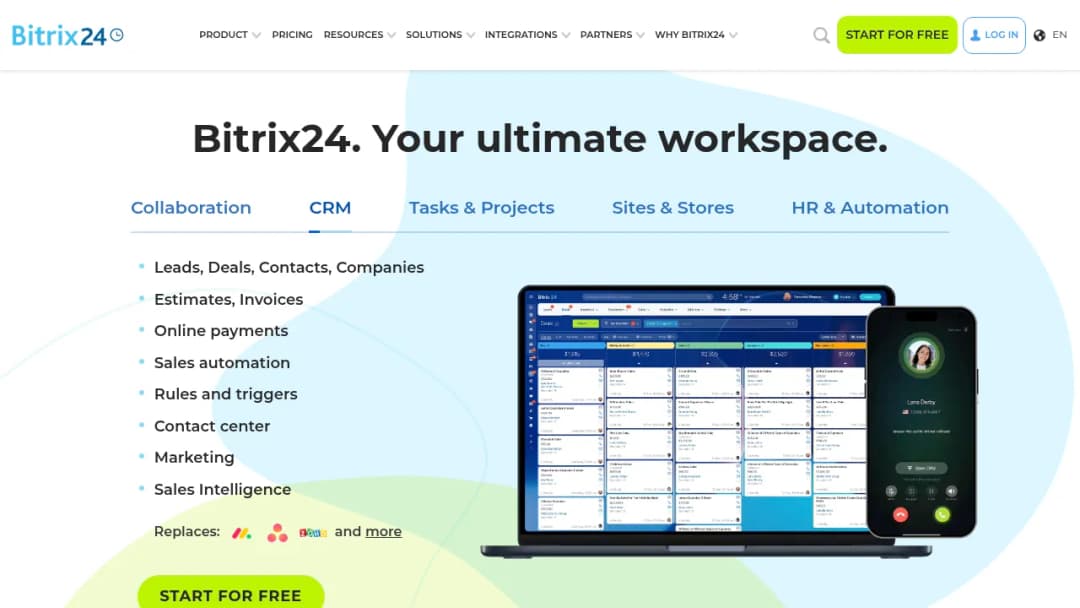
- Bitrix24 is an “all-in-one” work platform that combines CRM, task/project management, chat/video meetings, document collaboration/storage, automation, and additional business tools (e.g., contact center/omnichannel messaging and website tools) into a single suite.
- It is sold as both a cloud SaaS and a self-hosted/on‑premise option (uncommon among SMB-oriented “work OS” suites).
- Target market and market positioning
- Primary target: SMB to mid-market teams that want breadth (CRM + delivery/collaboration) with fewer separate tools.
- Secondary target: orgs with stricter control requirements that prefer (or require) self-hosted deployment.
- Positioning theme: consolidate tools to reduce “tool sprawl” and lower effective cost vs per-seat CRMs.
- Company background (founding year, HQ, key leadership)
- Bitrix24 is the product brand; corporate details (founding year, HQ, leadership) are not consistently presented in a single authoritative public “company facts” page for the global entity on the main site.
- Vendor “About” materials emphasize global infrastructure (data centers/servers) and product scope more than executive leadership bios.
- Funding and growth: investment rounds, acquisitions, estimated customer count/revenue if public
- Funding rounds and revenue are not clearly disclosed on the official Bitrix24 site pages reviewed.
- Bitrix24 publishes internal “insights”/survey PDFs and marketing presentations; these are vendor-produced and not independently validated.
- Pricing model with specific tiers and costs where available
- Cloud pricing is presented as “flat pricing” (organization-based) rather than purely per-user, with plan limits by users/storage/features. The official pricing page notes some features (e.g., Telephony and marketplace apps) are paid-plan only.
- Third-party summaries (which may vary by region and billing cadence) commonly show tiers like Free, Basic, Standard, Professional, Enterprise, with plan differences by included users and storage.
- On‑premise pricing is published separately on Bitrix24’s self-hosted purchase pages (e.g., Enterprise 1000) and uses a different licensing model than cloud.
- Total cost of ownership (TCO) considerations (implementation, training, hidden costs)
- Potential TCO reducers
- Bundled scope can reduce the number of separate subscriptions (CRM + PM + comms) for small teams.
- Flat-fee cloud plans can be cost-effective for larger teams vs per-seat CRMs (depending on feature fit).
- Potential TCO increasers
- Setup complexity: “all-in-one” breadth tends to increase configuration effort (pipelines, permissions, automations, storage, telephony, integrations).
- Add-on costs: telephony, some marketplace apps, and possibly advanced support/services can add cost beyond the base plan.
- Self-hosted cost: infrastructure, patching, backups, monitoring, security hardening, and internal admin time (or partner/consultant fees) can be significant.
- Key competitors in the space (4–6 direct alternatives)
- Zoho CRM (and broader Zoho One suite)
- HubSpot (CRM + marketing/sales/service hubs)
- monday.com (Work OS + monday Sales CRM)
- Salesforce (more enterprise CRM; often paired with other tools)
- Pipedrive (sales-focused CRM, typically paired with PM/collab tools)
- Freshworks (Freshsales + support/service products)