BRM
AI NativeBRM is your agentic Procurement and vendor management team and AI-native platorm.
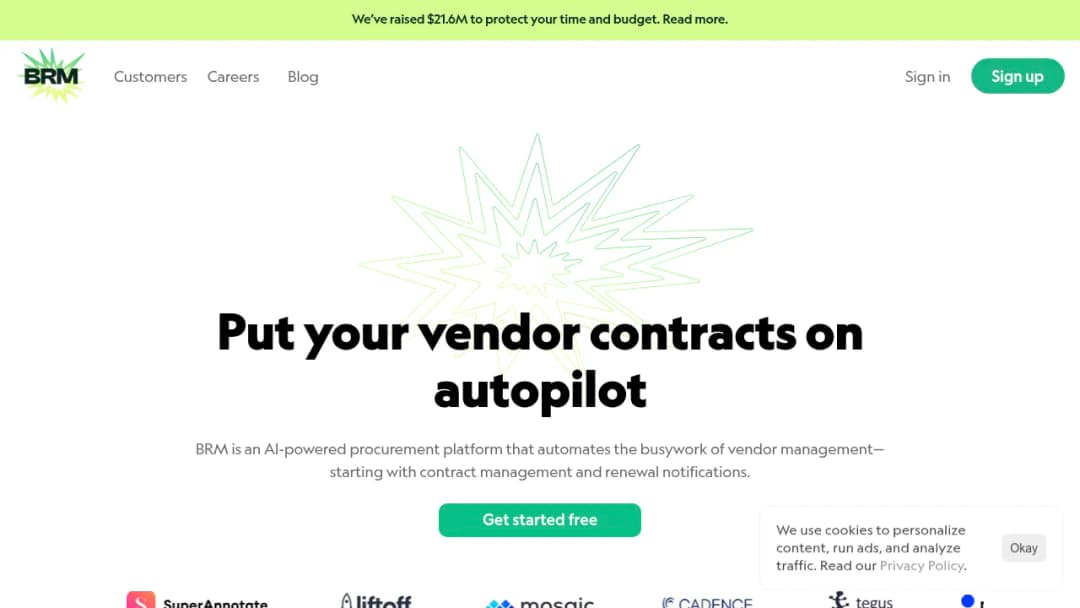
BRM is your agentic Procurement and vendor management team and AI-native platorm.
Published Oct 9, 2026
No clear public roadmap commitments or dated roadmap items were identified in the reviewed sources.
Not publicly documented. The vendor claims applicability up to 8,000+ employee organizations, but technical scale constraints (vendor count, ingestion volume, API rate limits, extraction throughput) are not detailed publicly.
Certifications and detailed security documentation were not publicly confirmed; buyers should assume additional diligence is required.
BRM appears to have limited public review volume at this stage; independent review presence is thin, which limits confidence in broad customer sentiment.
From the independent review platform:
Interpretation: the publicly surfaced independent review includes a functional gap related to analytics and reporting depth.
BRM provides multiple customer quotes emphasizing visibility into renewals and adoption and replacement of Jira-based procurement workflows.
Critical note: anonymous enterprise references can indicate enterprise reach but reduce verifiability.
Most relevant where SaaS and tool sprawl are cost and compliance concerns:
BRM targets lean finance teams and organizations without a dedicated procurement function. The vendor communicates applicability to companies across mid-market and enterprise segments.
BRM positions itself differently from traditional procurement and CLM tooling by emphasizing a vendor-centric data model (as opposed to a document-centric CLM repository) and automated agents that perform operational tasks rather than only storing data.
Get a comprehensive analysis of BRM including market position, competitive landscape, adoption trends, and peer benchmarks.
Download full report →Because public review volume is thin, churn reasons are not well documented. Risks suggested by independent analysis include:
From an independent review platform:
From BRM’s own published customer quotes (vendor-supplied):
Note: these are direct quotes from a public review and vendor-published excerpts; they reflect individual perspectives rather than independently validated outcomes.
BRM’s official information includes vendor-published case-style claims, for example:
Critical evaluation:
BRM is a procurement and vendor management platform that uses AI and machine learning to help organizations find, evaluate, purchase, and manage software and vendors by consolidating vendor-related data (contracts, spend, ownership, renewals, and compliance artifacts) into a unified system of record. The product includes automated agents (referred to by the vendor as "SuperAgents") that perform operational tasks such as contract discovery, renewal tracking, intake workflows, and, in some cases, assisting with negotiation-related tasks.
A practical interpretation of BRM’s positioning is: vendor management, intake, renewals, and compliance tracking, with an automation layer designed to reduce manual procurement and administrative work for lean Finance/Ops teams.