Workspace
    • Briefing
    • Ask Airframe
    Transformation
    • Audit
    Your Stack
    • Registry
    • Finance
    • Context
    Discover
    Powered by Airframe
    1. Research
    2. /
    3. Products
    4. /
    5. Calero
    Calero

    Calero

    Insights to Action. Faster.
    Est 1995|Raised $10.5M|54 Ref Customers
    LinkedIn 25K|Website|Web traffic 22K|FTEs 951|HQ Rochester, New York, US
    MarketsSource-to-PayEndpoint Management (UEM)
    Platform CoversProcurement AnalyticsIT Asset Management (ITAM)IT Financial Management (ITFM)SaaS ManagementSaaS Spend Optimization
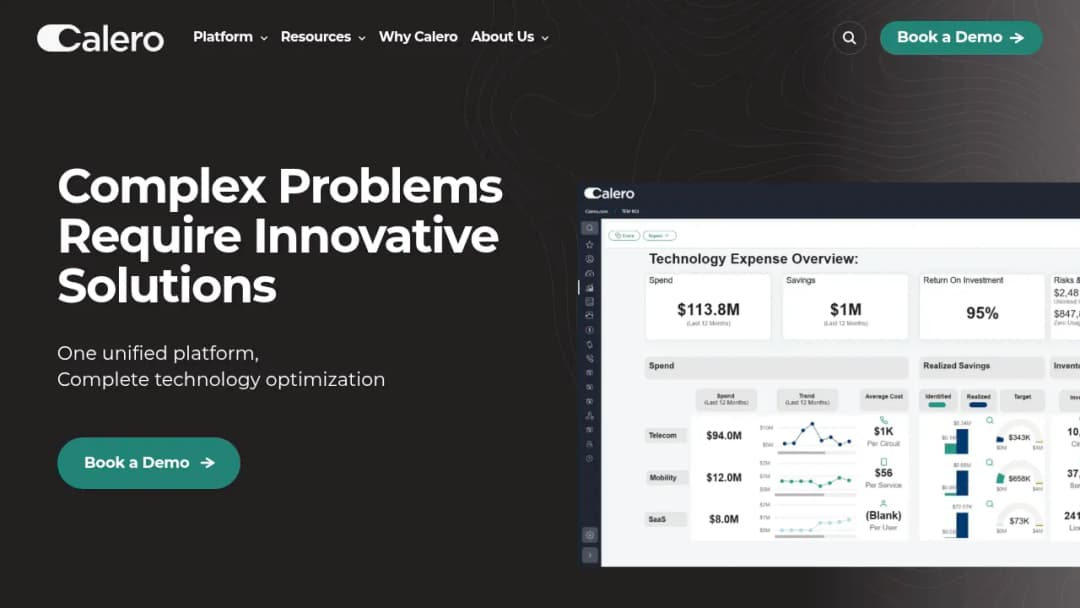
    Calero screenshot
    FirmCompareTractionAnalysisAdvocates

    Insights

    All insightsAccountingFinanceSoftwareCustomer experience

    Benchmarks

    The Software LeaderboardMethodology

    Tools & data

    Market ExplorerStudioRegistry

    Company

    AboutCareers

    Legal

    Privacy PolicyTerms of Service

    © 2026 Airframe, Inc. All rights reserved.

      Published Oct 15, 2026

      01Common complaints

      - If the primary requirement is deep SaaS access governance and automated identity-driven workflows - SaaS-first tools may provide more extensive automation for onboarding/offboarding and identity lifecycle use cases. - If transparent, self-serve pricing and rapid procurement are required - The vendor typically uses a sales-led, enterprise quote model that may not suit small teams seeking list pricing. - If the organization cannot sustain TEM data hygiene - Ongoing inventory and governance are necessary to preserve program value; organizations without capacity for this work may struggle to realize expected ROI. - If full service cannot be delivered in certain jurisdictions - Some geographies may present local constraints for mobility or portal-based operations; confirm regional service coverage during evaluation. - If the organization expects a plug-and-play implementation with minimal change management - Mobility and TEM deployments often require joint governance and implementation effort to achieve success. - Complexity and perceived redundancy - Some reviewers report that certain components feel redundant or do not fully interoperate, which can obscure holistic visibility. - Automation gaps - Reviewers cite inconsistent automation coverage across workflows; buyers should validate automation capabilities relevant to their use cases. - Learning curve and customization limits - The platform can require administrative learning and, in some cases, reviewers have described limitations in customization. - Geographic service constraints - Some countries may impose legislative or portal-access constraints that limit the vendor's ability to deliver end-to-end services in those markets. - Security and compliance transparency - While certifications are reported, details such as data residency options, SCIM provisioning support, and pen-test summaries are not publicly documented and should be requested.

      Deal disqualifiers: what makes a poor fit

      • Small companies with limited telecom complexity.
      • Teams seeking a lightweight, self-serve SaaS-only tool without services.
      • Organizations unwilling to invest in data cleanup, governance, and change management.

      02Why they buy

      - Unified multi-domain coverage - The platform addresses telecom, mobility, SaaS, and market data within a single vendor offering, paired with managed services. - Industry certifications reported by the vendor - The vendor reports ISO 27001, ISO 27701, and SOC 2 Type II certifications; buyers should request certification documents during procurement. - Integration narratives for market data and mobility - The vendor describes integrations (including eBonding with some providers) intended to automate entitlement and provisioning workflows. - Service model and operational capabilities - The vendor describes a structured service model and centralized operational teams to support invoice lifecycle, audits, provisioning, and implementation activities. Balanced view: - These differentiators are primarily vendor-described; customer reviews provide mixed validation, and buyers should verify through reference checks and pilot engagements.

      Why customers chose Calero over alternatives

      • TEM buyers commonly prioritize:
        • Carrier invoice normalization and bill-pay workflows.
        • Audit and dispute management.
        • Inventory and contract visibility.
        • Managed services staffing to outsource operational workload.

      03Field reports

      Review coverage and credibility notes

      • The product has review coverage across major review platforms, including user-submitted reviews and enterprise review sites.
      • Review volumes vary by product module: there is meaningful review volume for Telecom Expense Management and Managed Mobility Services, and fewer reviews available for SaaS Management.

      Positive feedback themes (what users report)

      - Visibility and reporting - Some reviewers report increased visibility into Microsoft 365 usage and described realizing material reductions in license spend (reviewer-reported outcomes; not independently validated). - Platform scope and insights - Reviewers have described the platform and service teams as able to provide useful operational insights. - Account and service management - Several reviews highlight effective account assignments and knowledgeable support personnel in certain engagements; these are mixed across accounts.

      Negative feedback themes (complaints and frustrations)

      - Complexity and learning curve - Reviewers frequently mention the platform can be complex and that administrators and end users may face a learning curve. - Slow ramp-up and implementation challenges - Some reviews note extended ramp-up times for mobility engagements and variability in implementation speed. - Knowledge transfer and internal coordination issues - Some reviewers describe instances of limited internal knowledge sharing or handover challenges within service teams. - Support gaps and responsiveness concerns - A subset of reviews cites issues with support responsiveness or limited automation in some processes; these reports appear in several review sources and should be considered in context.

      Why some customers leave / churn signals (inferred from complaints)

      • Implementation burden and sustained operational effort
        • Customers that lack internal capacity to maintain inventory hygiene and governance may find it difficult to sustain value from TEM programs.
      • Preference for simpler tools
        • Organizations seeking a lightweight SaaS discovery tool or a narrow TEM function may prefer simpler or more focused point solutions.

      Vendor / vendor-adjacent case studies identified

      • Vendor-hosted case study materials describe deployments in healthcare and other industries, focusing on inventory rebuild, invoice management, and lifecycle tracking.
      • Vendor blog narratives describe mobility implementations where consulting clients adopted an end-user mobility portal and automation to reduce manual processes; detailed outcome metrics were not independently validated.

      Quantified outcomes (and verification limits)

      • Some published profiles and vendor narratives include quantified outcomes (for example, reported savings over particular periods). These figures are vendor-reported or reviewer-reported and typically lack independent audit; treat as illustrative until verified with primary customer references.

      Typical adoption challenges (from reviews)

      • Noted adoption challenges include slow ramp-up in mobility engagements, country-specific operational constraints, and variability in carrier or supplier portal access in some jurisdictions.

      04Best fit

      Company sizes

      • Best fit tends to be enterprise-sized organizations with multi-location or multi-country telecom and mobility footprints and substantial annual telecom and mobility spend.

      Industries and verticals where adoption is strongest (with customer examples)

      • Government / public sector (referenced in review metadata).
      • Healthcare, real estate, insurance, retail, manufacturing, energy/utilities (review metadata and case studies reference these sectors).
      • Financial services and other market-data-intensive organizations use the market data management features.

      Roles and personas: decision makers AND end users

      • Decision makers: CIO/IT leadership, procurement/vendor management, finance/AP leadership, security/compliance leaders.
      • End users: telecom managers, mobility specialists, IT asset managers, finance analysts responsible for invoice reconciliation.

      Pain points and challenges the product addresses

      • Fragmented visibility across carriers, devices, applications, and contracts.
      • Invoice errors and dispute workload.
      • Inefficient provisioning and device lifecycle processes.
      • Shadow IT and underutilized SaaS licenses.
      • Audit readiness and chargeback/showback requirements.

      Qualification criteria: what makes a well-suited fit

      • The organization requires both a platform for inventory/invoice/contract lifecycle management and operational capability (managed services) to operate the program effectively.
      • The organization prefers a single vendor that can cover telecom, mobility, SaaS, and market data management.

      Real customer examples with company names when available

      • Vendor-published materials name customers such as Alight Solutions in relation to a managed telecom engagement; outcomes and terms are vendor-reported.

      05The pitch

      What the product does (core value proposition in objective terms)

      - Calero provides a Technology Expense Management (TEM) platform plus managed services designed to centralize and optimize spend, inventory, and workflows across: - Telecom (wireline + mobile), including invoice ingestion, audit and dispute processes, and inventory/contract tracking. - Mobility lifecycle management (procurement → provisioning → support → retirement). - SaaS management (discovery, license usage, shadow IT visibility, renewals). - Market data management (for financial services market data subscriptions/entitlements). - The vendor describes the platform as combining normalized data, operational workflows, and automation to support actions beyond reporting dashboards.

      Target market and market positioning

      - Primarily mid-market to large enterprises with complex, multi-carrier/multi-country telecom and mobility estates, and with growing SaaS and market-data spend. - Also targets regulated or operationally complex organizations (government, healthcare, financial services) where auditability, controls, and vendor management are important. - Positioned between traditional TEM/MMS outsourcers (focused on carrier invoices and operations) and SaaS Management Platforms (SMPs) that focus on applications and license management but may not cover telecom and mobility.

      Get a comprehensive analysis of Calero including market position, competitive landscape, adoption trends, and peer benchmarks.

      Download full report →
      • If the primary requirement is deep SaaS access governance and automated identity-driven workflows

        • SaaS-first tools may provide more extensive automation for onboarding/offboarding and identity lifecycle use cases.
      • If transparent, self-serve pricing and rapid procurement are required

        • The vendor typically uses a sales-led, enterprise quote model that may not suit small teams seeking list pricing.
      • If the organization cannot sustain TEM data hygiene

        • Ongoing inventory and governance are necessary to preserve program value; organizations without capacity for this work may struggle to realize expected ROI.
      • If full service cannot be delivered in certain jurisdictions

        • Some geographies may present local constraints for mobility or portal-based operations; confirm regional service coverage during evaluation.
      • If the organization expects a plug-and-play implementation with minimal change management

        • Mobility and TEM deployments often require joint governance and implementation effort to achieve success.
      • Complexity and perceived redundancy

        • Some reviewers report that certain components feel redundant or do not fully interoperate, which can obscure holistic visibility.
      • Automation gaps

        • Reviewers cite inconsistent automation coverage across workflows; buyers should validate automation capabilities relevant to their use cases.
      • Learning curve and customization limits

        • The platform can require administrative learning and, in some cases, reviewers have described limitations in customization.
      • Geographic service constraints

        • Some countries may impose legislative or portal-access constraints that limit the vendor's ability to deliver end-to-end services in those markets.
      • Security and compliance transparency

        • While certifications are reported, details such as data residency options, SCIM provisioning support, and pen-test summaries are not publicly documented and should be requested.
      • Unified multi-domain coverage

        • The platform addresses telecom, mobility, SaaS, and market data within a single vendor offering, paired with managed services.
      • Industry certifications reported by the vendor

        • The vendor reports ISO 27001, ISO 27701, and SOC 2 Type II certifications; buyers should request certification documents during procurement.
      • Integration narratives for market data and mobility

        • The vendor describes integrations (including eBonding with some providers) intended to automate entitlement and provisioning workflows.
      • Service model and operational capabilities

        • The vendor describes a structured service model and centralized operational teams to support invoice lifecycle, audits, provisioning, and implementation activities.

      Balanced view:

      • These differentiators are primarily vendor-described; customer reviews provide mixed validation, and buyers should verify through reference checks and pilot engagements.
      • Visibility and reporting
        • Some reviewers report increased visibility into Microsoft 365 usage and described realizing material reductions in license spend (reviewer-reported outcomes; not independently validated).
      • Platform scope and insights
        • Reviewers have described the platform and service teams as able to provide useful operational insights.
      • Account and service management
        • Several reviews highlight effective account assignments and knowledgeable support personnel in certain engagements; these are mixed across accounts.
      • Complexity and learning curve
        • Reviewers frequently mention the platform can be complex and that administrators and end users may face a learning curve.
      • Slow ramp-up and implementation challenges
        • Some reviews note extended ramp-up times for mobility engagements and variability in implementation speed.
      • Knowledge transfer and internal coordination issues
        • Some reviewers describe instances of limited internal knowledge sharing or handover challenges within service teams.
      • Support gaps and responsiveness concerns
        • A subset of reviews cites issues with support responsiveness or limited automation in some processes; these reports appear in several review sources and should be considered in context.
      • Calero provides a Technology Expense Management (TEM) platform plus managed services designed to centralize and optimize spend, inventory, and workflows across:
        • Telecom (wireline + mobile), including invoice ingestion, audit and dispute processes, and inventory/contract tracking.
        • Mobility lifecycle management (procurement → provisioning → support → retirement).
        • SaaS management (discovery, license usage, shadow IT visibility, renewals).
        • Market data management (for financial services market data subscriptions/entitlements).
      • The vendor describes the platform as combining normalized data, operational workflows, and automation to support actions beyond reporting dashboards.
      • Primarily mid-market to large enterprises with complex, multi-carrier/multi-country telecom and mobility estates, and with growing SaaS and market-data spend.
      • Also targets regulated or operationally complex organizations (government, healthcare, financial services) where auditability, controls, and vendor management are important.
      • Positioned between traditional TEM/MMS outsourcers (focused on carrier invoices and operations) and SaaS Management Platforms (SMPs) that focus on applications and license management but may not cover telecom and mobility.