- What the product does (core value proposition in objective terms)
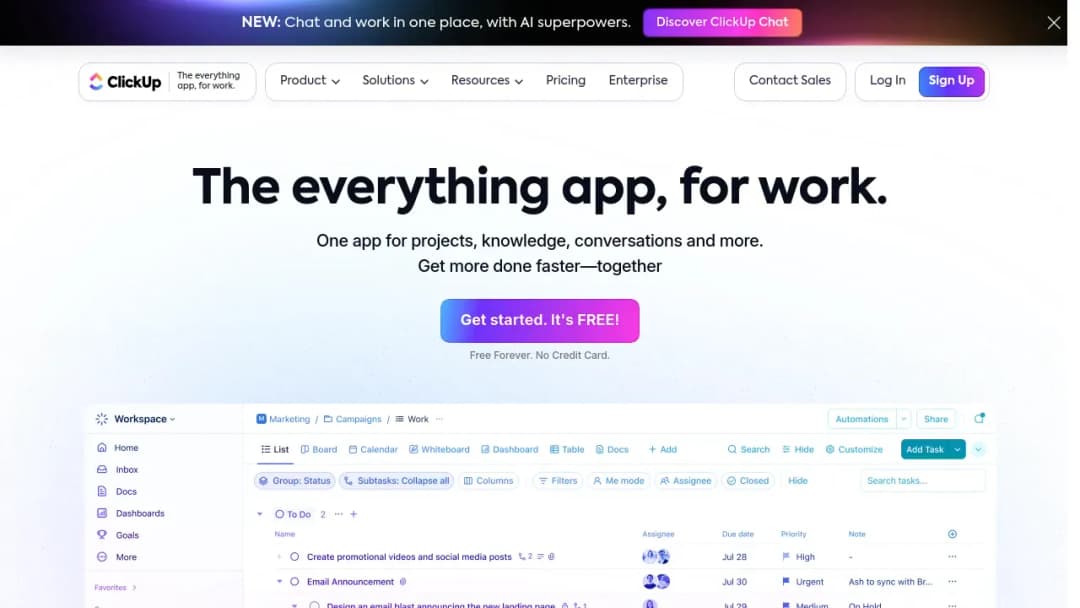
- ClickUp is a work management platform that combines project/task management with docs/knowledge, goals, dashboards/reporting, automations, time tracking, and increasingly “in-app communication” (Chat) plus AI features (ClickUp Brain / AI offerings). ([clickup.com](https://clickup.com/features?utm_source=openai))
- The product’s core promise is consolidation: reducing “tool sprawl” by placing multiple workflows into one workspace, with a high degree of customization (custom fields, multiple views, templates, integrations). ([clickup.com](https://clickup.com/features?utm_source=openai))
- Target market and market positioning
- Targets SMB through mid-market teams (marketing, ops, product/dev, agencies) that want configurable workflows, plus enterprise buyers looking for consolidation, governance, and security controls.
- Market position is “all-in-one” work hub vs. “best-of-breed” point solutions like Asana (project management) or Notion (docs/knowledge). ([clickup.com](https://clickup.com/g2?utm_source=openai))
- Company background (founding year, HQ, key leadership)
- ClickUp is commonly described as a San Diego-based company in major funding coverage. ([forbes.com](https://www.forbes.com/sites/kenrickcai/2021/10/27/clickup-raises-4-billion-series-c-productivity-software/?utm_source=openai))
- The Wikipedia entry notes the company trade name as ClickUp (Mango Technologies Inc.) and references product expansions like Chat. (Treat Wikipedia as secondary and verify key claims with primary sources where possible.) ([en.wikipedia.org](https://en.wikipedia.org/wiki/ClickUp?utm_source=openai))
- Funding and growth: investment rounds, acquisitions, estimated customer count/revenue if public
- Funding (publicly reported)
- Series B (Dec 2020) reported by TechCrunch: $100M and ~$1B valuation. ([techcrunch.com](https://techcrunch.com/2020/12/15/clickup-hits-1-billion-valuation-in-100m-series-b-raise/?utm_source=openai))
- Series C (Oct 27, 2021) reported by TechCrunch: $400M at $4B post-money valuation. ([techcrunch.com](https://techcrunch.com/2021/10/27/clickup-raises-400m-at-a-4b-valuation-to-expand-its-all-in-one-workplace-productivity-platform-to-europe/?utm_source=openai))
- Forbes also reported the Series C and named investors (e.g., Andreessen Horowitz, Tiger Global, Lightspeed, Meritech). ([forbes.com](https://www.forbes.com/sites/kenrickcai/2021/10/27/clickup-raises-4-billion-series-c-productivity-software/?utm_source=openai))
- Customer count claims
- ClickUp’s marketing pages state “more than 3 million teams” trust ClickUp (vendor claim; not independently verified in the public materials gathered). ([clickup.com](https://clickup.com/es-ES?utm_source=openai))
- Pricing model with specific tiers and costs where available
- Official pricing is published on ClickUp’s pricing page, but the exact dollar amounts can vary by monthly vs annual billing and can change over time; buyers should confirm directly in-product and on the pricing page at purchase time. ([clickup.com](https://clickup.com/pricing?utm_source=openai))
- Independent summaries (Forbes Advisor)
- Forbes Advisor describes ClickUp paid tiers with starting prices around $10/user/month (Unlimited) and $19/user/month (Business) when billed monthly, with Enterprise as “contact sales.” (This aligns with multiple secondary sources, but always verify against clickup.com/pricing.) ([forbes.com](https://www.forbes.com/advisor/business/software/clickup-review/?utm_source=openai))
- AI add-ons / AI pricing
- ClickUp’s pricing page explicitly includes an “AI pricing” area, indicating AI is monetized separately or via tiers/add-ons depending on plan. ([clickup.com](https://clickup.com/pricing?utm_source=openai))
- Some third-party posts claim per-user AI add-on pricing; these are not authoritative and have been controversial in community posts, so buyers should rely on ClickUp’s official AI pricing pages/contract terms. ([reddit.com](https://www.reddit.com/r/clickup/comments/1ka01uc?utm_source=openai))
- Total cost of ownership considerations (implementation, training, hidden costs)
- Implementation/training
- Reviews frequently emphasize a learning curve and complexity due to breadth of features and customization. ([g2.com](https://www.g2.com/products/clickup/reviews?utm_source=openai))
- Hidden/secondary costs reported by users
- Seat/role rules (members vs guests/limited members) and plan limits (automation/action limits, wiki limits, etc.) are recurring pain points in Reddit threads alleging “unpredictable” or “sneaky” pricing changes. ([reddit.com](https://www.reddit.com/r/clickup/comments/1hxmnui?utm_source=openai))
- Potential “tool consolidation” savings
- Some users report replacing multiple tools (e.g., Slack + other SaaS) after adopting ClickUp, which can offset subscription costs—but this depends on reliability and feature parity (especially for chat). ([reddit.com](https://www.reddit.com/r/clickup/comments/1nkcrub?utm_source=openai))
- Key competitors in the space (list 4-6 direct alternatives)
- Asana ([asana.com](https://asana.com/pricing?utm_source=openai))
- monday.com ([monday.com](https://www.monday.com/pricing?utm_source=openai))
- Notion ([notion.com](https://www.notion.com/pricing?utm_source=openai))
- Smartsheet ([smartsheet.com](https://www.smartsheet.com/pricing?utm_source=openai))
- (Frequently considered by teams in adjacent workflows) Basecamp (often discussed in PM comparisons) ([news.ycombinator.com](https://news.ycombinator.com/item?id=43778151&utm_source=openai))
- Other alternatives mentioned by communities include Fibery, Linear, Todoist/TickTick + knowledge base tools, and self-hosted/open-source options (context-dependent). ([reddit.com](https://www.reddit.com/r/clickup/comments/1q06ivr/clickup_critique/?utm_source=openai))