CrewAI
AI NativeBuild a crew of AI agents today, scale everything tomorrow.
Build a crew of AI agents today, scale everything tomorrow.
Published Oct 15, 2026
G2 shows a very highly rated sentiment for the product but with limited review volume. One reviewer described the role/goal/backstory pattern as improving agent performance and noted broad LLM provider support.
Representative sentiment (paraphrased):
Caveat: The review volume is limited and some reviews were marked as incentivized.
Search results returned listings for a different product with a similar name (team communication software), not CrewAI.
Conclusion: Capterra results identified in the review are not a reliable source for CrewAI reviews in the materials collected.
Common reasons surfaced in public feedback and product messaging include:
No independent, detailed third-party case studies were identified in the collected sources.
Get a comprehensive analysis of CrewAI including market position, competitive landscape, adoption trends, and peer benchmarks.
Download full report →Trustpilot shows a poorly rated sentiment with limited review volume. Reported complaints included privacy/telemetry concerns and product instability.
Representative negative points (paraphrased):
Caveat: Sample size is very small and technical context is not known; nevertheless, these complaints indicate telemetry transparency as a reputational risk to investigate.
Reddit threads describe mixed and practical discussions:
Representative community sentiment (paraphrased):
The vendor website cites enterprise outcomes such as reductions in time-to-contact with leads. These metrics are vendor-published and do not include detailed methodology, baseline definitions, sample sizes, or independent validation in the materials reviewed.
Critical evaluation: procurement teams should request the following when evaluating vendor case studies:
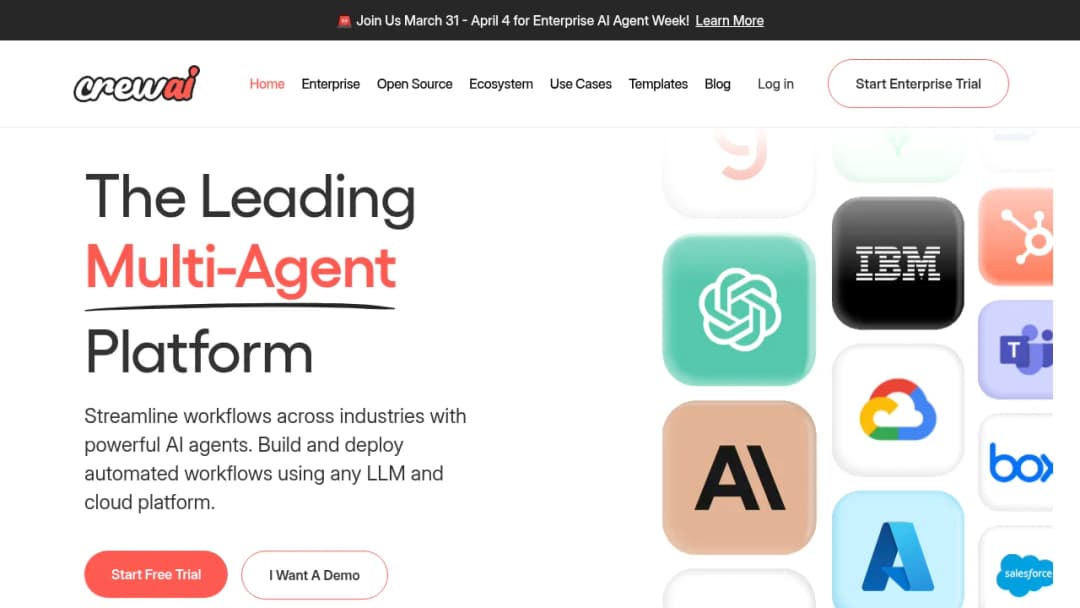
CrewAI is a multi-agent orchestration product comprising two main elements:
CrewAI follows a two-layer go-to-market approach:
Positioning is in the space of multi-agent frameworks and agentic workflow automation, with competition from agent frameworks (e.g., LangGraph, AutoGen) and enterprise automation tooling (traditional RPA vendors adding agentic features).