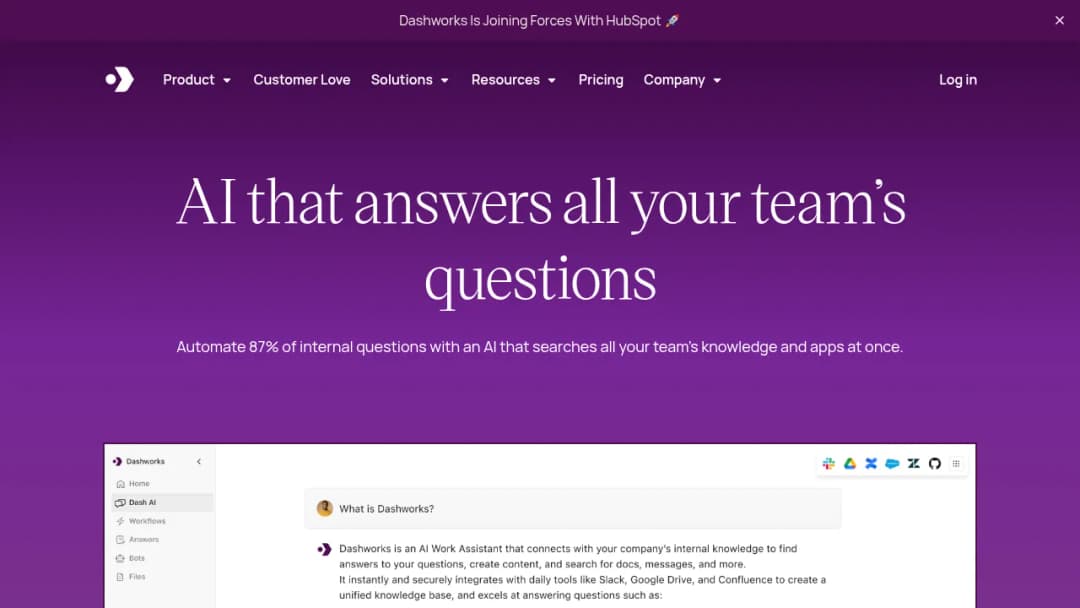
- What the product does (core value proposition in objective terms)
- Dashworks is an AI workplace search and knowledge assistant that answers employee questions by querying connected enterprise systems (for example: Slack, Google Drive, Notion, Jira, Salesforce) and returning synthesized answers with supporting source references.
- The vendor positions the product on real-time retrieval (API-based access at query time) rather than copying or indexing all data into a separate search store, with the stated intent of improving data freshness and reducing data duplication risk. Buyers should validate actual data flows, caching, and retention behavior in contracts.
- Feature surface includes:
- Web app
- Slackbot (DM and channels)
- Browser extension
- Configurable assistants and workflow templates
- "Deep Research" capability for multi-step research-like tasks (vendor-described)
- Target market and market positioning
- Primary buyers and users appear to include:
- Support teams (deflection, faster initial responses)
- Sales / GTM enablement teams (retrieving account context and answering customer questions)
- Product and engineering teams (finding historical context across tickets, documents, and threads)
- HR / onboarding (policy and people/org knowledge)
- The product competes in the enterprise search, AI knowledge assistant, and internal Q&A/chatbot categories, positioned between traditional indexing-based enterprise search and newer AI-native workplace assistants.
- Company background (founding year, HQ, key leadership)
- Dashworks was founded around 2020 (company communication cited "five years ago" in April 2025).
- Headquarters: San Francisco.
- Co-founder / CEO: Prasad Kawthekar (named in press/interviews).
- Co-founder: Praty Sharma (named in TechCrunch coverage).
- Funding and growth: investment rounds, acquisitions, estimated customer count/revenue if public
- Funding (publicly reported)
- Press coverage reported early seed funding in 2022 and additional seed expansion reporting in 2023; the company has also participated in a well-known startup accelerator. Public reporting on specific round sizes and investor names is varied and has been generalized here.
- Acquisition
- HubSpot announced an acquisition of Dashworks in April 2025; public filings referenced an agreement in late April 2025 and a closing in early May 2025.
- Adoption / customer count
- Dashworks’ public pages state usage by many industry leaders (vendor-stated), but this figure is not independently verified and does not include a documented methodology.
- Pricing model with specific tiers and costs where available
- Vendor pricing (vendor pricing page)
- Team
- Published per-seat pricing available from the vendor (vendor page indicates a lower per-seat price for annual billing)
- No seat minimums
- Includes unlimited usage per vendor marketing, core integrations, file uploads, Slackbot, workflows, browser extension, shared topics. Organizations should confirm contractual and fair-use terms.
- Business
- Published per-seat pricing available from the vendor (vendor page indicates a lower per-seat price for annual billing)
- Minimum seat requirement applies
- Adds custom assistants, choice of LLMs, org-wide integrations, AI customization, multiple accounts for integrations, priority support.
- Enterprise
- Contact vendor for pricing
- Adds SSO/SCIM, API access add-on, custom data retention, analytics and insights, HRIS integrations, prioritized integration requests, uptime SLA.
- Time-limited free trial (vendor-stated), no credit card required.
- Third-party pricing references can differ or be out of date; public listings on review platforms do not always reflect current vendor pricing.
- Total cost of ownership considerations (implementation, training, hidden costs)
- Likely TCO drivers (inferred from the product model and category patterns):
- Integration setup effort: OAuth approvals, admin consent, scoping of which workspaces/drives/projects to connect, and verification of permission correctness.
- Assistant configuration and prompting: teams will likely need to iterate on instructions, assistant templates, and content hygiene to minimize incorrect or irrelevant answers.
- Identity and access integration overhead (SSO/SCIM): mapping groups and validating deprovisioning behavior requires operational effort.
- Change management: achieving employee adoption typically requires training, internal communications, and iterative refinements.
- Model and LLM costs: vendor messaging includes "unlimited usage" in some tiers, but organizations should confirm whether usage thresholds, fair-use policies, or premium-model surcharges apply in contract terms.
- Key competitors in the space (list 4-6 direct alternatives)
- Glean
- Guru
- Microsoft Copilot (Microsoft 365)
- Atlassian Intelligence / Confluence + Jira search
- Notion AI + Notion enterprise search
- Slack AI / Slack search (depending on plan)
- Adjacent: Dropbox Dash (universal search)