Default
The connected foundation for your go-to-market engine.
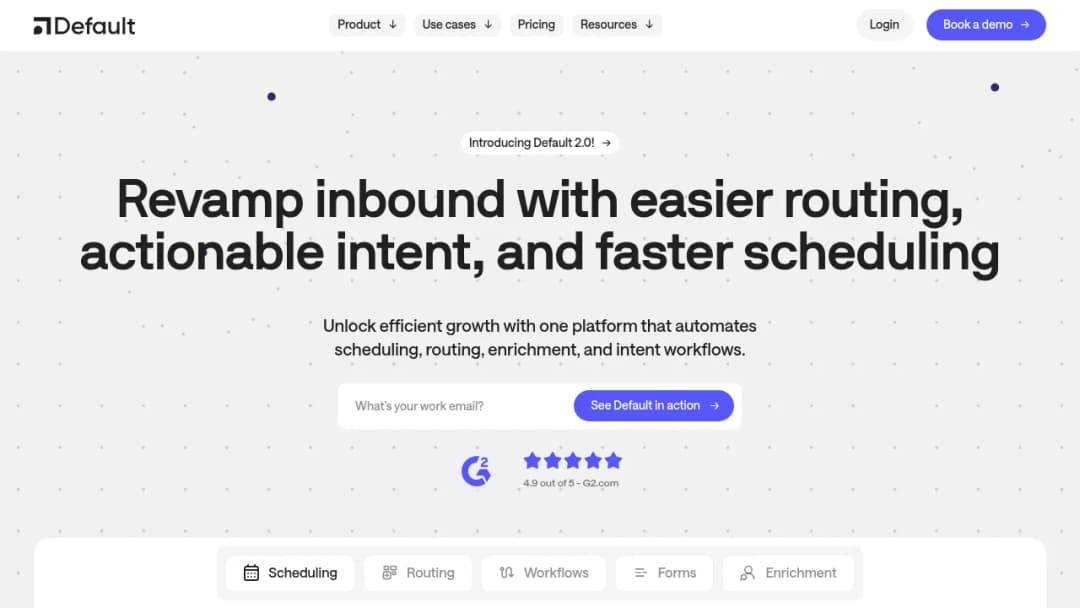
The connected foundation for your go-to-market engine.
Published Oct 15, 2026
Patterns in reviews and vendor materials suggest buyers select Default to:
Searches did not surface substantive public community threads specifically about Default. This could indicate limited public community discussion relative to larger incumbents, or that discussion occurs in private RevOps communities.
Negative reviews cite reasons that could drive churn:
Based on pricing and the need for operations maturity, Default is likely best suited for SMB and mid-market growth-stage B2B companies with dedicated RevOps or Marketing Ops functions. It can fit enterprise customers if the enterprise plan and security controls meet procurement requirements, though buyers should plan for additional diligence.
Most relevant to B2B SaaS and tech-enabled companies with inbound lead capture and demo booking. Vendor materials and case studies are oriented toward B2B go-to-market motions.
Positioning is toward RevOps, Marketing Ops, and Sales Ops teams (and growth/PLG teams) who manage high-velocity inbound and want a single place to orchestrate routing, scheduling, enrichment, and follow-up logic. Default also positions itself as a consolidation tool intended to replace multiple point solutions (for example, routing and scheduling tools paired with CRM and marketing automation).
Get a comprehensive analysis of Default including market position, competitive landscape, adoption trends, and peer benchmarks.
Download full report →Consider alternatives when:
Sources:
No public product roadmap was found in the materials reviewed. References to feature updates and roadmaps in third-party comparisons reflect reviewer impressions rather than a vendor-published roadmap.
Sources:
Caveats: reviewer feedback also notes usability and feature completeness concerns that may affect adoption.
Sources:
Default’s site includes multiple vendor-published case studies that present directional, quantified outcomes. These case studies offer positive signals but generally lack independent methodology disclosure.
Example outcomes (vendor case study pages / on-site quotes):
Critical notes:
Default has an active profile on G2 and is described as very highly rated on that platform.
Positive review examples (G2 quotes):
Negative review examples (G2 quotes):
Common G2 “Pros & Cons” themes: pros frequently reference ease of use, scheduling, automation, lead generation, and integrations; cons include a learning curve, perceived poor UX, feature limitations, and integration issues.
Default is a B2B revenue operations / inbound orchestration platform that automates the top-of-funnel path from website visitor → form submission → qualification/enrichment → routing/assignment → scheduling → follow-up. The core product is a workflow engine (visual canvas) that integrates CRM, marketing operations, scheduling, and enrichment data providers to address lead loss and ad-hoc operational integrations.
Default’s documentation describes three main components: