Didero
AI NativeGreat recommendations that you tailor.
Great recommendations that you tailor.
Published Oct 7, 2026
No detailed public roadmap with dates was found in the sources reviewed; buyers should request roadmap commitments and timelines during evaluation.
Mainstream review platforms do not show broad, independently verifiable review volume for Didero procurement in the sources captured for this research. There is evidence of a name collision on one review site and no clear listing on others.
This implies buyer evidence is likely to come from vendor case examples, press coverage, and direct customer references provided during sales cycles rather than large public review corpora.
A forum thread included a commenter identifying with the vendor; the thread did not provide detailed third-party buyer feedback. Social signals are limited and do not substitute for structured references.
The vendor announced an acquisition intended to expand PO lifecycle automation capabilities. Coverage indicates deployments commonly start with human approvals. Quantitative gains quoted by the vendor should be validated with customer references and pilots. Deal terms were not disclosed publicly.
Based on vendor positioning, the ideal customers are mid-market through upper mid-market organizations with procurement teams facing capacity constraints. Procurement organizations are typically small-to-mid teams dealing with operational volume and exception handling.
Vendor materials emphasize manufacturing and distribution contexts, including:
Get a comprehensive analysis of Didero including market position, competitive landscape, adoption trends, and peer benchmarks.
Download full report →The vendor provides an example from a privately described industrial manufacturer that claims significant reductions in PO-related administrative effort, fewer delayed orders, and further reductions in invoice-related workloads after expanding to invoice ingestion and 3-way matching.
These figures are vendor-published and lack methodological detail (no named customer in public materials, no timeframes, no baseline definitions). They should be validated via references and audit where possible.
Based on typical buyer concerns for agent-based procurement tools and verification gaps in third-party evidence:
Claimed outcomes:
Critical evaluation:
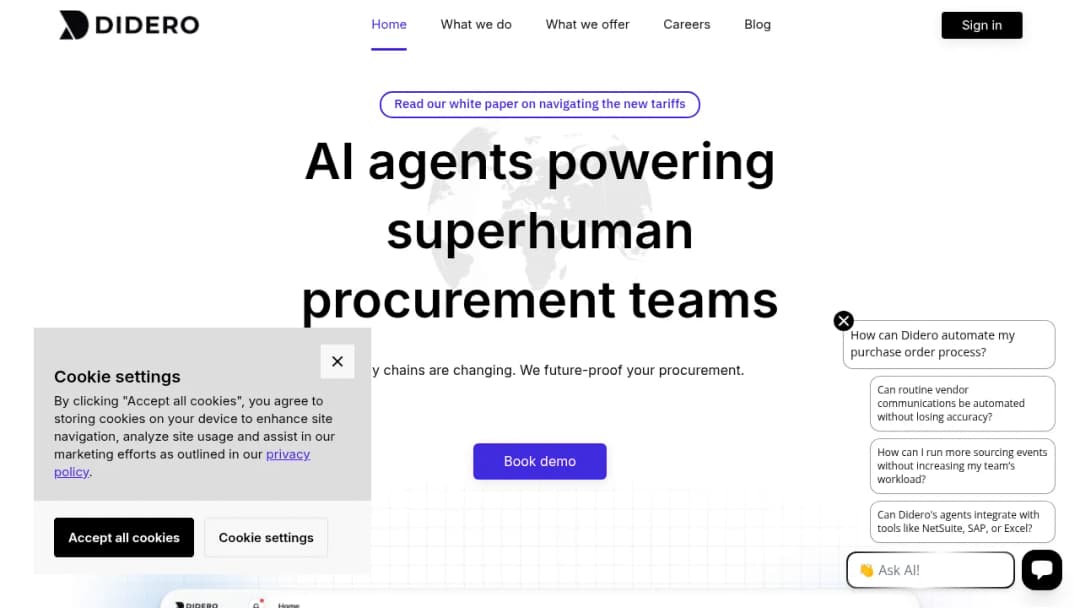
Didero positions its product as an AI-based procurement agent designed to automate routine procurement and supply-chain workflows that commonly rely on email threads, PDFs, spreadsheets, portals, and ERP updates. The product supports automation across:
The vendor frames the product as deployable more quickly than large-suite implementations and positions it as an automation layer that integrates with existing systems rather than replacing them.
Vendor materials and press coverage emphasize deployment speed and workflow/time-savings benchmarks. Press coverage described the product as an AI-based tool aimed at mid-market companies that seek alternatives to large ERP projects.
Didero’s messaging primarily targets:
Market positioning themes: