eSpatial
Unlock revenue with power mapping. Boost revenue up to 12%. Slash territory alignment administration by 90%.
Unlock revenue with power mapping. Boost revenue up to 12%. Slash territory alignment administration by 90%.
Published Oct 15, 2026
Buyers should request references that match their own use case in terms of data volume, geographic footprint, and collaboration model.
Get a comprehensive analysis of eSpatial including market position, competitive landscape, adoption trends, and peer benchmarks.
Download full report →The vendor publishes customer stories and success claims on marketing pages. However, detailed methodological disclosures (baseline, sample size, measurement period) are generally not provided alongside headline metrics.
Critical evaluation: Treat vendor ROI claims as directional until the buyer obtains:
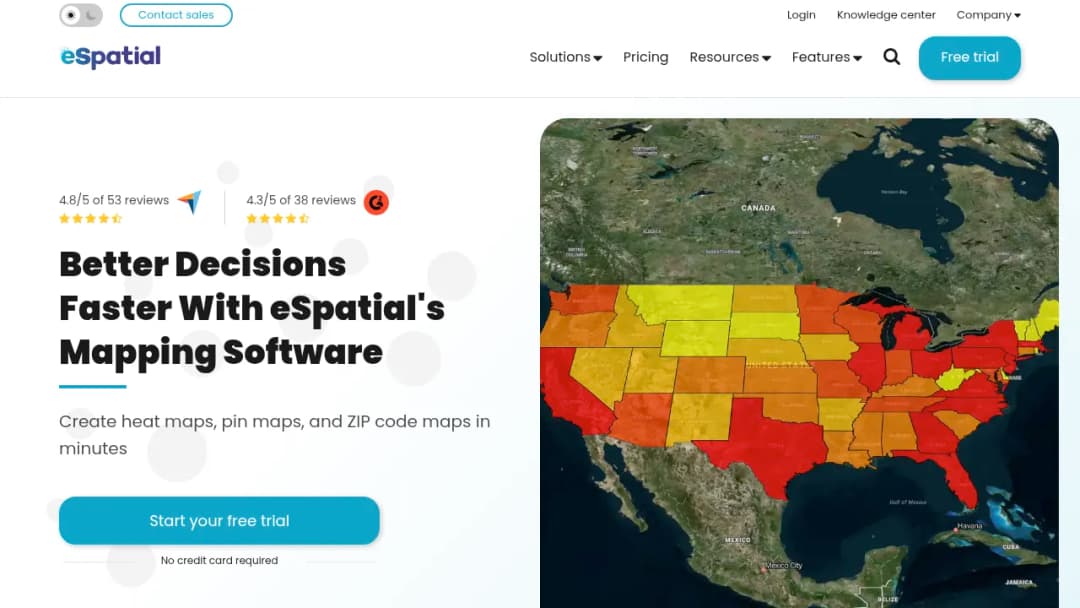
eSpatial is a cloud-based location intelligence platform focused on business mapping, territory design/management, and route planning/optimization. Its core workflow is: upload customer/asset data (often from spreadsheets/CRMs), visualize it on interactive maps (pins, heatmaps, thematic styling), create and rebalance territories, and plan/optimize routes and drive-time analysis for field operations. The vendor positions the product as providing GIS capabilities with a simplified user experience targeted at non-GIS specialists.
Vendor performance and productivity claims (for example, large speed or onboarding improvements) are presented on marketing pages without supporting methodology or independent validation. These vendor-provided performance claims should be treated as assertions unless corroborated by detailed customer case studies with measurement methodology and baseline data.
Primary product pages reviewed: homepage, pricing, features, security statement, privacy policy, customers page.
Based on product messaging and review profiles, eSpatial targets:
Positioning emphasizes usability for non-GIS users, territory planning, and routing, with an emphasis on responsive, human support and rapid initial setup (upload spreadsheet → map creation).