Workspace
    • Briefing
    • Ask Airframe
    Transformation
    • Audit
    Your Stack
    • Registry
    • Finance
    • Context
    Discover
    Powered by Airframe
    1. Research
    2. /
    3. Products
    4. /
    5. Five9
    Five9

    Five9

    Leader

    The New CX Starts Here. Transformed by AI, Powered by Five9.

    Est 2001|Valuation $2.6B|Raised $204.3M|262 Ref Customers
    LinkedIn 126K|Web traffic 5.0M|FTEs 2,910|HQ San Ramon, California, US
    MarketsContact Center as a Service (CCaaS)CS AI Agent
    Platform CoversVoice AI AgentsCS AI AgentCS Quality Management & CoachingWorkforce Management (WFM)Interactive Voice Response (IVR)Conversation Intelligence
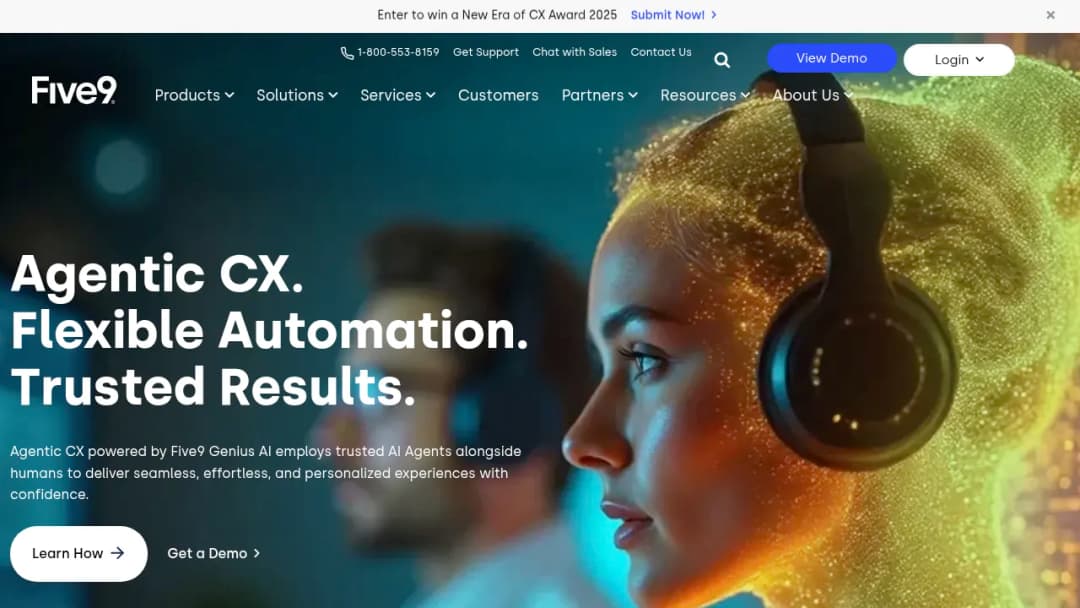
    Five9 screenshot
    FirmCompareTractionAnalysisAdvocates

    Insights

    All insightsAccountingFinanceSoftwareCustomer experience

    Benchmarks

    The Software LeaderboardMethodology

    Tools & data

    Market ExplorerStudioRegistry

    Company

    AboutCareers

    Legal

    Privacy PolicyTerms of Service

    © 2026 Airframe, Inc. All rights reserved.

      Published Oct 22, 2026

      01Common complaints

      - If highly responsive, high-touch vendor support is a primary procurement requirement - Community-sourced threads frequently highlight concerns about support responsiveness and account management. - If your team is small and cost-sensitive - The vendor’s pricing model often requires direct engagement; smaller teams may prefer explicitly priced SMB-focused alternatives. - If you cannot allocate time or personnel for implementation and ongoing administration - Community commentary suggests deployment outcomes can be strongly influenced by implementation quality and internal resource allocation. - If your environment has unstable networks or unmanaged endpoints - Agent-side complaints about audio quality and "no audio" have been reported in community sources; network and endpoint stability are important for any CCaaS deployment. - Known limitations evidenced by user feedback (not vendor-confirmed) - Recurring themes in community feedback include concerns about support responsiveness and administrative complexity. - Agent reports of audio quality issues have been posted in community forums; root causes are not confirmed without incident analyses. - Roadmap / future features - Roadmap specifics were not assessed in depth in this report. Buyers should request vendor briefings on: - AI governance, model update cadence, and evaluation tooling - Data residency and retention controls for AI transcripts and training data - Additional channel and CRM integrations as relevant to the buyer - Scale limitations - No specific scale limits were identified in the reviewed materials; buyers should require performance SLAs and concurrency/throughput validation for their expected volumes. - Security or compliance gaps - ISO 27017/27018 certifications were not evidenced in the reviewed materials; confirm if these are required. - Public documentation of penetration-test summaries and detailed enterprise security feature lists (SSO/SCIM/audit logs specifics) were not located; these represent diligence gaps until vendor-provided documentation is reviewed.

      Deal disqualifiers (poor fit)

      • Very small teams seeking transparent, self-serve pricing and minimal setup
      • Organizations with low tolerance for potential vendor support friction based on community-reported patterns

      02Why they buy

      - Vendor-expressed differentiation (vendor claims) - The vendor promotes a branded AI suite intended for conversational AI and agent assistance. - The vendor asserts high availability and exposes APIs for integration. - Differentiation supported by market signals - A substantial presence across review platforms and case-study materials suggests broad adoption and a mature product footprint. - Where competitors may have advantage - Some competitors emphasize deeper workforce engagement and analytics capabilities or lower-cost entry tiers for smaller customers.

      03Field reports

      Review-platform signals (volume and star ratings)

      - Major review platforms show substantial review volume for the vendor’s products and generally positive average ratings in publicly visible snapshots. Access and the visibility of full review detail varies by platform. - Some review platforms include vendor-invited review collection practices; this can influence review composition and should be considered when interpreting platform scores. - Consumer review sites can reflect operational issues (billing, cancellations, support disputes) that are not directly comparable to enterprise IT review sites.

      Direct quotes — positive and negative (community + review platforms)

      - Positive (community deployment sentiment): - "Very satisfied with our Five9 and Zendesk deployment." (community post) - Negative (community — support and account management): - "I’ve had nothing but problems with five9’s product, support, CSM, and Account Manager." (community post) - "Support isn’t perfect but tier 2 actually reads your ticket before responding, which felt notable coming from Five9." (community post) - "Has anyone else been having Five9 issues? … Five9 has no audio…" (community post) - Notes: These are representative community excerpts and are anecdotal in nature.

      Common reasons customers choose Five9 (as reflected across sources)

      • Robust call routing and ACD capabilities are frequently cited as foundational strengths in review summaries.
      • Compliance posture and features relevant to regulated industries are often selection factors.

      Common reasons customers are unhappy / leave (churn drivers cited in community)

      • Support responsiveness, administrative complexity, and implementation experience are common negative themes in community discussions.

      Deal-breakers and reasons customers didn’t purchase (indicative)

      • Perceived weaker support/CSM compared with alternatives
      • Concerns about implementation complexity
      • Pricing opacity and quote-based procurement

      Vendor-published case studies highlighted on the vendor site (summarized with caveats)

      - Alaska Airlines - Vendor claim: transitioned to cloud, scaled omnichannel, supported a remote workforce, and used agent-assist features to simplify operations. - Critical note: benefits are vendor-authored; independent validation of KPIs was not found in this research. - Central Bank - Vendor claim: achieved high intent-matching accuracy for routine inquiries using AI agents. - Critical note: accuracy metrics depend on measurement methodology and dataset; methodology was not provided. - Exact Sciences - Vendor claim: significantly reduced test scheduling time with AI-driven solutions. - Critical note: baseline definitions and measurement methodology were not provided for independent comparison. - Lumexa Imaging / US Radiology - Vendor claim: attributed a substantial revenue impact to automated reminders and scheduling improvements. - Critical note: revenue attribution is multi-factor and vendor-provided figures were not independently audited.

      Forrester TEI study (vendor-linked)

      • The vendor promotes a Forrester Total Economic Impact (TEI) study.
      • Critical note: commissioned TEI studies can be informative but rely on the study’s assumptions and modeling; buyers should request underlying model assumptions and sensitivity analyses.

      04Best fit

      Company sizes

      • Indicative fit:
        • Mid-market to enterprise (broadly mid-to-large organizations)
        • Contact centers with a substantially sized agent workforce where omnichannel, WFM/WEM, and analytics are required
      • Smaller organizations with limited budgets may find quote-based pricing and implementation overhead less well suited unless the use case has high regulatory or high-value requirements.

      Industries and verticals where adoption is strongest (examples)

      • Airlines and travel
      • Banking and financial services
      • Healthcare and life sciences

      Roles and personas

      • Decision makers: VP/Director of Contact Center or CX, CIO/IT Director, Compliance/Security leaders
      • End users: contact center agents, supervisors, workforce management analysts, quality teams

      Pain points the product addresses

      • Scaling omnichannel operations and supporting remote workforces
      • Reducing cost-to-serve through automation while aiming to maintain CSAT
      • Improving agent efficiency through assistive AI features

      Qualification criteria (great fit)

      • Complex routing requirements and high interaction volumes
      • Need for documented compliance controls (SOC 2 / ISO 27001 / HIPAA as applicable)
      • Budget and staffing to support structured implementation and ongoing administration

      05The pitch

      What the product does (core value proposition in objective terms)

      - Five9 is a cloud contact center (CCaaS) and customer experience platform that the vendor describes as using AI to support personalized customer interactions and orchestration across channels. The vendor presents AI-led features intended to support automation, containment, and customer satisfaction (CSAT) improvements based on their materials. - The vendor markets a suite of AI capabilities under the name "Five9 Genius AI," which the vendor positions for conversational and agent-assist use cases. - The vendor states platform attributes such as APIs for integration and a high-availability configuration claimed as very high uptime.

      Target market and market positioning

      • Primary customers are mid-market to enterprise contact centers requiring omnichannel capabilities, workforce engagement/optimization (WEM/WFO), analytics, and AI-assisted automation at scale.
      • Vendor messaging emphasizes organizational change and intelligence-focused CX capabilities, which typically aligns with organizations that have complex workflows and formal change-management needs.

      Get a comprehensive analysis of Five9 including market position, competitive landscape, adoption trends, and peer benchmarks.

      Download full report →
      • If highly responsive, high-touch vendor support is a primary procurement requirement

        • Community-sourced threads frequently highlight concerns about support responsiveness and account management.
      • If your team is small and cost-sensitive

        • The vendor’s pricing model often requires direct engagement; smaller teams may prefer explicitly priced SMB-focused alternatives.
      • If you cannot allocate time or personnel for implementation and ongoing administration

        • Community commentary suggests deployment outcomes can be strongly influenced by implementation quality and internal resource allocation.
      • If your environment has unstable networks or unmanaged endpoints

        • Agent-side complaints about audio quality and "no audio" have been reported in community sources; network and endpoint stability are important for any CCaaS deployment.
      • Known limitations evidenced by user feedback (not vendor-confirmed)

        • Recurring themes in community feedback include concerns about support responsiveness and administrative complexity.
        • Agent reports of audio quality issues have been posted in community forums; root causes are not confirmed without incident analyses.
      • Roadmap / future features

        • Roadmap specifics were not assessed in depth in this report. Buyers should request vendor briefings on:
          • AI governance, model update cadence, and evaluation tooling
          • Data residency and retention controls for AI transcripts and training data
          • Additional channel and CRM integrations as relevant to the buyer
      • Scale limitations

        • No specific scale limits were identified in the reviewed materials; buyers should require performance SLAs and concurrency/throughput validation for their expected volumes.
      • Security or compliance gaps

        • ISO 27017/27018 certifications were not evidenced in the reviewed materials; confirm if these are required.
        • Public documentation of penetration-test summaries and detailed enterprise security feature lists (SSO/SCIM/audit logs specifics) were not located; these represent diligence gaps until vendor-provided documentation is reviewed.
      • Vendor-expressed differentiation (vendor claims)

        • The vendor promotes a branded AI suite intended for conversational AI and agent assistance.
        • The vendor asserts high availability and exposes APIs for integration.
      • Differentiation supported by market signals

        • A substantial presence across review platforms and case-study materials suggests broad adoption and a mature product footprint.
      • Where competitors may have advantage

        • Some competitors emphasize deeper workforce engagement and analytics capabilities or lower-cost entry tiers for smaller customers.
      • Major review platforms show substantial review volume for the vendor’s products and generally positive average ratings in publicly visible snapshots. Access and the visibility of full review detail varies by platform.
      • Some review platforms include vendor-invited review collection practices; this can influence review composition and should be considered when interpreting platform scores.
      • Consumer review sites can reflect operational issues (billing, cancellations, support disputes) that are not directly comparable to enterprise IT review sites.
      • Positive (community deployment sentiment):
        • "Very satisfied with our Five9 and Zendesk deployment." (community post)
      • Negative (community — support and account management):
        • "I’ve had nothing but problems with five9’s product, support, CSM, and Account Manager." (community post)
        • "Support isn’t perfect but tier 2 actually reads your ticket before responding, which felt notable coming from Five9." (community post)
        • "Has anyone else been having Five9 issues? … Five9 has no audio…" (community post)
      • Notes: These are representative community excerpts and are anecdotal in nature.
      • Alaska Airlines

        • Vendor claim: transitioned to cloud, scaled omnichannel, supported a remote workforce, and used agent-assist features to simplify operations.
        • Critical note: benefits are vendor-authored; independent validation of KPIs was not found in this research.
      • Central Bank

        • Vendor claim: achieved high intent-matching accuracy for routine inquiries using AI agents.
        • Critical note: accuracy metrics depend on measurement methodology and dataset; methodology was not provided.
      • Exact Sciences

        • Vendor claim: significantly reduced test scheduling time with AI-driven solutions.
        • Critical note: baseline definitions and measurement methodology were not provided for independent comparison.
      • Lumexa Imaging / US Radiology

        • Vendor claim: attributed a substantial revenue impact to automated reminders and scheduling improvements.
        • Critical note: revenue attribution is multi-factor and vendor-provided figures were not independently audited.
      • Five9 is a cloud contact center (CCaaS) and customer experience platform that the vendor describes as using AI to support personalized customer interactions and orchestration across channels. The vendor presents AI-led features intended to support automation, containment, and customer satisfaction (CSAT) improvements based on their materials.
      • The vendor markets a suite of AI capabilities under the name "Five9 Genius AI," which the vendor positions for conversational and agent-assist use cases.
      • The vendor states platform attributes such as APIs for integration and a high-availability configuration claimed as very high uptime.

      How it compares

      • Customer Support AI market report

        Top vendors: Gorgias, Intercom, Minimal AI, Glia, LivePerson.

      • Voice AI Agents market report (competes in this market)

        Top vendors: Cognigy, Yellow.ai, ElevenLabs, Kore.ai, Druid AI.