FullCast
Sell More Efficiently with AI-Powered Sales Performance Management. We provide end-to-end RevOps, from Plan to Pay.
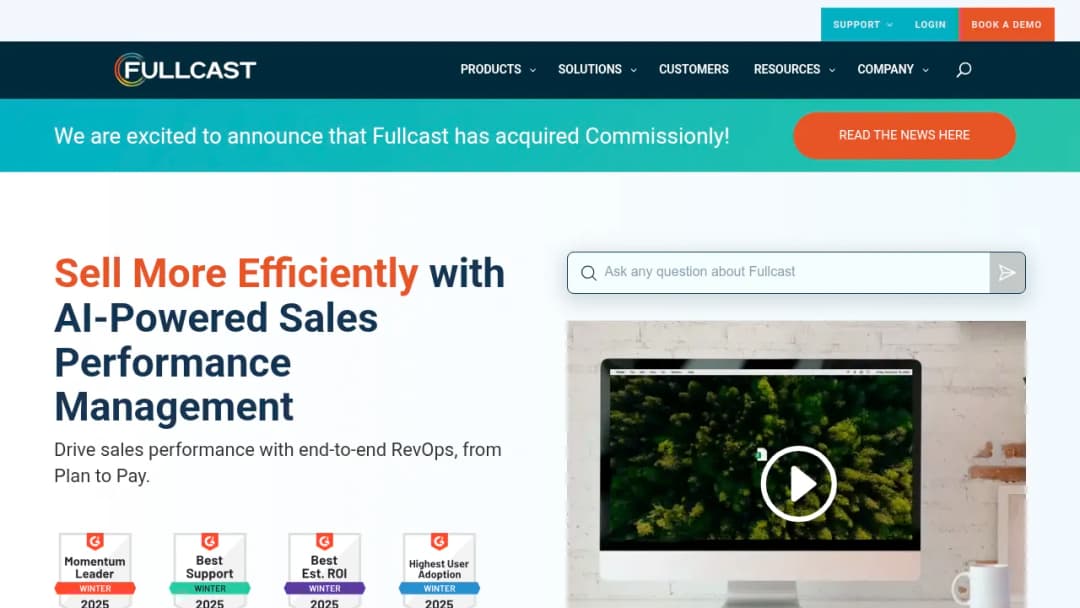
Sell More Efficiently with AI-Powered Sales Performance Management. We provide end-to-end RevOps, from Plan to Pay.
Published Jul 10, 2026
Acquisition activity and bundled modules from acquired products can create confusion about which modules are included in contracts, the degree of integration across modules, and the product roadmap. Buyers should clarify module inclusion and integration status as part of contracting.
Drivers indicated in vendor materials and reviews include the need to replace spreadsheets for territory and quota planning, the ability to deploy changes into Salesforce with reduced manual effort, and a preference for a RevOps-focused solution rather than a broad enterprise planning platform.
Fullcast is generally well rated on G2 with positive reviewer feedback. The platform lists an average time to implement of approximately two months and an average time-to-value indicator in the vendor's profile range.
Note: G2 contains other similarly named listings. This review focuses on Fullcast, the RevOps platform.
Review excerpts include praise for customer success engagement and for actionable insights reported by some reviewers. Several reviews referenced improved planning processes when converting from spreadsheet-based approaches.
Common negative themes in public reviews include:
Potential churn drivers inferred from reviews and product positioning include:
Reasons likely to prevent purchase include lack of transparent pricing, insufficiently documented security materials for enterprise procurement, and limited integration scope beyond Salesforce.
Vendor materials include directional performance claims (for example, faster territory design and reduced planning time). These improvements against spreadsheet-based processes are plausible, but the specific multipliers and figures are vendor-provided and were not independently verified in the reviewed materials.
Fullcast appears most applicable to mid-market and enterprise organizations where territory and quota planning complexity create operational overhead. Smaller organizations with complex GTM structures can also be candidates if operational complexity justifies the investment.
Public customer examples and vendor materials indicate B2B SaaS and technology-adjacent companies among users; no comprehensive industry segmentation was publicly available in the materials reviewed.
Get a comprehensive analysis of FullCast including market position, competitive landscape, adoption trends, and peer benchmarks.
Download full report →Where competitors have strengths:
Vendor case materials highlight outcomes such as reduced planning time for specific customers and reductions in manual review meetings. For example, vendor content cited reductions in planning time for specific customers.
Critical evaluation: These case outcomes are vendor-published claims. The methodology, baseline definitions, and representativeness of the results were not disclosed in the source excerpts reviewed. Buyers should request full case-study documentation that includes:
Fullcast is a B2B Revenue Operations (RevOps) / go-to-market (GTM) planning and execution platform that connects GTM planning (territories, quotas, capacity, scenarios) to operational execution in CRM systems (especially Salesforce). The product is positioned by the vendor as including AI capabilities and a planning-to-compensation workflow. It is intended to reduce reliance on spreadsheet-based planning and to shorten the time required to update territories and quotas and to deploy those changes into the CRM.
Key product areas:
Target teams: RevOps / Sales Ops / GTM Operations leaders, particularly organizations using Salesforce and requiring repeatable territory and quota operations.
Typical needs Fullcast addresses:
The vendor presents the product as focused on RevOps use cases rather than as a general enterprise planning tool, and emphasizes Salesforce-native integration.