Assista
AI NativeMultiple AI agents working across 80+ apps to eliminate your busywork while you focus on what actually matters.
MarketsWorkflow Automation
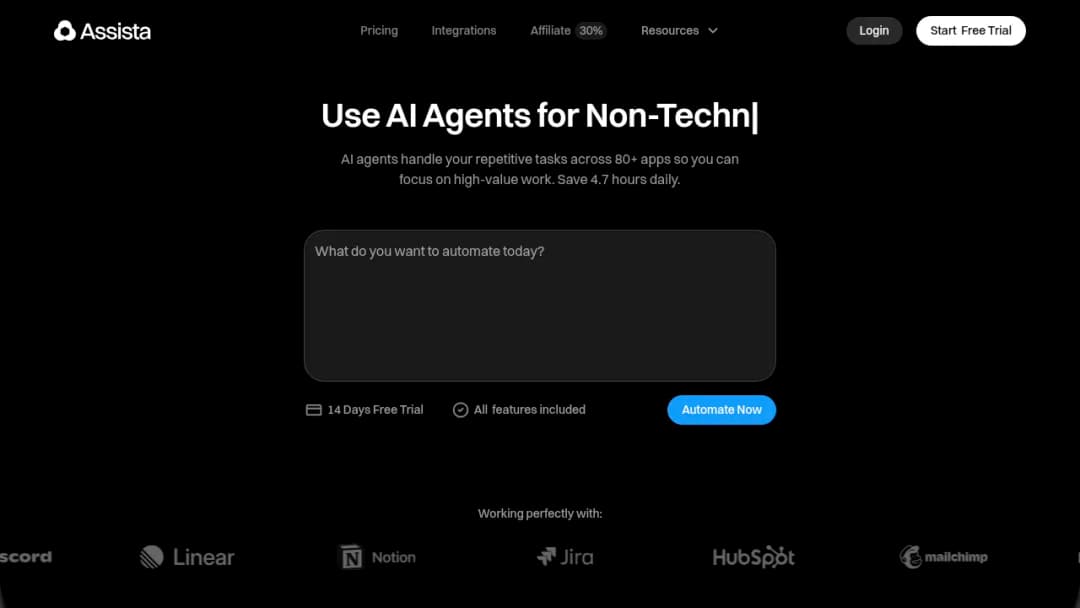
Multiple AI agents working across 80+ apps to eliminate your busywork while you focus on what actually matters.
Published Sep 26, 2026
The vendor's public pages emphasize ease of setup and speed; they do not include an explicit limitations section. The absence of an enumerated limitations section is a procurement risk because buyers must surface potential failure modes during evaluation.
No formal public roadmap with dated commitments was found in the sources reviewed. The vendor publishes workflow templates and an integrations catalog with dates for connector additions, but no comprehensive roadmap was located.
Based on vendor positioning and Product Hunt context, typical reasons cited for choosing the product include:
From limited third-party evidence, Product Hunt users expressed interest in automation that reduces manual effort for common tasks.
No detailed, independently verifiable case studies (long-form customer stories with baseline → implementation steps → measured outcomes → timeframe) were found in the reviewed sources.
Buyer recommendation: Ask the vendor for reference calls, documented before/after workflow metrics, implementation timelines, and security review artifacts.
Based on public positioning and footprint:
Get a comprehensive analysis of Assista including market position, competitive landscape, adoption trends, and peer benchmarks.
Download full report →You need enterprise compliance now If an organization requires SOC 2 Type II or ISO 27001 documentation as a prerequisite, the vendor may need to provide these artifacts privately before engagement.
You require deterministic, governed automation For workflows that must run identically every time with strict approvals and change management, traditional automation builders or enterprise iPaaS offerings may be more suitable.
You run high-volume operations and must forecast costs tightly Token pricing can be harder to model than per-execution or per-operation pricing; organizations requiring predictable unit costs may prefer alternatives.
You cannot tolerate early-stage product instability Independent reports and vendor acknowledgements of known bugs indicate a risk profile consistent with emerging products. Teams that require guaranteed stability may prefer more mature incumbents.
You need deep, specialized connectors While the vendor lists many integrations, the depth of supported actions and edge-case handling may lag mature platforms.
The vendor's independent review footprint on major enterprise review sites is limited. Low review volume increases uncertainty because a small sample may skew apparent sentiment.
A Trustpilot review referenced slow performance and freezing while building a LinkedIn automation.
Product Hunt shows limited engagement and early-adopter feedback. Community feedback can be biased toward early use cases and should be treated as qualitative signal rather than definitive evidence of long-term product quality.
A vendor representative on Product Hunt acknowledged that some product areas are buggy and may not work reliably in all cases.
G2 lists an Assista product by a different vendor focused on Trello time tracking. That listing appears to describe a different product and should not be treated as evidence about Assista AI unless the product identity is confirmed.
Searches returned similarly named products that could not be confidently mapped to Assista AI. Verify product identity before relying on Capterra entries.
The vendor's site includes headline outcome metrics such as claimed time savings, number of automated workflows, and response-time figures. These vendor-published metrics lack published methodology, sample sizes, or definitions for the measures (e.g., what constitutes a "workflow automated").
A vendor-attributed testimonial includes a claim of reduced onboarding time; this remains a vendor-provided claim without independently published validation.
Critical evaluation: The vendor-published metrics should be treated as self-reported. Buyers should request reference calls, before/after metrics, and methodology details when evaluating claims.
Assista is a no-code platform that accepts natural-language requests and orchestrates multi-step workflows across connected business applications (CRM, email, calendar, project management, communications, etc.). The product is positioned to reduce repetitive operational tasks by enabling users to type requests in plain English and have the platform perform actions across connected tools (example flow: lead research → CRM updates → personalized outreach via email → team notifications).
Important naming/identity note: There appear to be at least two distinct products using the “Assista” name:
The vendor's messaging targets non-technical users and uses language that suggests basic texting skills are sufficient to operate the product. Primary buyer personas include founders, solopreneurs, and small teams seeking cross-app automation without building integrations, with business functions such as sales ops, marketing ops, finance admin, recruiting coordination, and project coordination cited as typical use areas.
The vendor positions the product as an AI-focused alternative to traditional visual builder-first automation platforms, emphasizing natural-language orchestration and agent-style execution rather than a visual flow-builder interface.