- What the product does (core value proposition in objective terms)
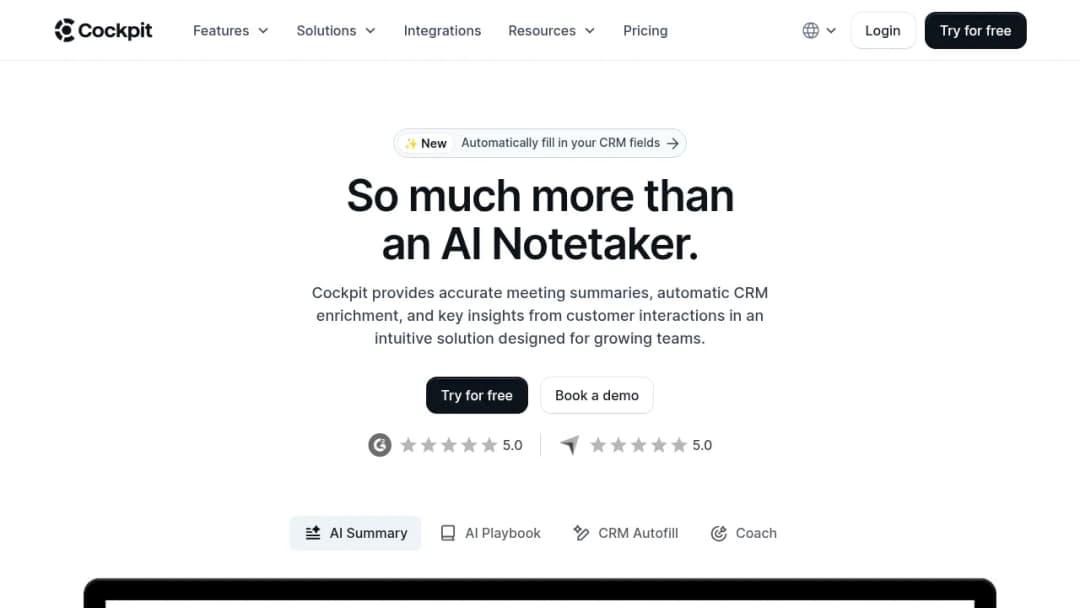
- Cockpit (the vendor’s meeting/conversation intelligence product) is an AI meeting and conversation intelligence tool targeted at go-to-market teams. Capabilities described in vendor materials and reviews include:
- Recording calls and meetings through integrations with common conferencing tools
- Producing transcripts and structured summaries
- Generating follow-up outputs (email drafts, action items)
- Autofilling CRM fields (including custom fields) and supporting sales coaching workflows (e.g., call scoring and playbooks), according to marketplace listings and reviews
- Note on naming ambiguity
- "Cockpit" is a widely used product name. Research surfaced multiple unrelated products (for example, an open-source headless CMS with the same name; Red Hat’s Cockpit server admin console; and other products referenced as "cockpit" in analyst listings). This report specifically addresses Cockpit from the meeting/conversation intelligence vendor. Some third-party pages use generic "Cockpit" descriptions that could be conflated.
- Target market and market positioning
- Primary: SMB to mid-market revenue teams (sales, RevOps, customer success) seeking conversation intelligence and workflow automation into CRM.
- Positioning themes referenced by vendor materials:
- Post-meeting automation (notes, CRM updates, follow-up messages, coaching)
- Emphasis on hosting in Europe and GDPR-related controls in trust and solutions pages
- Company background (founding year, HQ, key leadership)
- Founded: 2022 (per third-party company profiles; the vendor site did not prominently publish founding details in the crawled pages).
- HQ: France / Paris area is commonly reported by company databases.
- CEO/Founder: Romain Eliard (reported by third-party profiles).
- Funding and growth: investment rounds, acquisitions, estimated customer count/revenue if public
- Growth / revenue estimates
- Third-party profiles report modest estimated revenue/ARR in the lower millions for the mid-term horizon and a small team (roughly around twenty employees); these figures are estimates and not company-audited.
- Funding ambiguity
- Some third-party sources report an early seed round of modest size while others characterize the company as bootstrapped. Primary financing documents were not located in the accessible material. Treat funding status as uncertain without confirmation from the company.
- Pricing model with specific tiers and costs where available
- Public pricing transparency appears limited in the accessible crawls.
- The vendor site references pricing, but a clear pricing grid was not retrieved in the available pages.
- Some review listings include pricing fields, but detailed tier pricing often requires deeper navigation or a sales interaction.
- Practical implication
- Buyers should expect a sales-assisted or semi-transparent pricing process and validate:
- Whether pricing is per-seat, per-recording minute, or per-workspace
- Whether AI features (summaries, CRM write-back, coaching) are included or sold as add-ons
- Whether minimum seat counts or annual commitments apply
- Total cost of ownership considerations (implementation, training, hidden costs)
- Implementation
- Typical effort includes connecting conferencing tools (Google Meet/Teams/Zoom), connecting CRM systems (e.g., HubSpot, Salesforce), configuring templates/playbooks, and setting permissions.
- Hidden/variable cost drivers to validate
- Usage-based limits (recording minutes, storage retention)
- CRM write-back limits and effort to map custom fields
- Data retention and export requirements for compliance and offboarding
- Change-management time for rep adoption and coaching workflow redesign
- Key competitors in the space (list 4-6 direct alternatives)
- Gong
- ZoomInfo Chorus (formerly Chorus.ai)
- Avoma
- Fireflies.ai
- Otter.ai (meeting notes-focused; less positioned as revenue intelligence)
- Clari (adjacent; often paired with Gong/Chorus rather than a direct replacement)