Published May 18, 2026
Some Customer Agent capabilities (for example, actions) and agent customization ecosystems include beta components, which suggests evolving functionality and possible stability or support limitations.
Multiple review sources cite reporting limitations and the need to upgrade for advanced analytics, which can limit the ability to rigorously manage and optimize AI outcomes.
Review themes include limited customization, which can be a blocker for organizations requiring highly tailored service experiences.
Community discussions indicate Breeze Assistant is not directly integrated with Microsoft Copilot, despite similarities in naming and potential buyer assumptions.
HubSpot provides SOC reports, but HubSpot itself is not ISO 27001 certified. Organizations that require vendor-held ISO 27001 should validate compliance requirements.
Forum discussions reveal practical friction and expectation gaps. For example, community responses indicate that the in-product assistant is not integrated with certain external copilot products, highlighting common assumptions about broad integrations that may not match current capabilities.
Common reasons across review sources:
A vendor-selected customer statement reports that Customer Agent handled a large portion of inquiries automatically and that setup was straightforward.
Critical evaluation:
The platform supports agent actions that can trigger tasks or lookups in external systems (for example, order status checks or password resets).
Critical evaluation:
Common fits include B2B SaaS, professional services, education, and e-commerce/subscription businesses—particularly where Customer Agent actions integrate with order or account workflows.
Decision makers:
End users:
Get a comprehensive analysis of Hubspot Breeze including market position, competitive landscape, adoption trends, and peer benchmarks.
Download full report →Review platforms typically evaluate HubSpot Hubs rather than Breeze as an isolated product. Breeze-related sentiment is inferred from comments mentioning AI features, chatbot/customer agent experience, and impacts on reporting, automation, and pricing.
Positive example:
"Service Hub makes it easy to manage customer communication in one place… The ticketing system and automation tools streamline our workflows…"
Mixed/negative example emphasizing cost and complexity:
"Cost scaling and hidden fees are challenging… features locked behind more expensive plans… The ticketing UI feels messy and unintuitive…"
Common themes from G2’s aggregated Pros/Cons include ease of use and rich feature sets on the positive side, and missing features, limited customization, and reporting constraints on the negative side.
Capterra highlights ease of use and integrations while noting reporting limitations and intermittent bugs; it also references the introduction of AI-powered Breeze Agents in a recent product update.
Positive sentiment often emphasizes the unified timeline, tasks, and history visibility:
"HubSpot takes care of logging e-mails, calls, and notes all in one timeline…"
Negative excerpts include requests for deeper analytics and mentions of clunky integrations and cumbersome reporting.
Vendor communications indicate that Customer Agent resolves a majority of support conversations for a subset of Service Hub customers, with higher reported rates in selected examples.
Critical evaluation:
Operational prerequisites and controls include:
Critical evaluation:
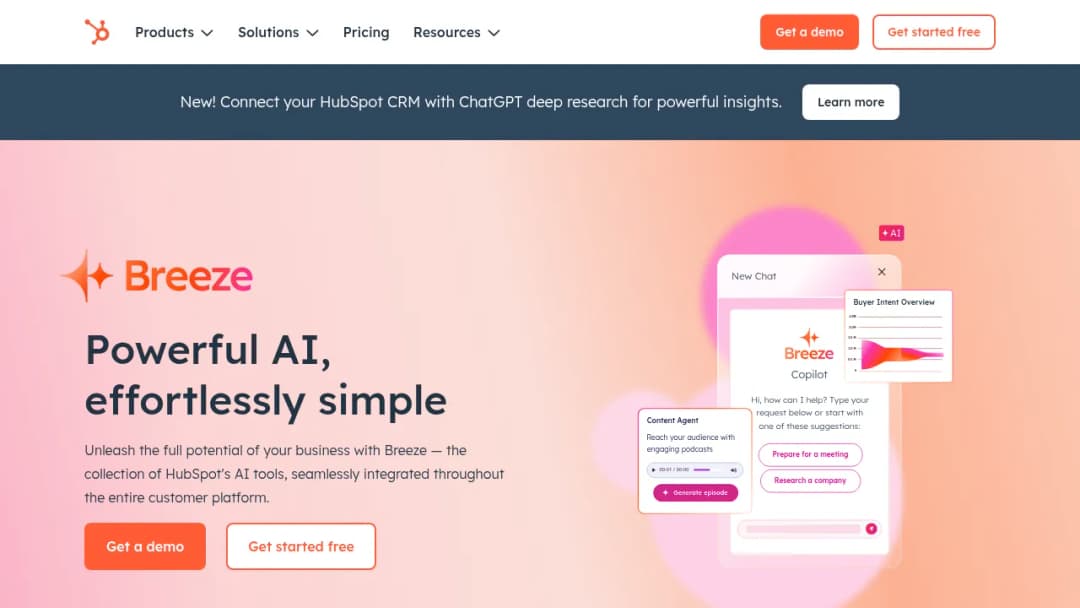
HubSpot Breeze is the AI layer across the HubSpot Customer Platform (Smart CRM plus Marketing, Sales, Service, Content, and Operations hubs). It spans:
From a buyer’s perspective, Breeze is not positioned as a standalone SKU but as a suite of AI capabilities embedded into HubSpot. Value and limitations depend heavily on which HubSpot edition is used, the presence and structure of CRM data, and data hygiene.