Workspace
    • Briefing
    • Ask Airframe
    Transformation
    • Audit
    Your Stack
    • Registry
    • Finance
    • Context
    Discover
    Powered by Airframe
    1. Research
    2. /
    3. Products
    4. /
    5. Hugging Face
    Hugging Face

    Hugging Face

    Leader

    The AI community building the future.

    Est 2016|Valuation $12.9B|Raised $394.7M|157 Ref Customers
    LinkedIn 1.3M|Web traffic 39.5M|FTEs 250|HQ New York, NY
    MarketsData Science & Machine Learning PlatformsFoundation ModelsMachine Learning Ops (MLOps)
    Platform CoversLearning Management System (LMS)Artifact ManagementCommunity Platforms
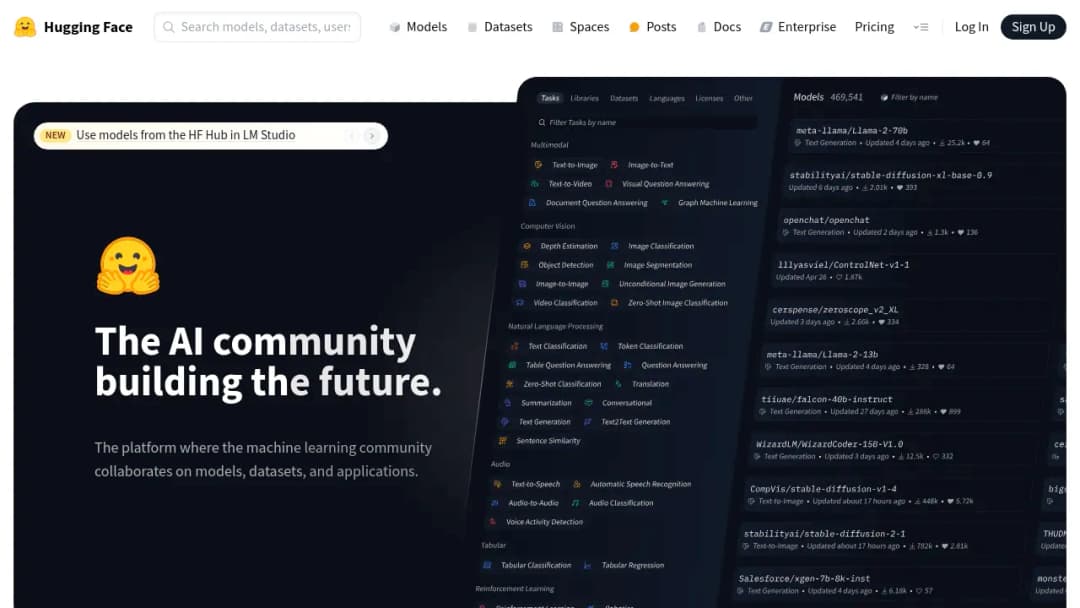
    Hugging Face screenshot
    FirmCompareTractionAnalysisAdvocates

    Insights

    All insightsAccountingFinanceSoftwareCustomer experience

    Benchmarks

    The Software LeaderboardMethodology

    Tools & data

    Market ExplorerStudioRegistry

    Company

    AboutCareers

    Legal

    Privacy PolicyTerms of Service

    © 2026 Airframe, Inc. All rights reserved.

      Published Oct 23, 2026

      01Common complaints

      - Company sizes or stages where this product is overkill or insufficient - For organizations that only require a simple internal artifact store for a small number of models, an internal registry (S3 + metadata/versioning) may be a lower-cost, lower-complexity option. - Industries or use cases where competitors are more appropriate - If the primary requirement is integrated experiment tracking, lineage, and production monitoring across training and deployment, a dedicated MLOps suite may better meet those needs. - Technical constraints - Fully air-gapped or strictly on-premises requirements may not be satisfied by the SaaS offering without specific enterprise arrangements. - Budget considerations - While seat pricing is modest, compute, storage, and inference charges can compound for production workloads. - Workflow limitations - If semantic discovery for similar assets is a critical operational workflow, current community feedback indicates the search experience may be a limiting factor at scale. - Procurement red flags - Do not assume specific certifications (e.g., ISO 27001) without receiving and validating formal documentation and scope statements. - Vendor-acknowledged limitations - Vendor documentation highlights SOC 2 Type 2 certification but public details on other compliance frameworks and pen-test reporting are limited in the reviewed sources. - Reliability and outage exposure - The platform publishes a status page; community reports of outages and build delays indicate dependency on underlying cloud infrastructure and the usual operational risks for hosted services. - Discovery and metadata quality at scale - Community feedback indicates search for semantically similar assets can be a pain point as the catalog grows; improving metadata and search relevance is important for findability. - Supply chain governance - Academic and security analyses flag risks such as license drift and producer-consumer misalignment; enterprises should implement governance processes to mitigate these structural risks.
      Deal disqualifiers (poor fit)

      • Strict air-gapped or fully on-premises-only environments without third-party SaaS usage.
      • Organizations without the capacity to implement model governance and provenance controls.

      02Why they buy

      - Advantages indicated by community usage and library adoption - The vendor’s open-source libraries (e.g., Transformers, Diffusers) and the Hub’s role as a distribution point for community models and datasets are commonly cited by practitioners as reasons for adoption. - Distinct capabilities - Combined artifact hosting: model registry, dataset registry, and interactive demo hosting (Spaces) under one platform. - Integration with widely used open-source ML libraries and a range of deployment/serving tools. - Areas where competitors have advantages - Git-based developer platforms may provide tighter integration with engineering workflows; MLOps vendors may provide more comprehensive experiment tracking and monitoring features.

      03Field reports

      Review platform access notes

      • Gartner Peer Insights listings for vendor tools may require login and may be categorized in multiple ways.
      • G2 and TrustRadius maintain vendor review pages; some content may be gated behind login or require a user account.

      Community and aggregated sentiment (representative themes)

      - Common positive themes - Practitioners report using libraries and assets hosted on the Hub (e.g., Transformers and datasets) for research and development workflows. - The platform is commonly used as a primary distribution point for open-source models across the community. - Common negative themes - Search and discovery: users report difficulty finding related or similar assets unless specific terms are known, indicating metadata and search relevance challenges as the catalog scales. - Operational reliability: community threads document incidents such as downtime or build/deploy issues for demo applications (Spaces); these are anecdotal reports consistent with a hosted service that relies on underlying cloud infrastructure.

      Drivers for selection

      • Centralized hosting for models, datasets, and demo applications combined with vendor libraries and ecosystem adoption are frequently cited as reasons teams use the Hub.
      • Team plan enterprise features (SSO, audit logs, resource groups) are commonly treated as baseline features for compliance workflows by some buyers.

      Reasons for avoidance or migration

      • Organizations with strict governance policies may prefer self-hosted registries to minimize third-party platform risk and to implement end-to-end provenance controls.
      • Teams focused exclusively on inference may evaluate specialized inference providers or cloud-native model serving options instead of a hub-first approach.

      Vendor-published deployment and performance material

      • Text Generation Inference (TGI): Vendor-published materials provide benchmarking guidance and a stated benchmarking protocol with caveats; these materials are useful starting points but should be validated against target hardware, workloads, and concurrency patterns.

      Academic and third-party analyses

      • Research on the platform’s ecosystem highlights governance and documentation challenges that indicate successful adoption depends on internal processes as well as tooling.

      Gaps in independent case evidence

      • Independently verified, quantified enterprise ROI case studies were not prominent in the accessible sources reviewed. Procurement should request references and deployment case studies that match regulatory and technical requirements.

      04Best fit

      Company sizes

      • Strong fit:
        • Small to mid-sized AI teams seeking managed private repositories for models and datasets with SSO and audit logging.
        • Enterprises requiring a vendor with SOC 2 coverage and formal access controls (subject to vendor verification).
      • Heuristic sizing: teams across a broad range of ML practitioner counts — from small teams to larger groups — often with some regulatory or security requirements.

      Industries and verticals

      • Common adopters include software/AI companies, research groups, media, e-commerce, and organizations building LLM-based features; regulated industries can adopt with mature governance processes.

      Roles and personas

      • Decision makers: Head of AI/ML, VP Engineering, Security/Compliance, Platform Engineering.
      • End users: ML engineers, data scientists, research engineers.

      Pain points addressed

      • Centralization of model and dataset sharing, versioning, collaboration, and demo application hosting; managed inference endpoints for deployment.

      Qualification criteria (good fit)

      • Teams already using vendor libraries (Transformers/Diffusers) and seeking an artifact hub consistent with those workflows; teams that benefit from external distribution and discovery.

      05The pitch

      What the product does (core value proposition in objective terms)

      - Hugging Face provides a hosted platform (the "Hub") for storing and collaborating on machine learning artifacts—models, datasets, and applications ("Spaces")—and offers paid features for enterprise collaboration, access control, and managed inference/compute. - The vendor describes the Hub as a community platform for hosting and sharing machine learning assets and lists a catalog that it reports includes a broad set of models, datasets, and applications (vendor-provided figures cited in vendor materials).

      Target market and market positioning

      - Primary audiences include: - Individual researchers and developers publishing open models, datasets, and demos. - ML/AI teams standardizing internal model/dataset collaboration, access controls, and governance. - Product teams deploying models via managed endpoints or unified inference APIs. - Market positioning is analogous to a code-hosting service adapted for ML artifacts, with ML-specific primitives such as model cards, dataset cards, Spaces demos, and inference endpoints.

      Get a comprehensive analysis of Hugging Face including market position, competitive landscape, adoption trends, and peer benchmarks.

      Download full report →
      • Company sizes or stages where this product is overkill or insufficient

        • For organizations that only require a simple internal artifact store for a small number of models, an internal registry (S3 + metadata/versioning) may be a lower-cost, lower-complexity option.
      • Industries or use cases where competitors are more appropriate

        • If the primary requirement is integrated experiment tracking, lineage, and production monitoring across training and deployment, a dedicated MLOps suite may better meet those needs.
      • Technical constraints

        • Fully air-gapped or strictly on-premises requirements may not be satisfied by the SaaS offering without specific enterprise arrangements.
      • Budget considerations

        • While seat pricing is modest, compute, storage, and inference charges can compound for production workloads.
      • Workflow limitations

        • If semantic discovery for similar assets is a critical operational workflow, current community feedback indicates the search experience may be a limiting factor at scale.
      • Procurement red flags

        • Do not assume specific certifications (e.g., ISO 27001) without receiving and validating formal documentation and scope statements.
      • Vendor-acknowledged limitations

        • Vendor documentation highlights SOC 2 Type 2 certification but public details on other compliance frameworks and pen-test reporting are limited in the reviewed sources.
      • Reliability and outage exposure

        • The platform publishes a status page; community reports of outages and build delays indicate dependency on underlying cloud infrastructure and the usual operational risks for hosted services.
      • Discovery and metadata quality at scale

        • Community feedback indicates search for semantically similar assets can be a pain point as the catalog grows; improving metadata and search relevance is important for findability.
      • Supply chain governance

        • Academic and security analyses flag risks such as license drift and producer-consumer misalignment; enterprises should implement governance processes to mitigate these structural risks.
      • Advantages indicated by community usage and library adoption
        • The vendor’s open-source libraries (e.g., Transformers, Diffusers) and the Hub’s role as a distribution point for community models and datasets are commonly cited by practitioners as reasons for adoption.
      • Distinct capabilities
        • Combined artifact hosting: model registry, dataset registry, and interactive demo hosting (Spaces) under one platform.
        • Integration with widely used open-source ML libraries and a range of deployment/serving tools.
      • Areas where competitors have advantages
        • Git-based developer platforms may provide tighter integration with engineering workflows; MLOps vendors may provide more comprehensive experiment tracking and monitoring features.
      • Common positive themes
        • Practitioners report using libraries and assets hosted on the Hub (e.g., Transformers and datasets) for research and development workflows.
        • The platform is commonly used as a primary distribution point for open-source models across the community.
      • Common negative themes
        • Search and discovery: users report difficulty finding related or similar assets unless specific terms are known, indicating metadata and search relevance challenges as the catalog scales.
        • Operational reliability: community threads document incidents such as downtime or build/deploy issues for demo applications (Spaces); these are anecdotal reports consistent with a hosted service that relies on underlying cloud infrastructure.
      • Hugging Face provides a hosted platform (the "Hub") for storing and collaborating on machine learning artifacts—models, datasets, and applications ("Spaces")—and offers paid features for enterprise collaboration, access control, and managed inference/compute.
      • The vendor describes the Hub as a community platform for hosting and sharing machine learning assets and lists a catalog that it reports includes a broad set of models, datasets, and applications (vendor-provided figures cited in vendor materials).
      • Primary audiences include:
        • Individual researchers and developers publishing open models, datasets, and demos.
        • ML/AI teams standardizing internal model/dataset collaboration, access controls, and governance.
        • Product teams deploying models via managed endpoints or unified inference APIs.
      • Market positioning is analogous to a code-hosting service adapted for ML artifacts, with ML-specific primitives such as model cards, dataset cards, Spaces demos, and inference endpoints.

      How it compares

      • Corporate LMS market report (competes in this market)

        Top vendors: EVERFI, Bridge, Axonify, LearnWorlds, HackerRank.