Hume
AI NativeEmpathic AI research lab building multimodal AI with emotional intelligence. Experience our API at demo.hume.ai
MarketsAI Voice Agent Platform
Empathic AI research lab building multimodal AI with emotional intelligence. Experience our API at demo.hume.ai
Published Oct 15, 2026
A limitation of this report: clear, product-specific listings for Hume on major B2B review platforms were not found in the sources reviewed. This reduces the ability to quantify satisfaction at scale using established review platforms.
Community feedback that surfaced during searches is noisy due to brand overlap with an unrelated company. Posts about the unrelated hardware company include negative sentiment but are not attributable to this vendor. Posts specifically about the vendor were more often news reposts than hands-on reviews; comparative commentary sometimes positions other vendors as quality benchmarks for voice.
Press coverage included hands-on testing that noted strong expressiveness potential alongside occasional technical glitches; these are external and anecdotal datapoints that may be useful in evaluation.
Based on case studies and product positioning, likely adoption drivers include:
The vendor’s blog lists additional case studies across phone support, training, and creative workflows. Case studies provide directional evidence but typically emphasize positive outcomes; request references and independently verifiable metrics where relevant.
Get a comprehensive analysis of Hume including market position, competitive landscape, adoption trends, and peer benchmarks.
Download full report →If only basic TTS is required for internal tools: Commodity TTS (or bundled cloud TTS) may be sufficient and lower cost.
If maximum enterprise maturity is required immediately: If procurement mandates a public trust center, mature IAM (SSO/SCIM/audit logs), and detailed subprocessor disclosures, consider vendors with an established trust center or expect an enterprise sales process to address gaps.
If emotion-aware voices create risk in the use case: In regulated or sensitive domains (mental health, HR, debt collection), emotionally adaptive voices can increase ethical and legal risk; a more neutral voice approach may reduce exposure.
If the organization cannot tolerate vendor volatility: Reported talent movement and licensing arrangements introduce some transition risk; risk-averse programs may prefer vendors with longer-term stability or more predictable roadmaps.
Independent reviews on major B2B platforms were not found in the reviewed sources, making it difficult to quantify user satisfaction and production issues at scale.
Vendor-published performance and comparative claims rely on the vendor’s study methodology; buyers should reproduce benchmarks on representative workloads.
Enterprise security details (beyond claims of SOC 2 Type II / GDPR / HIPAA) are not publicly documented in the reviewed sources.
Potential organizational transition risk following reported talent movement and licensing arrangements.
The vendor describes a partnership with a compute/acceleration partner to provide emotionally aware voice to hosted language models, highlighting low-latency speech-to-speech performance in published materials.
Critical evaluation:
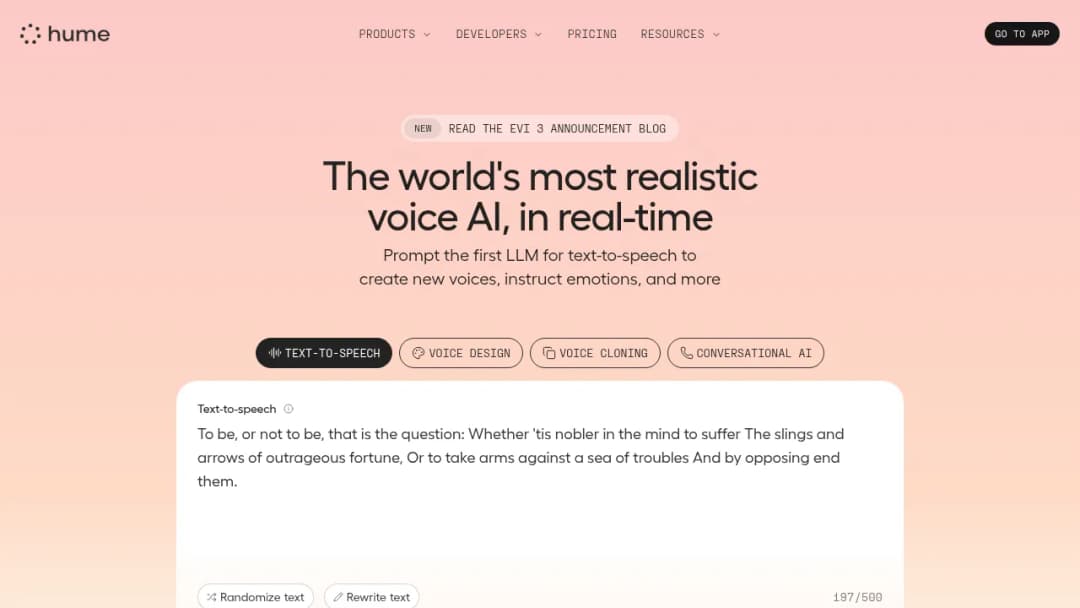
Hume is a voice AI platform focused on expressive and emotion-aware audio generation and voice interactions. The company positions its stack around emotional understanding as a capability, spanning:
Hume’s differentiation claim is that emotional understanding and expressivity improve naturalness, engagement, and satisfaction in voice experiences. This claim is plausible but difficult to validate independently without customer-side outcome data.
Hume targets:
Hume's messaging implies a marketed combination of realism and emotion control, competing with specialist voice vendors (ElevenLabs, Cartesia) and, indirectly, voice modes bundled into large LLM platforms.