Workspace
    • Briefing
    • Ask Airframe
    Transformation
    • Audit
    Your Stack
    • Registry
    • Finance
    • Context
    Discover
    Powered by Airframe
    1. Research
    2. /
    3. Products
    4. /
    5. Make
    Make

    Make

    AI automation you can visually build and orchestrate in real time.

    Est 2012|Valuation $100M|145 Ref Customers
    LinkedIn 114K|Web traffic 9.2M|FTEs 350|HQ Prague, Capital City of Prague, CZ
    MarketsBusiness Process Management (BPM)Low-Code Development PlatformsAgent Builder PlatformsMarketing Automation Platforms
    Platform CoversAI Agent Tool Integration PlatformsData Integration (ETL/ELT)Workflow Automation
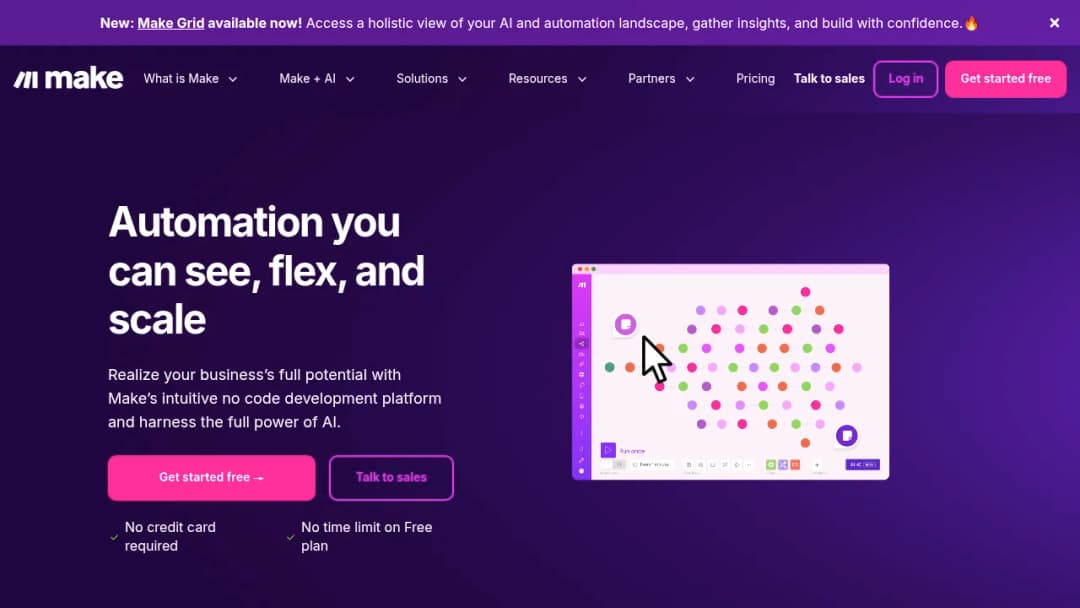
    Make screenshot
    FirmCompareTractionAnalysisAdvocates

    Insights

    All insightsAccountingFinanceSoftwareCustomer experienceMethodologyThe Software Leaderboard

    Tools & data

    Market ExplorerStudioRegistry

    Company

    AboutCareers

    Legal

    Privacy PolicyTerms of Service

    © 2026 Airframe, Inc. All rights reserved.

      Published Oct 10, 2026

      01Common complaints

      - Company sizes or stages where this product is overkill or insufficient - Very early stage with a handful of simple “if X then Y” workflows: Zapier or built-in app automations may be simpler and require less ongoing maintenance. - Very large enterprise integration programs: Make may be insufficient compared to Workato/Informatica/MuleSoft-type governance and integration lifecycle tooling. - Industries or use cases where competitors are clearly superior - Regulated environments requiring self-hosting or strict residency: n8n self-hosted (or enterprise iPaaS with on-prem agents) may fit better than a managed SaaS model. ([reddit.com](https://www.reddit.com/r/nocode/comments/1sswo8g/n8n_vs_make/?utm_source=openai)) - Technical requirements that this product cannot meet - If you must deploy custom integrations as first-class reusable nodes, or run automations inside a private network without external SaaS execution, Make is structurally less suitable than self-hosted tools. - Budget constraints that make alternatives more appropriate - High-volume workflows can become expensive if not engineered to minimize steps/polling; self-hosted n8n may be cheaper if you can operate infrastructure. ([reddit.com](https://www.reddit.com/r/nocode/comments/1sswo8g/n8n_vs_make/?utm_source=openai)) - Specific workflows or integrations where the product falls short - If a critical upstream vendor only supports Zapier (or has better Zapier support), you may end up paying for Zapier anyway (and possibly dual-running workflows). ([reddit.com](https://www.reddit.com/r/zapier/comments/1muatwz/zapier_vs_make_which_one_do_you_prefer_for/?utm_source=openai)) - Red flags in the buying process (e.g., requires annual commitment, no free trial) - Budgeting risk: credit slider + variable credit burn (especially with AI features) can make spend modeling difficult; insist on a proof-of-concept with representative volumes. - Current limitations acknowledged by the vendor - Vendor sources in this crawl do not provide a consolidated “limitations” page; limitations are implied via plan gating (SSO Enterprise-only) and pricing/credits model. - Features on the roadmap (not yet available) - note estimated dates if available - Not reliably sourced in retrieved materials; community/product update posts exist but are not a formal roadmap. ([community.make.com](https://community.make.com/?utm_source=openai)) - Scale limitations (at what volume/size does it break down?) - No official hard limits captured here; practical limits tend to be economic (credits) and operational (maintaining many scenarios, log review, connector health). - Security or compliance gaps - Some compliance items (HIPAA/PCI/ISO 27017/27018) were not confirmed in retrieved sources. - SSO and audit logs are Enterprise-gated, which can be a blocker for some orgs. ([help.make.com](https://help.make.com/single-sign-on?utm_source=openai)) - Technical debt or architectural limitations mentioned in reviews - Users describe UI sluggishness/latency and clutter at scale. ([trustpilot.com](https://www.trustpilot.com/review/make.com?utm_source=openai)) - API limitations or integration constraints - Connector authentication issues can occur and require reauthorization; community topics suggest this is recurring for some apps (e.g., Reddit module credentials). ([community.make.com](https://community.make.com/?utm_source=openai))

      Deal disqualifiers: what makes a POOR fit

      • Requirement for on‑prem/self‑hosting, highly customized node ecosystems, or strict network control.
      • Need for enterprise identity governance features but inability to justify enterprise‑level contracting or plans.
      • Requirement for extremely predictable monthly spend without modeling workflow credit consumption.

      02Why they buy

      - Competitive advantages validated by customer feedback (not just vendor claims) - Visual canvas + strong flow control is consistently praised as enabling complex automation without code. ([techradar.com](https://www.techradar.com/best/best-ai-tools?utm_source=openai)) - Broad connector coverage is frequently mentioned as a key reason to choose Make. ([gartner.com](https://www.gartner.com/reviews/product/make?utm_source=openai)) - Unique features and capabilities competitors lack - Make’s “scenario as flowchart” approach is often perceived as more transparent for complex branching compared with linear builders (though competitors are evolving quickly). ([techradar.com](https://www.techradar.com/best/best-ai-tools?utm_source=openai)) - Differentiation from competitors based on reviews - Common buyer narrative: Make is the “middle ground” between Zapier simplicity and n8n technical depth. ([reddit.com](https://www.reddit.com/r/automation/comments/1o8ptba/which_is_better_n8n_zappier_make_what_do_you_us/?utm_source=openai)) - Value propositions with evidence from case studies - Strongest “evidence” in retrieved sources is qualitative (time savings, reduced manual work) rather than audited ROI. - Areas where competitors clearly have advantages (be balanced) - Zapier: integration breadth + packaging predictability (per Zapier editorial). ([zapier.com](https://zapier.com/blog/which-is-the-best-value-zapier-vs-make/?utm_source=openai)) - n8n: self-hosting + extensibility + long-run economics at scale (community discussions). ([reddit.com](https://www.reddit.com/r/nocode/comments/1sswo8g/n8n_vs_make/?utm_source=openai)) - Workato: enterprise integration governance and sales-supported deployments (enterprise class). ([docs.workato.com](https://docs.workato.com/pricing/?utm_source=openai))

      03Field reports

      - Detailed customer success stories with metrics - In the sources retrieved, there were not many rigorous, independently validated Make-specific case studies with ROI methodology. Most “impact” statements are user anecdotes or vendor growth stats. - Specific results and quantified business impact - Vendor growth statistics exist (users, scenarios, apps) but are not business-outcome metrics and are vendor-reported. (Source: vendor annual review/blog post) - Implementation details and time to value - Practical implementation discussions are more visible in community venues than formal case studies (e.g., users discussing building multi-path automations in a short timeframe). (Source: industry Reddit and community threads) - Challenges faced during adoption and how they were resolved - Community forum topics suggest troubleshooting is common (credential reauthorization, module behavior), implying ongoing maintenance work. (Source: official vendor community forums) - CRITICAL: Note when metrics are vendor-published without independent verification - Make’s vendor-published review metrics are not independently validated in this report. (Source: vendor annual review/blog post) - Include mixed results - projects that struggled or failed when available - Community example of an AI+Make content automation: a user reported publishing a large batch of AI-generated posts via a Make-based pipeline and reporting no measurable revenue (business outcome failure, not necessarily a Make product failure—but relevant as a warning about “automation ≠ strategy”). (Source: industry Reddit and community threads)

      Customer Testimonials

      #### Direct quotes from Gartner Peer Insights, Reddit, TrustRadius, G2, HackerNews - Gartner Peer Insights (positive): “the visual interface allows me to build workflows intuitively, without needing advanced technical knowledge.” (Gartner Peer Insights) - Gartner Peer Insights (critical): “Being a closed, non-open-source platform, customization, scalability and connectivity with niche tools are limited. On top of that, the pricing model doesn't scale in a friendly way for growing teams.” (Gartner Peer Insights) - Trustpilot (negative, support/security incident claim): “Our account somehow got hacked and spent a significant sum… There is no support…” (user allegation; not independently verified in this report). (Trustpilot) - Trustpilot (mixed, UX): “Capable logic, High friction UI… the platform's UI latency is a constant bottleneck.” (Trustpilot) - Reddit (balanced/critical tone): “Make is the fun Lego toy that introduced me to automation. It's adorable, largely effective, and has silly quirks…” (Reddit thread) - Reddit (beginner-friendly positioning): “Since you don't come from the coding background, I suggest you to use make.com initially…” (Reddit thread) #### BALANCE: Include both 5-star AND low-star reviews with equal weight - 5-star example (Trustpilot): “Make.com changed my life… saves so much time.” (Trustpilot) - 1-star example (Trustpilot): “A waste of time. Very bad user interface…” (Trustpilot) #### Common criticisms and complaints (support issues, bugs, missing features) - UI friction and latency, and increasing clutter as scenarios grow, plus mapping complexity appear repeatedly across review narratives. (User review sites and analyst summaries) - Pricing and credits scaling concerns: reviewers frequently mention that costs grow with volume and that credit models can be hard to forecast. (Analyst and user reviews) - Platform limitations for niche tools and closed-source extensibility (vs. open-source alternatives) are commonly raised. (Analyst and community discussions) #### Why customers chose this product over alternatives - The visual canvas enables branching logic and complex workflows more easily than many linear builders (commonly cited versus other vendors). (Product reviews and comparisons) - Perceived cost efficiency at low-to-mid volumes compared to some competitors is frequently mentioned in community discussions. (Community forums) - Breadth of connectors and integrations is repeatedly praised. (Analyst and marketplace summaries) #### Why some customers left for competitors (churn reasons) - Desire for self-hosting/control and long-term cost predictability drives some users toward open-source, self-hosted alternatives—especially for high-volume or enterprise-scale scenarios. (Community discussions) - Some users report preferring competing vendors for ease of use, management, or coverage of specific integrations. (Community forums) #### Specific outcomes customers achieved (anecdotal, not independently validated) - User anecdotes claim time savings and substantial operational uplift. These are unverified and should be treated as subjective reports. (User reviews) #### Customer pain points and frustrations mentioned in reviews - Initial learning curve: modules and complex workflows can be hard to understand for newcomers. (User reviews) - Governance/support expectations vary: some users report difficulty reaching support or slow response times; others praise empathetic handling of exceptions. (User reviews) #### Deal-breakers and reasons customers didn't purchase - Enterprises needing SSO, advanced audit logging, or strict governance often require higher-tier plans, which introduces contract and pricing friction. - Engineering-led teams wanting open-source extensibility, custom nodes, and local execution frequently prefer self-hosted alternatives for long-term control. (Community discussions)
      04Best fit

      Company sizes

      - Strong fit: - Solo operators to SMB teams: very small to small‑medium teams; typically lower‑revenue companies; teams that want to automate across a common SaaS stack without hiring integration engineers. (Inference from review platform skew toward small business reviews and pricing tier structure.) - Mid‑market ops teams: mid‑market organizations where automation volume starts to make alternative integration platforms comparatively costly. - Enterprise fit exists (SSO / audit logs / SLAs), but buyers should validate governance and support expectations in contract. (Refer to vendor help documentation for feature specifics.)

      Industries and verticals where adoption is strongest (with customer examples)

      • Reviews indicate broad cross‑industry usage including IT services, manufacturing, real estate, and construction, based on analyst and peer‑review platforms.

      Roles and personas: decision makers AND end users

      • End users: RevOps, marketing ops, operations managers, automation agencies/freelancers, and other “technical operators.” (Referenced in industry publications and review sites.)
      • Decision makers: Heads of Ops, Marketing, Growth; IT stakeholders for enterprise plan security features.

      Pain points and challenges the product addresses

      • Reducing manual work between SaaS tools.
      • Enforcing consistent data movement across systems.
      • Building multi‑step workflows with conditional branching and retries. (Documented in analyst and peer reviews.)

      Qualification criteria: what makes a GREAT fit

      • Need for multi‑branch logic and data transformation without building a full custom application.
      • A tech stack largely within Make’s connector ecosystem (or comfort using generic HTTP/API modules).
      • Willingness to accept a learning curve to gain greater power and cost advantages over simpler/no‑code alternatives.

      Real customer examples with company names when available

      • Publicly accessible sources used for this section typically expose roles and industries but often anonymize company names; reviewer platforms and analyst sites frequently omit exact customer company names.

      05The pitch

      What the product does (core value proposition in objective terms)

      - Make is a visual integration-platform-as-a-service (iPaaS) / workflow automation tool used to connect SaaS apps and APIs into multi-step, branching automations (“scenarios”). It supports both no-code users (drag-and-drop) and more technical builders (HTTP modules, data mapping, custom apps). (Analyst and vendor product pages) - It is positioned as “more powerful/visual than linear automation tools” (e.g., Zapier-style step chains), offering routers/iterators/error handlers and richer data transformation capabilities. (Analyst and vendor product pages)

      Target market and market positioning

      • Core audience: SMBs, agencies, ops teams, marketing/revops, and “technical operators” who need multi-branch logic and are price-sensitive at higher volumes. (Industry reviews and vendor materials)
      • Secondary audience: Enterprise buyers via an Enterprise plan (SSO, audit logs, SLAs, dedicated support), though Make is often perceived as more “indie/hobby” in UI feel than traditional enterprise iPaaS suites. (Analyst and community commentary)

      Get a comprehensive analysis of Make including market position, competitive landscape, adoption trends, and peer benchmarks.

      Download full report →
      • Company sizes or stages where this product is overkill or insufficient

        • Very early stage with a handful of simple “if X then Y” workflows: Zapier or built-in app automations may be simpler and require less ongoing maintenance.
        • Very large enterprise integration programs: Make may be insufficient compared to Workato/Informatica/MuleSoft-type governance and integration lifecycle tooling.
      • Industries or use cases where competitors are clearly superior

        • Regulated environments requiring self-hosting or strict residency: n8n self-hosted (or enterprise iPaaS with on-prem agents) may fit better than a managed SaaS model. (reddit.com)
      • Technical requirements that this product cannot meet

        • If you must deploy custom integrations as first-class reusable nodes, or run automations inside a private network without external SaaS execution, Make is structurally less suitable than self-hosted tools.
      • Budget constraints that make alternatives more appropriate

        • High-volume workflows can become expensive if not engineered to minimize steps/polling; self-hosted n8n may be cheaper if you can operate infrastructure. (reddit.com)
      • Specific workflows or integrations where the product falls short

        • If a critical upstream vendor only supports Zapier (or has better Zapier support), you may end up paying for Zapier anyway (and possibly dual-running workflows). (reddit.com)
      • Red flags in the buying process (e.g., requires annual commitment, no free trial)

        • Budgeting risk: credit slider + variable credit burn (especially with AI features) can make spend modeling difficult; insist on a proof-of-concept with representative volumes.
      • Current limitations acknowledged by the vendor

        • Vendor sources in this crawl do not provide a consolidated “limitations” page; limitations are implied via plan gating (SSO Enterprise-only) and pricing/credits model.
      • Features on the roadmap (not yet available) - note estimated dates if available

        • Not reliably sourced in retrieved materials; community/product update posts exist but are not a formal roadmap. (community.make.com)
      • Scale limitations (at what volume/size does it break down?)

        • No official hard limits captured here; practical limits tend to be economic (credits) and operational (maintaining many scenarios, log review, connector health).
      • Security or compliance gaps

        • Some compliance items (HIPAA/PCI/ISO 27017/27018) were not confirmed in retrieved sources.
        • SSO and audit logs are Enterprise-gated, which can be a blocker for some orgs. (help.make.com)
      • Technical debt or architectural limitations mentioned in reviews

        • Users describe UI sluggishness/latency and clutter at scale. (trustpilot.com)
      • API limitations or integration constraints

        • Connector authentication issues can occur and require reauthorization; community topics suggest this is recurring for some apps (e.g., Reddit module credentials). (community.make.com)
      • Competitive advantages validated by customer feedback (not just vendor claims)

        • Visual canvas + strong flow control is consistently praised as enabling complex automation without code. (techradar.com)
        • Broad connector coverage is frequently mentioned as a key reason to choose Make. (gartner.com)
      • Unique features and capabilities competitors lack

        • Make’s “scenario as flowchart” approach is often perceived as more transparent for complex branching compared with linear builders (though competitors are evolving quickly). (techradar.com)
      • Differentiation from competitors based on reviews

        • Common buyer narrative: Make is the “middle ground” between Zapier simplicity and n8n technical depth. (reddit.com)
      • Value propositions with evidence from case studies

        • Strongest “evidence” in retrieved sources is qualitative (time savings, reduced manual work) rather than audited ROI.
      • Areas where competitors clearly have advantages (be balanced)

        • Zapier: integration breadth + packaging predictability (per Zapier editorial). (zapier.com)
        • n8n: self-hosting + extensibility + long-run economics at scale (community discussions). (reddit.com)
        • Workato: enterprise integration governance and sales-supported deployments (enterprise class). (docs.workato.com)
      • Detailed customer success stories with metrics

        • In the sources retrieved, there were not many rigorous, independently validated Make-specific case studies with ROI methodology. Most “impact” statements are user anecdotes or vendor growth stats.
      • Specific results and quantified business impact

        • Vendor growth statistics exist (users, scenarios, apps) but are not business-outcome metrics and are vendor-reported. (Source: vendor annual review/blog post)
      • Implementation details and time to value

        • Practical implementation discussions are more visible in community venues than formal case studies (e.g., users discussing building multi-path automations in a short timeframe). (Source: industry Reddit and community threads)
      • Challenges faced during adoption and how they were resolved

        • Community forum topics suggest troubleshooting is common (credential reauthorization, module behavior), implying ongoing maintenance work. (Source: official vendor community forums)
      • CRITICAL: Note when metrics are vendor-published without independent verification

        • Make’s vendor-published review metrics are not independently validated in this report. (Source: vendor annual review/blog post)
      • Include mixed results - projects that struggled or failed when available

        • Community example of an AI+Make content automation: a user reported publishing a large batch of AI-generated posts via a Make-based pipeline and reporting no measurable revenue (business outcome failure, not necessarily a Make product failure—but relevant as a warning about “automation ≠ strategy”). (Source: industry Reddit and community threads)

      Direct quotes from Gartner Peer Insights, Reddit, TrustRadius, G2, HackerNews

      • Gartner Peer Insights (positive): “the visual interface allows me to build workflows intuitively, without needing advanced technical knowledge.” (Gartner Peer Insights)
      • Gartner Peer Insights (critical): “Being a closed, non-open-source platform, customization, scalability and connectivity with niche tools are limited. On top of that, the pricing model doesn't scale in a friendly way for growing teams.” (Gartner Peer Insights)
      • Trustpilot (negative, support/security incident claim): “Our account somehow got hacked and spent a significant sum… There is no support…” (user allegation; not independently verified in this report). (Trustpilot)
      • Trustpilot (mixed, UX): “Capable logic, High friction UI… the platform's UI latency is a constant bottleneck.” (Trustpilot)
      • Reddit (balanced/critical tone): “Make is the fun Lego toy that introduced me to automation. It's adorable, largely effective, and has silly quirks…” (Reddit thread)
      • Reddit (beginner-friendly positioning): “Since you don't come from the coding background, I suggest you to use make.com initially…” (Reddit thread)

      BALANCE: Include both 5-star AND low-star reviews with equal weight

      • 5-star example (Trustpilot): “Make.com changed my life… saves so much time.” (Trustpilot)
      • 1-star example (Trustpilot): “A waste of time. Very bad user interface…” (Trustpilot)

      Common criticisms and complaints (support issues, bugs, missing features)

      • UI friction and latency, and increasing clutter as scenarios grow, plus mapping complexity appear repeatedly across review narratives. (User review sites and analyst summaries)
      • Pricing and credits scaling concerns: reviewers frequently mention that costs grow with volume and that credit models can be hard to forecast. (Analyst and user reviews)
      • Platform limitations for niche tools and closed-source extensibility (vs. open-source alternatives) are commonly raised. (Analyst and community discussions)

      Why customers chose this product over alternatives

      • The visual canvas enables branching logic and complex workflows more easily than many linear builders (commonly cited versus other vendors). (Product reviews and comparisons)
      • Perceived cost efficiency at low-to-mid volumes compared to some competitors is frequently mentioned in community discussions. (Community forums)
      • Breadth of connectors and integrations is repeatedly praised. (Analyst and marketplace summaries)

      Why some customers left for competitors (churn reasons)

      • Desire for self-hosting/control and long-term cost predictability drives some users toward open-source, self-hosted alternatives—especially for high-volume or enterprise-scale scenarios. (Community discussions)
      • Some users report preferring competing vendors for ease of use, management, or coverage of specific integrations. (Community forums)

      Specific outcomes customers achieved (anecdotal, not independently validated)

      • User anecdotes claim time savings and substantial operational uplift. These are unverified and should be treated as subjective reports. (User reviews)

      Customer pain points and frustrations mentioned in reviews

      • Initial learning curve: modules and complex workflows can be hard to understand for newcomers. (User reviews)
      • Governance/support expectations vary: some users report difficulty reaching support or slow response times; others praise empathetic handling of exceptions. (User reviews)

      Deal-breakers and reasons customers didn't purchase

      • Enterprises needing SSO, advanced audit logging, or strict governance often require higher-tier plans, which introduces contract and pricing friction.
      • Engineering-led teams wanting open-source extensibility, custom nodes, and local execution frequently prefer self-hosted alternatives for long-term control. (Community discussions)
      • Strong fit:
        • Solo operators to SMB teams: very small to small‑medium teams; typically lower‑revenue companies; teams that want to automate across a common SaaS stack without hiring integration engineers. (Inference from review platform skew toward small business reviews and pricing tier structure.)
        • Mid‑market ops teams: mid‑market organizations where automation volume starts to make alternative integration platforms comparatively costly.
      • Enterprise fit exists (SSO / audit logs / SLAs), but buyers should validate governance and support expectations in contract. (Refer to vendor help documentation for feature specifics.)
      • Make is a visual integration-platform-as-a-service (iPaaS) / workflow automation tool used to connect SaaS apps and APIs into multi-step, branching automations (“scenarios”). It supports both no-code users (drag-and-drop) and more technical builders (HTTP modules, data mapping, custom apps). (Analyst and vendor product pages)
      • It is positioned as “more powerful/visual than linear automation tools” (e.g., Zapier-style step chains), offering routers/iterators/error handlers and richer data transformation capabilities. (Analyst and vendor product pages)