Workspace
    • Briefing
    • Ask Airframe
    Transformation
    • Audit
    Your Stack
    • Registry
    • Finance
    • Context
    Discover
    Powered by Airframe
    1. Research
    2. /
    3. Products
    4. /
    5. Observe.AI
    Observe.AI

    Observe.AI

    Leader

    AI Agents for customer experience.

    Est 2017|Valuation $825M|Raised $213.2M|92 Ref Customers
    LinkedIn 118K|Web traffic 47K|FTEs 407|HQ Redwood City, California, US
    MarketsCustomer Service CRM (CSM)CS AI Agent
    Platform CoversContact Center as a Service (CCaaS)CS AI AgentCS Quality Management & CoachingConversation Intelligence
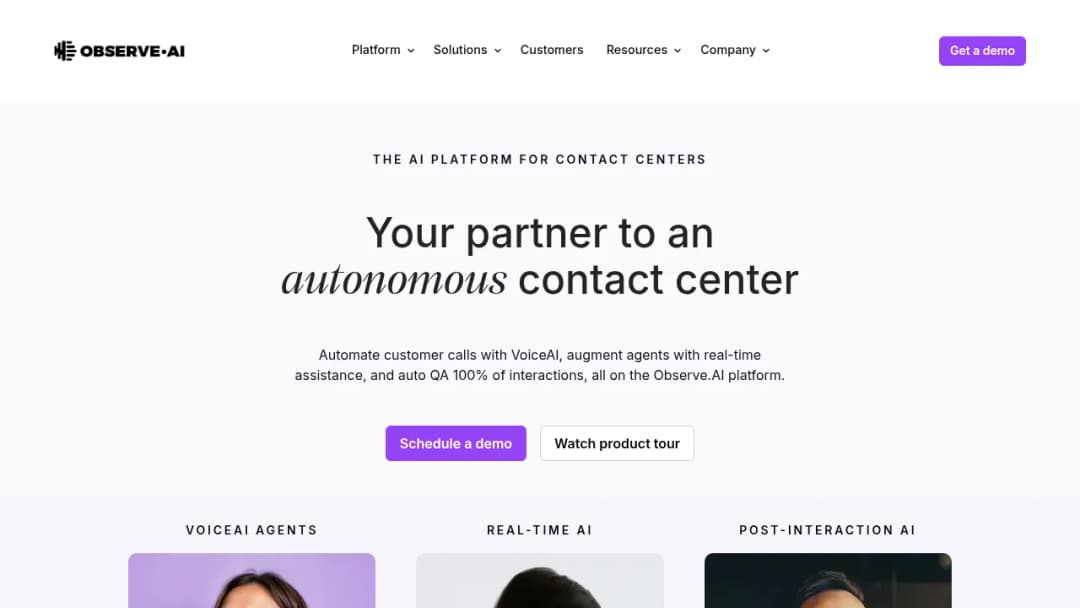
    Observe.AI screenshot
    FirmCompareTractionAnalysisAdvocates

    Insights

    All insightsAccountingFinanceSoftwareCustomer experience

    Benchmarks

    The Software LeaderboardMethodology

    Tools & data

    Market ExplorerStudioRegistry

    Company

    AboutCareers

    Legal

    Privacy PolicyTerms of Service

    © 2026 Airframe, Inc. All rights reserved.

      Published Oct 22, 2026

      01Common complaints

      - Company sizes or stages where this product is overkill or insufficient - Overkill for small teams that primarily need basic call recording and lightweight QA sampling. - Potentially insufficient if an organization requires a full CCaaS replacement (routing, telephony, WFM) rather than an overlay analytics and assistance platform. - Industries or use cases where competitors are more appropriate - If the highest priority is mature compliance analytics and long-standing speech analytics heritage, buyers may prefer other vendors focused on compliance or analytics-first capabilities. - If a buyer needs an integrated CCaaS + WEM + AI suite from one vendor for procurement simplicity, incumbent platform vendors may be preferred. - Technical requirements that this product may not meet - If an organization requires clearly documented regional-only data residency and the vendor cannot confirm available options for the mandated geography. - If on-premise or fully offline deployment is required (no public indication of full on-prem options in public materials). - Budget constraints that make alternatives more appropriate - If budgets do not support enterprise licensing and implementation, consider lighter helpdesk/contact-center tools or CCaaS-native analytics. - Specific workflows or integrations where the product falls short - If bi-directional write-back automation into multiple backend systems is essential, buyers should validate integration depth; connector listing alone does not guarantee full workflow automation. - Red flags in the buying process - No publicly stated free trial; pricing is sales-led and requires contact for a demo and quoting, which can slow evaluation. - Current limitations acknowledged by the vendor - The vendor provides guidance on structured workflows and tuning for accuracy and compliance but does not publish an exhaustive public list of limitations. - Features on the roadmap (not yet available) - note estimated dates if available - No clear public roadmap dates were found in the retrieved sources. - Scale limitations (at what volume/size does it break down?) - No explicit public limits were identified. Real-time use cases for agent assist and voice automation will depend on deployment architecture, latency requirements, and integration robustness. - Security or compliance gaps - Certifications are claimed (SOC 2 Type II, ISO 27001, HITRUST r2, PCI Level 1) but buyers should verify: - Scope of certification (which services and environments are covered) - Subprocessor list and data flow diagrams - Data retention and deletion SLAs - Model training and data usage policies for customer data - Technical debt or architectural limitations mentioned in reviews - Reviews emphasize configuration complexity rather than explicit architectural design flaws in public commentary. - API limitations or integration constraints - Integration depth varies by connector. Buyers should validate: - Whether integrations support bi-directional workflows and write-back automation - Whether real-time agent assist embeds cleanly into the agent desktop for the target CCaaS - Limits on event ingestion, retention, and export APIs
      Deal disqualifiers: what makes a POOR fit

      • Small contact centers that cannot justify integration overhead or enterprise-oriented deployment
      • Organizations that require fully transparent, self-serve pricing and immediate trial access
      • Use cases requiring extremely precise detection without tolerance for false positives in specific detection categories

      Why some customers left for competitors (churn reasons)

      • Public, product-specific churn narratives were limited in accessible sources.
      • Inferred churn drivers from negative reviews include perceived low ROI relative to cost and accuracy limitations that required manual rework.

      02Why they buy

      - Competitive advantages validated by customer feedback (not just vendor claims) - Reviews commonly highlight usability of workflows for QA and coaching and the ability to scale QA coverage as operational benefits. - Some reviewers rate the platform favorably for administrative and deployment workflows compared with certain legacy incumbents. - Unique features and capabilities competitors lack (observed or claimed) - The vendor frames its platform as a multi-agent ecosystem (customer-facing agents, frontline agent assistance, and operations agents) that share context and workflows; independent validation of distinctiveness should be confirmed in comparative evaluations. - Differentiation from competitors based on reviews - Relative ease of administration and focus on operational coaching workflows are common themes in reviews comparing Observe.AI to heavier legacy analytics vendors. - Areas where competitors clearly have advantages - Incumbent suite vendors provide integrated CCaaS + workforce engagement management and may simplify procurement for buyers seeking an all-in-one stack. - Other vendors may offer deeper scoring, transcription accuracy, or compliance tooling for specific regulated environments.

      Why customers chose this product over alternatives

      • Based on review summaries and comparisons, likely reasons include:
        • Comparatively favorable ease-of-use and administrative workflows versus some legacy speech analytics vendors.
        • Coaching and QA workflows and real-time agent assistance.
        • Integration coverage with common CCaaS/CRM platforms.

      03Field reports

      Important note on source ambiguity

      • A naming collision exists between Observe.AI and an unrelated observability vendor named "Observe"; a Gartner product page for the unrelated vendor was surfaced during searches and should not be treated as Observe.AI reviews.

      G2 (examples)

      - Positive (G2 review, early 2026): "Observe.AI treats customer conversations as a data asset—turning insights into coaching and performance improvements teams can act on right away, not just dashboards to look at." (user-submitted review) - Mixed/negative (same reviewer): "Some features can feel complex at first, and it takes time to fully learn and configure the platform to get the most value out of it." (user-submitted review) - Critical (G2 snippet visible in page content): a reviewer wrote that after an extended period they did not realize expected value; the excerpt suggests a strong negative ROI experience and should be read in full on G2 for context. - Another mixed example (G2 review, late 2025) reported false positives in moment detection and limited built-in recommendations after themes are surfaced.

      Reddit (limited product-specific user review content found)

      • A telecom subreddit comment (post removed, excerpt captured) stated: "We’re using Observe.AI - but it’s mostly allowing our QA team process more calls than they used to." This suggests observed value centered on QA throughput rather than end-to-end automation in that instance.
      • Many other Reddit hits were unrelated (naming collisions, job posts, or other mentions) and were not clearly product reviews.

      TrustRadius / HackerNews

      • Direct TrustRadius review pages for Observe.AI were not reliably accessible in the retrieved results. A TrustRadius comparison page exists but did not include detailed user narratives in the retrieved snippets.
      • No clear, substantive product discussion threads were found on HackerNews in the retrieved results.

      Balance: examples of high and low ratings (themes)

      - Positive themes (commonly reported) - Reviewers commonly note the UI and workflows for coaching and QA as helpful for operationalizing conversational insights. - Integration breadth is frequently listed (connectors for CCaaS/CRM tools such as Genesys, Five9, RingCentral, Zoom Contact Center, Salesforce, Zendesk, etc.). - Negative themes (commonly reported) - Setup/configuration complexity and time-to-value uncertainty. - Accuracy concerns in sentiment/moment detection and reported false positives. - At least one reviewer described a poor ROI experience over an extended period.

      Common criticisms and complaints (support issues, bugs, missing features)

      • Accuracy issues: multiple reviews and aggregated reviewer tags indicate recurring concerns about accuracy in certain detection categories.
      • Setup complexity: multiple reviews mention a learning curve and non-trivial configuration.
      • Missing features: some reviews and aggregator tags note missing functionality relative to specific buyer requirements.

      Specific outcomes customers achieved (with metrics when available)

      • The vendor publishes outcomes such as reductions in average handle time (AHT) and operational efficiency improvements; these are vendor-published figures and do not include independent methodology in publicly accessible materials.

      Deal-breakers and reasons customers didn't purchase

      • Likely deal-breakers based on review themes and enterprise evaluation dynamics:
        • Sales-led custom pricing without public transparency.
        • Data privacy/compliance requirements that mandate detailed review of security documentation.
        • Limitations in detection accuracy for specific languages, accents, or domain-specific terminology.

      Detailed customer success stories with metrics

      - The vendor publishes case studies and testimonials naming customers such as SoFi, DoorDash, Asurion, and Woodforest National Bank. These marketing case studies indicate vendor-reported outcomes but do not provide independent validation of scope or methodology. - Vendor-published quantified impacts (e.g., AHT reduction, operational efficiency, revenue uplift, adoption percentages) are presented without detailed methodology in public materials and should be validated in buyer reference checks and pilot programs.

      Implementation details and time to value

      • Vendor materials state some customers have moved from setup to production in a short timeframe; aggregated reviewer data on public review sites suggests typical implementations may average a few months depending on integrations and customization.

      Challenges faced during adoption and how they were resolved

      • Public case studies with detailed failure‑mode narratives were not prominent in the retrieved sources.
      • Common adoption challenges inferred from reviews include model tuning, taxonomy development for QA categories, change management for supervisors and frontline agents, and integration testing for CCaaS/CRM write‑backs.

      Note when metrics are vendor-published without independent verification

      • The vendor's claims about customer counts and percentage impacts are vendor‑published and lack transparent third‑party verification in the publicly retrievable materials. Buyers should validate impact claims in pilots and reference checks.

      04Best fit

      Company sizes: specific employee counts and revenue ranges

      • Likely best fit:
        • Mid-market to enterprise organizations
        • Organizations with sizable contact center seat counts (third-party commentary sometimes suggests lower minimums, but this is not vendor-confirmed)
        • Companies above a mid-market revenue threshold are more likely to achieve measurable ROI; stronger fit often seen in larger enterprises where compliance and QA scale pressures are significant

      Industries and verticals where adoption is strongest (with customer examples)

      • Financial services and banking (vendor references Woodforest National Bank)
      • Fintech (vendor references SoFi)
      • Healthcare (vendor references HIPAA-relevant use cases)
      • Insurance and high-volume consumer services (vendor references DoorDash, Asurion)

      Roles and personas: decision makers AND end users

      • Decision makers
        • VP/Head of Customer Experience
        • Contact Center Operations leaders
        • QA/Compliance leadership
        • CIO/CTO and Security/Procurement for compliance review
      • End users
        • QA analysts and supervisors
        • Coaches/trainers
        • Frontline agents (for agent assist guidance)

      Pain points and challenges the product addresses

      • Low QA sampling rates and manual QA workflows
      • Inconsistent coaching and compliance adherence
      • Long handle times and limited visibility into common friction points across channels

      Qualification criteria: what makes a GREAT fit

      • High interaction volumes where broader conversation analysis materially improves QA and coaching coverage
      • An internal operations team capable of configuring and tuning taxonomies, scorecards, and workflows
      • Clear compliance requirements and desire for auditability
      • Existing CCaaS/CRM stack where the product can be deployed as an overlay for analytics and agent assist

      Real customer examples with company names when available

      • Vendor-referenced customers include SoFi, DoorDash, Asurion, Woodforest National Bank, Transcarent, and Verida.

      05The pitch

      What the product does (core value proposition in objective terms)

      - Observe.AI describes its platform as an "Agentic CX Platform" and states it uses AI agents to automate and assist in customer interactions and to support operational analytics for voice and chat channels. The vendor presents three agent categories: - AI Agents for Customers (automated end-to-end interaction resolution across voice/chat, including authentication and execution) - AI Agents for Frontline Teams (real-time guidance with contextual information, next-best actions, and automated actions) - AI Agents for Operations (evaluation, coaching generation, and surfacing insights to inform operational decisions) - The vendor also describes capabilities in interaction analytics and performance management, including analysis of a large portion of conversations and operational reporting.

      Target market and market positioning

      • Target buyers appear to be mid-market to enterprise contact centers (including regulated industries), with emphasis on customer service operations, quality assurance (QA), coaching, compliance, and automation of agent and operational workflows.
      • The vendor highlights vertical solutions such as banking/financial services, healthcare (provider/payer), insurance, transportation, travel & hospitality, and utilities.

      Get a comprehensive analysis of Observe.AI including market position, competitive landscape, adoption trends, and peer benchmarks.

      Download full report →
      • Company sizes or stages where this product is overkill or insufficient

        • Overkill for small teams that primarily need basic call recording and lightweight QA sampling.
        • Potentially insufficient if an organization requires a full CCaaS replacement (routing, telephony, WFM) rather than an overlay analytics and assistance platform.
      • Industries or use cases where competitors are more appropriate

        • If the highest priority is mature compliance analytics and long-standing speech analytics heritage, buyers may prefer other vendors focused on compliance or analytics-first capabilities.
        • If a buyer needs an integrated CCaaS + WEM + AI suite from one vendor for procurement simplicity, incumbent platform vendors may be preferred.
      • Technical requirements that this product may not meet

        • If an organization requires clearly documented regional-only data residency and the vendor cannot confirm available options for the mandated geography.
        • If on-premise or fully offline deployment is required (no public indication of full on-prem options in public materials).
      • Budget constraints that make alternatives more appropriate

        • If budgets do not support enterprise licensing and implementation, consider lighter helpdesk/contact-center tools or CCaaS-native analytics.
      • Specific workflows or integrations where the product falls short

        • If bi-directional write-back automation into multiple backend systems is essential, buyers should validate integration depth; connector listing alone does not guarantee full workflow automation.
      • Red flags in the buying process

        • No publicly stated free trial; pricing is sales-led and requires contact for a demo and quoting, which can slow evaluation.
      • Current limitations acknowledged by the vendor

        • The vendor provides guidance on structured workflows and tuning for accuracy and compliance but does not publish an exhaustive public list of limitations.
      • Features on the roadmap (not yet available) - note estimated dates if available

        • No clear public roadmap dates were found in the retrieved sources.
      • Scale limitations (at what volume/size does it break down?)

        • No explicit public limits were identified. Real-time use cases for agent assist and voice automation will depend on deployment architecture, latency requirements, and integration robustness.
      • Security or compliance gaps

        • Certifications are claimed (SOC 2 Type II, ISO 27001, HITRUST r2, PCI Level 1) but buyers should verify:
          • Scope of certification (which services and environments are covered)
          • Subprocessor list and data flow diagrams
          • Data retention and deletion SLAs
          • Model training and data usage policies for customer data
      • Technical debt or architectural limitations mentioned in reviews

        • Reviews emphasize configuration complexity rather than explicit architectural design flaws in public commentary.
      • API limitations or integration constraints

        • Integration depth varies by connector. Buyers should validate:
          • Whether integrations support bi-directional workflows and write-back automation
          • Whether real-time agent assist embeds cleanly into the agent desktop for the target CCaaS
          • Limits on event ingestion, retention, and export APIs
      • Competitive advantages validated by customer feedback (not just vendor claims)

        • Reviews commonly highlight usability of workflows for QA and coaching and the ability to scale QA coverage as operational benefits.
        • Some reviewers rate the platform favorably for administrative and deployment workflows compared with certain legacy incumbents.
      • Unique features and capabilities competitors lack (observed or claimed)

        • The vendor frames its platform as a multi-agent ecosystem (customer-facing agents, frontline agent assistance, and operations agents) that share context and workflows; independent validation of distinctiveness should be confirmed in comparative evaluations.
      • Differentiation from competitors based on reviews

        • Relative ease of administration and focus on operational coaching workflows are common themes in reviews comparing Observe.AI to heavier legacy analytics vendors.
      • Areas where competitors clearly have advantages

        • Incumbent suite vendors provide integrated CCaaS + workforce engagement management and may simplify procurement for buyers seeking an all-in-one stack.
        • Other vendors may offer deeper scoring, transcription accuracy, or compliance tooling for specific regulated environments.
      • Positive (G2 review, early 2026): "Observe.AI treats customer conversations as a data asset—turning insights into coaching and performance improvements teams can act on right away, not just dashboards to look at." (user-submitted review)
      • Mixed/negative (same reviewer): "Some features can feel complex at first, and it takes time to fully learn and configure the platform to get the most value out of it." (user-submitted review)
      • Critical (G2 snippet visible in page content): a reviewer wrote that after an extended period they did not realize expected value; the excerpt suggests a strong negative ROI experience and should be read in full on G2 for context.
      • Another mixed example (G2 review, late 2025) reported false positives in moment detection and limited built-in recommendations after themes are surfaced.
      • Positive themes (commonly reported)
        • Reviewers commonly note the UI and workflows for coaching and QA as helpful for operationalizing conversational insights.
        • Integration breadth is frequently listed (connectors for CCaaS/CRM tools such as Genesys, Five9, RingCentral, Zoom Contact Center, Salesforce, Zendesk, etc.).
      • Negative themes (commonly reported)
        • Setup/configuration complexity and time-to-value uncertainty.
        • Accuracy concerns in sentiment/moment detection and reported false positives.
        • At least one reviewer described a poor ROI experience over an extended period.
      • The vendor publishes case studies and testimonials naming customers such as SoFi, DoorDash, Asurion, and Woodforest National Bank. These marketing case studies indicate vendor-reported outcomes but do not provide independent validation of scope or methodology.
      • Vendor-published quantified impacts (e.g., AHT reduction, operational efficiency, revenue uplift, adoption percentages) are presented without detailed methodology in public materials and should be validated in buyer reference checks and pilot programs.
      • Observe.AI describes its platform as an "Agentic CX Platform" and states it uses AI agents to automate and assist in customer interactions and to support operational analytics for voice and chat channels. The vendor presents three agent categories:
        • AI Agents for Customers (automated end-to-end interaction resolution across voice/chat, including authentication and execution)
        • AI Agents for Frontline Teams (real-time guidance with contextual information, next-best actions, and automated actions)
        • AI Agents for Operations (evaluation, coaching generation, and surfacing insights to inform operational decisions)
      • The vendor also describes capabilities in interaction analytics and performance management, including analysis of a large portion of conversations and operational reporting.

      How it compares

      • Customer Support AI market report

        Top vendors: Gorgias, Intercom, Minimal AI, Glia, LivePerson.