Published May 19, 2026
Vendor materials list additional agents and features as planned, such as Next Best Action Agent, Meeting Agent, and Reply Agent. Procurement should confirm current availability and edition-specific access during vendor evaluation.
Because the AI Agents branding is relatively new, most third-party reviews reference Outreach as a platform rather than each agent specifically. Platform-level reviews remain relevant because AI Agents are integrated into the same product experience (user interface, integrations, reliability, and support).
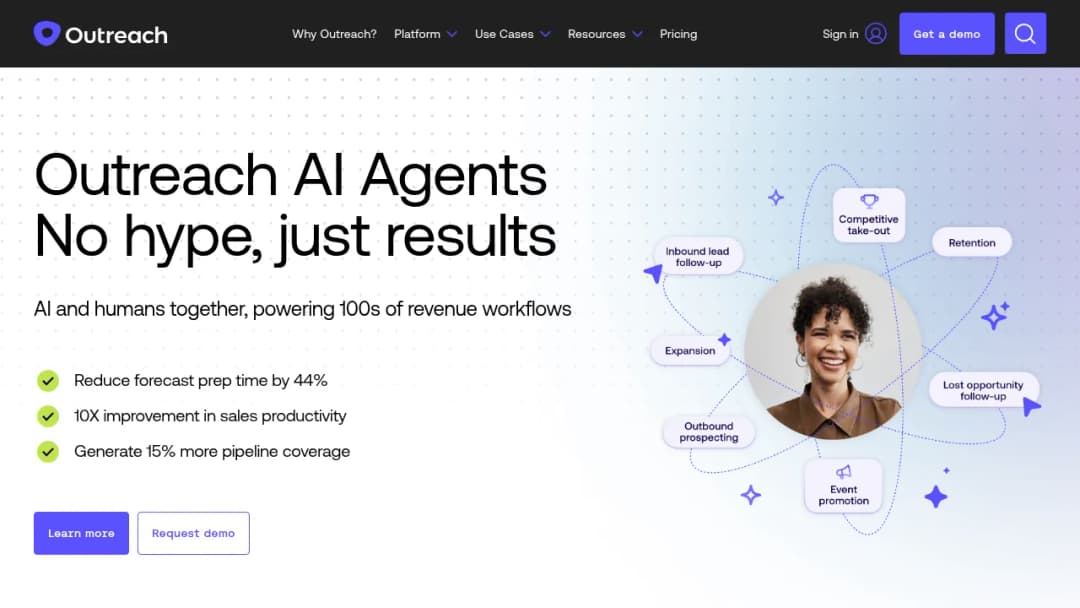
Vendor materials list outcome claims such as reductions in forecast preparation time and increases in productivity and pipeline coverage.
Critical evaluation:
Common verticals with a good fit include:
Decision makers:
Get a comprehensive analysis of Outreach AI Agents including market position, competitive landscape, adoption trends, and peer benchmarks.
Download full report →Requirement for transparent pricing and a low-friction trial. Outreach typically requires engagement with sales for pricing and may not offer a free trial according to third-party listings.
Lack of internal enablement resources. Implementation commonly requires process alignment and enablement; without internal champions, adoption may stall.
Low tolerance for platform performance issues. Reports of intermittent glitches and slow loading should be validated in a pilot if the organization cannot tolerate such issues.
Weak CRM data hygiene and concerns about automated writebacks. Documented cases show that incorrect data changes in Outreach can synchronize to Salesforce; automated updates increase this operational risk.
Primary use case focused on low-cost prospecting database plus sequences. Tools with transparent self-serve pricing may offer better value for strictly prospecting-focused teams.
Tight deliverability constraints. Systems that scale outbound messaging require deliverability governance; organizations with strict enterprise filtering or compliance requirements should pilot deliverability controls and domain configurations.
Implications:
A case study published by a GRC vendor describes Outreach’s use of a governance and compliance tool and reports metrics such as a substantial reduction in audit preparation time and evidence collection effort.
Critical evaluation:
Outreach AI Agents are a suite of AI-enabled agents embedded in the Outreach sales engagement / revenue workflow platform. They are intended to automate and assist repetitive revenue workflows across prospecting, account research, personalization, calling, and deal execution—using a mix of first-party engagement data (emails, calls, meetings), CRM data, and third-party/public web data.
Outreach positions the agents as preconfigured, workflow-native automation designed to reduce time spent on research and administrative tasks and increase time in customer-facing activities. Vendor materials include outcome-oriented claims such as reductions in forecast preparation time, significant seller productivity gains, and increases in pipeline coverage; those claims are presented without public methodology or independent verification.
Key agent families and related capabilities mentioned by Outreach: