Workspace
    • Briefing
    • Ask Airframe
    Transformation
    • Audit
    Your Stack
    • Registry
    • Finance
    • Context
    Discover
    Powered by Airframe
    1. Research
    2. /
    3. Products
    4. /
    5. Promena
    Promena

    Promena

    Procure the Future
    Est 2001|30 Ref Customers
    LinkedIn 4K|Website|Web traffic 37K|FTEs 5|HQ Üsküdar, Istanbul, TR
    MarketsSource-to-PaySource-to-ContractProcure-to-PayeSourcing
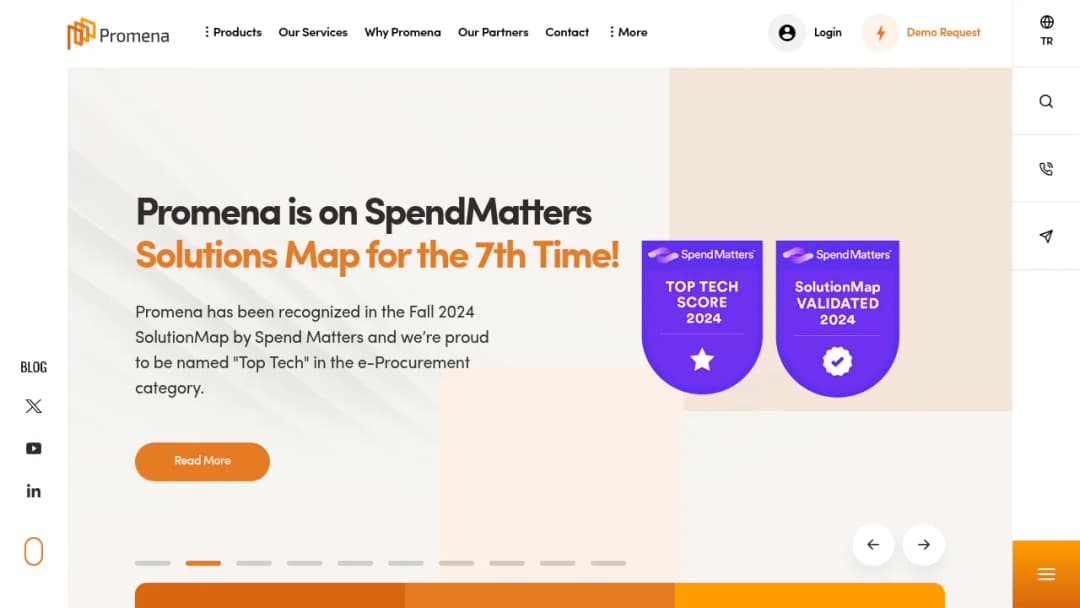
    Promena screenshot
    FirmCompareTractionAnalysisAdvocates

    Insights

    All insightsAccountingFinanceSoftwareCustomer experience

    Benchmarks

    The Software LeaderboardMethodology

    Tools & data

    Market ExplorerStudioRegistry

    Company

    AboutCareers

    Legal

    Privacy PolicyTerms of Service

    © 2026 Airframe, Inc. All rights reserved.

      Published Oct 15, 2026

      01Common complaints

      Consider alternatives when: 1) The organization requires publicly available enterprise-grade security attestations (SOC 2 Type II, ISO 27001) and will not proceed without them. 2) Advanced dashboards and executive-level analytics are a primary requirement; review feedback indicates analytics visualization may require customization or external BI tooling. 3) A mature, documented integration/API strategy is required for deep automation across ERP/MDM/AP systems; third-party listings suggest limited public API information and this should be validated directly with the vendor. 4) A complete source-to-pay suite including native invoicing, AP automation, and payment processing is required; other vendors may provide broader native coverage. 5) The buyer is a very small organization seeking a lightweight purchasing tool with rapid time-to-value; some SMB-focused tools may be more appropriate. Buying-process red flags to verify during evaluation: - unclear boundaries between platform licensing and managed services, - lack of clarity on module pricing and what is included in a baseline package, - incomplete SLA and support scope information across regions.

      Deal disqualifiers (poor fit)

      • Organizations that require publicly documented SOC 2/ISO certifications and a formal trust center before procurement.
      • Organizations that require a documented API ecosystem as a precondition for purchase.
      • Buyers that require full AP automation and payments natively in the core product.

      Known limitations from user feedback and public listings

      • Dashboards/reporting visualization: multiple reviews identify limitations in dashboarding and visualization features.
      • API availability: a GetApp Q&A entry lists Promena as not having an API; buyers should validate current API/ integration options directly with the vendor, as access can be plan-dependent.

      Vendor-acknowledged roadmap / changes

      • The vendor announced a new interface scheduled live July 1, 2024, described as an update to navigation, onboarding, and supplier experience.

      Security/compliance transparency gap

      • Public materials reviewed do not document SOC 2/ISO certifications, data residency statements, or a detailed enterprise security controls matrix.

      02Why they buy

      Validated or partially validated by reviews and vendor materials: - Usability signals: multiple reviewers describe the product as straightforward for event participants. - Transparency and traceability: process logs and auditable tendering/auction workflows are emphasized in vendor materials and reviewer feedback. - Operational service options: vendor materials describe services such as tender modeling and supplier commissioning as available. Claims requiring validation during diligence: - Vendor-stated efficiency or ROI figures and scale metrics (for example, auction counts and transaction volumes). - Any solution claims referencing AI-enhanced capabilities should be validated for methodology and scope. Areas where competitors may have clearer strengths: deeper S2P coverage, more mature analytics, and more extensive public security documentation.

      Why customers chose Promena (inferred from reviews)

      Common reasons, inferred from reviewer comments and vendor materials, include:

      • Transparent and auditable supplier bidding and auction processes.
      • Time savings versus manual bid collection workflows.
      • Ease of use reported for both buyer and supplier participants.
      • Responsive support as reported in some reviews.
      Areas where competitors may have clearer strengths: deeper S2P coverage, more mature analytics, and more extensive public security documentation.
      Key Differentiator

      03Field reports

      Review volume and distribution (important context)

      - Capterra: listings show reviews with an overall reported rating that is skewed toward positive ratings. - G2: limited review volume with positive ratings; some entries are labeled vendor-referred or incentivized. - Gartner Peer Insights: a small number of ratings appear in e-sourcing-related listings. Interpretation caution: The review dataset is modest in size and displays a strong positive skew. A low volume of critical reviews may reflect limited review coverage, selection bias, or vendor-referred submissions.

      Positive feedback themes (with direct quotes)

      Reviewer-sourced comments appearing on public review platforms include phrases such as: - "Reliable fast and efficient procurement." (G2 reviewer) - "Save time with promena software." (G2 reviewer) - "we have been able to manage our procurement processes more transparently and efficiently." (G2 reviewer) - "Highly satisfied, easy to use and intuitive with great variety of features." (Capterra reviewer) - "User friendly interfaces and strong customer support" (Capterra reviewer) - "With Promena, a user-friendly, easily understandable and fast software, we save both time and money." (Capterra reviewer) Vendor-published testimonials on Promena’s site include statements such as: - "Our experience has been wonderful… attractive user interface… great value for money…" - "The software functions well and has delivered the required value… excellent reporting and audit trail… Bidders have found the software to be stable and easy to use." Reviewer quotes and vendor-published testimonials should be interpreted as subjective feedback. They document perceived benefits and experiences but do not substitute for independent verification.

      Negative/critical feedback themes (with direct quotes)

      A recurring critique in public reviews is limited analytics visualization and dashboards: - "The lack of dashboards on this software is a major problem." (Capterra review) - "Their reporting can be better… it would be useful… to prepare and share reports that will highlight the visuality." (Capterra review) These comments suggest the platform may be functional for running tenders/auctions while requiring additional work or external tools for executive-ready visual analytics.

      Why some customers might leave / churn (limited evidence)

      Public sources provide limited direct evidence of churn. Plausible drivers for migration include:

      • A need for more advanced dashboards and analytics.
      • A requirement for broader source-to-pay coverage (for example, invoicing, payments, or AP automation).
      • Enterprise-level requirements for publicly documented security certifications and trust-center materials.

      Vendor-published success stories (examples)

      Vendor-published customer success materials reference customers across retail, hospitality, insurance, and energy sectors. These items highlight outcomes such as improved efficiency, transparency, and supplier competitiveness.

      Critical evaluation: These are vendor-published materials. Methodology, baselines, and measurement approaches are not disclosed in the vendor materials cited.

      Quantified outcomes found in reviews

      A reviewer described a hospital procurement use case and reported measurable cost benefits per e-auction event.

      Critical evaluation: This is a user-submitted review and not a controlled study. Savings attribution is complex and may reflect multiple market and sourcing factors beyond software capabilities.

      Independent analyst perspective (limited)

      An industry blog describes Promena as a mid-market source-to-contract player and notes workflow capabilities (RFx, auctions, contract indexing) and some functional limitations (for example, contract handling requiring manual signature processes in the write-up). This content is independent commentary but not a formal analyst report.

      04Best fit

      Company sizes (practical estimate)

      • Mid-market to enterprise.
      • Procurement maturity: organizations that run frequent RFQs/tenders and require auditable sourcing and structured supplier competition.

      Industries / verticals

      Signals indicate use in:

      • Energy / Oil & Gas
      • Manufacturing / industrial
      • Retail
      • Banking / financial services
      • Healthcare procurement

      Roles and personas

      • Decision makers: CPO / Head of Procurement / Procurement Transformation / Finance leadership.
      • Admins/power users: strategic sourcing managers, category managers, procurement operations.
      • Occasional users: requesters and approvers.
      • External users: suppliers participating in RFx/e-auctions.

      Pain points Promena addresses

      • Manual or slow tendering and bid collection processes.
      • Need for transparency and auditability in supplier negotiations.
      • Requirement to expand supplier access and generate competitive supplier engagement.
      • Standardizing approval workflows and order processes via e-procurement features.

      Qualification criteria (good fit)

      • Frequent RFx events and reverse auctions.
      • Supplier participation usability is a priority.
      • A modular platform with optional operational services is acceptable.
      • Organizations that can accept additional work for advanced analytics or BI integration.

      05The pitch

      What the product does (objective value proposition)

      Promena is a modular procurement and supplier solutions platform focused on upstream and midstream procurement workflows, particularly e-sourcing (RFx) and e-auctions, with adjacent modules such as supplier relationship management (SRM), contract management, and e-procurement (requisitions/approvals/orders/catalog). The platform digitizes tendering and quotation processes and standardizes procurement workflows; it provides audit trails and reporting. Core functional areas Promena lists: - Sourcing (RFx + e-auctions): supports RFI/RFQ workflows and multiple auction formats, plus bid comparison and event logs. - e-Procurement: requisition, approvals, purchase order management, and catalogs with budget-controlled workflows. - SRM: supplier onboarding/registration and supplier data/performance/risk tracking (including vendor-led messaging; third-party review sites also reference vendor management use cases). - Contract Management: centralized tracking/filing and contract risk tracking.

      Target market and positioning

      Promena is positioned for mid-market to enterprise procurement use cases, with a user base that includes organizations in Türkiye and activity in EMEA/Europe. Its functional footprint aligns with source-to-contract (S2C) workflows plus some e-procurement capabilities. Typical buyer profiles include organizations that run frequent competitive bidding and large tender volumes (industrial, energy, retail, banking, and healthcare procurement teams). Review-platform evidence shows usage across company sizes, including large enterprises and mid-market organizations.

      Get a comprehensive analysis of Promena including market position, competitive landscape, adoption trends, and peer benchmarks.

      Download full report →

      Consider alternatives when:

      1. The organization requires publicly available enterprise-grade security attestations (SOC 2 Type II, ISO 27001) and will not proceed without them.
      2. Advanced dashboards and executive-level analytics are a primary requirement; review feedback indicates analytics visualization may require customization or external BI tooling.
      3. A mature, documented integration/API strategy is required for deep automation across ERP/MDM/AP systems; third-party listings suggest limited public API information and this should be validated directly with the vendor.
      4. A complete source-to-pay suite including native invoicing, AP automation, and payment processing is required; other vendors may provide broader native coverage.
      5. The buyer is a very small organization seeking a lightweight purchasing tool with rapid time-to-value; some SMB-focused tools may be more appropriate.

      Buying-process red flags to verify during evaluation:

      • unclear boundaries between platform licensing and managed services,
      • lack of clarity on module pricing and what is included in a baseline package,
      • incomplete SLA and support scope information across regions.

      Validated or partially validated by reviews and vendor materials:

      • Usability signals: multiple reviewers describe the product as straightforward for event participants.
      • Transparency and traceability: process logs and auditable tendering/auction workflows are emphasized in vendor materials and reviewer feedback.
      • Operational service options: vendor materials describe services such as tender modeling and supplier commissioning as available.

      Claims requiring validation during diligence:

      • Vendor-stated efficiency or ROI figures and scale metrics (for example, auction counts and transaction volumes).
      • Any solution claims referencing AI-enhanced capabilities should be validated for methodology and scope.

      Areas where competitors may have clearer strengths: deeper S2P coverage, more mature analytics, and more extensive public security documentation.

      • Capterra: listings show reviews with an overall reported rating that is skewed toward positive ratings.
      • G2: limited review volume with positive ratings; some entries are labeled vendor-referred or incentivized.
      • Gartner Peer Insights: a small number of ratings appear in e-sourcing-related listings.

      Interpretation caution: The review dataset is modest in size and displays a strong positive skew. A low volume of critical reviews may reflect limited review coverage, selection bias, or vendor-referred submissions.

      Reviewer-sourced comments appearing on public review platforms include phrases such as:

      • "Reliable fast and efficient procurement." (G2 reviewer)
      • "Save time with promena software." (G2 reviewer)
      • "we have been able to manage our procurement processes more transparently and efficiently." (G2 reviewer)
      • "Highly satisfied, easy to use and intuitive with great variety of features." (Capterra reviewer)
      • "User friendly interfaces and strong customer support" (Capterra reviewer)
      • "With Promena, a user-friendly, easily understandable and fast software, we save both time and money." (Capterra reviewer)

      Vendor-published testimonials on Promena’s site include statements such as:

      • "Our experience has been wonderful… attractive user interface… great value for money…"
      • "The software functions well and has delivered the required value… excellent reporting and audit trail… Bidders have found the software to be stable and easy to use."

      Reviewer quotes and vendor-published testimonials should be interpreted as subjective feedback. They document perceived benefits and experiences but do not substitute for independent verification.

      A recurring critique in public reviews is limited analytics visualization and dashboards:

      • "The lack of dashboards on this software is a major problem." (Capterra review)
      • "Their reporting can be better… it would be useful… to prepare and share reports that will highlight the visuality." (Capterra review)

      These comments suggest the platform may be functional for running tenders/auctions while requiring additional work or external tools for executive-ready visual analytics.

      Promena is a modular procurement and supplier solutions platform focused on upstream and midstream procurement workflows, particularly e-sourcing (RFx) and e-auctions, with adjacent modules such as supplier relationship management (SRM), contract management, and e-procurement (requisitions/approvals/orders/catalog). The platform digitizes tendering and quotation processes and standardizes procurement workflows; it provides audit trails and reporting.

      Core functional areas Promena lists:

      • Sourcing (RFx + e-auctions): supports RFI/RFQ workflows and multiple auction formats, plus bid comparison and event logs.
      • e-Procurement: requisition, approvals, purchase order management, and catalogs with budget-controlled workflows.
      • SRM: supplier onboarding/registration and supplier data/performance/risk tracking (including vendor-led messaging; third-party review sites also reference vendor management use cases).
      • Contract Management: centralized tracking/filing and contract risk tracking.

      Promena is positioned for mid-market to enterprise procurement use cases, with a user base that includes organizations in Türkiye and activity in EMEA/Europe. Its functional footprint aligns with source-to-contract (S2C) workflows plus some e-procurement capabilities. Typical buyer profiles include organizations that run frequent competitive bidding and large tender volumes (industrial, energy, retail, banking, and healthcare procurement teams).

      Review-platform evidence shows usage across company sizes, including large enterprises and mid-market organizations.