- What the product does (core value proposition in objective terms)
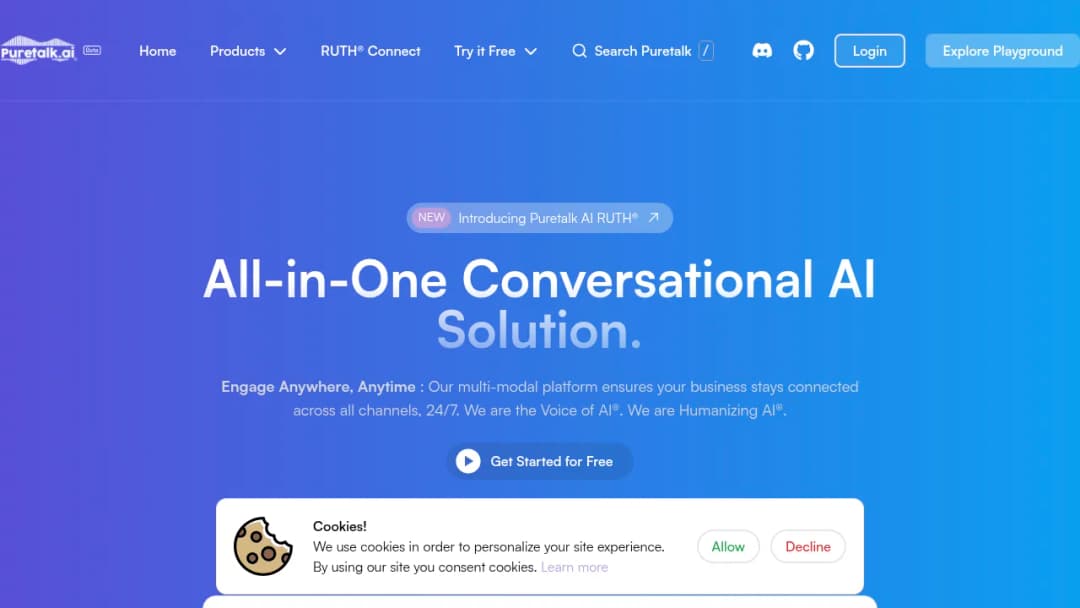
- Puretalk AI describes itself as a conversational AI platform for building and deploying voice agents and chatbots across channels (phone, web, SMS). The platform provides an API-first approach and a low/no-code agent builder. The vendor states the platform is designed to produce interactions the vendor characterizes as "human-like" and "empathetic" using its RUTH engine; these are vendor claims and were treated as such in this research.
- Key product lines/pages referenced by the vendor include:
- RUTH AI Assistant (builder and a trial workflow)
- RUTH Connect (API endpoints for telephony and integrations)
- Text-to-Speech product page that documents available voices, languages, and API/WebSocket integration options
- Target market and market positioning
- Target customers appear to be SMB, midmarket, and enterprise buyers seeking voice and chat automation for inbound calls, customer service, scheduling, lead qualification, and outbound call campaigns.
- Vertical marketing is present for healthcare, which indicates the vendor is targeting regulated-industry use cases.
- Company background (founding year, HQ, key leadership)
- Public third-party company databases provide inconsistent information. One dataset-style profile reports:
- Founded: early 2020s (database-reported)
- Location: Orlando, Florida, United States
- Team: reported as a small, single-digit headcount in that dataset
- Funding: no funding reported in that dataset
- A third-party interview references a Chief Product Officer (named in the interview) and lists a location for that individual; this is an interview/article source rather than an official corporate filing.
- Puretalk AI’s LinkedIn company page lists focus areas (conversational AI, voice cloning, TTS, RUTH product family) but does not independently confirm founding year or audited corporate facts.
- Funding and growth: investment rounds, acquisitions, estimated customer count/revenue if public
- A commercial database reports modest revenue for a recent year and reports no outside funding; this information is database-compiled and not independently audited.
- No acquisition history was identified in accessible sources for this research.
- Pricing model with specific tiers and costs where available
- The vendor’s documentation contains a "Pricing" page but it does not list specific tiers or prices; it functions as a placeholder that directs readers to contact the vendor.
- Marketing pages reference trial and free-plan options as well as a monthly subscription model, but no public rate cards or unit pricing were found.
- Practical implication: procurement will likely require direct engagement with the vendor to obtain detailed unit economics (e.g., telephony minutes, STT/TTS usage, LLM inference costs, platform fees).
- Total cost of ownership considerations (implementation, training, hidden costs)
- Typical cost drivers for a voice-agent platform (not always visible on vendor pricing pages) include:
- Telephony (DID numbers, minutes, outbound calling costs)
- Speech-to-text and text-to-speech usage
- LLM inference usage (token costs), tool calls, and retrieval/knowledge base synchronization
- Human QA, prompt/flow tuning, analytics, and ongoing monitoring and maintenance
- Puretalk’s documentation shows API endpoints for connecting phone numbers and lists integrations, which implies developer involvement for production-grade deployment even if a low-code/no-code builder is available.
- Key competitors in the space (list 4-6 direct alternatives)
- Retell AI (voice agents, usage-based pricing model)
- Vapi (voice agent infrastructure/developer platform)
- CloudTalk (business calling platform with AI voice agent use cases)
- Intercom (customer support automation; category-adjacent)
- Zendesk (support automation; category-adjacent)
- Synthflow / Bland AI (discussed in voice-agent communities)