Workspace
    • Briefing
    • Ask Airframe
    Transformation
    • Audit
    Your Stack
    • Registry
    • Finance
    • Context
    Discover
    Powered by Airframe
    1. Research
    2. /
    3. Products
    4. /
    5. Quantified AI
    Quantified AI

    Quantified AI

    AI Roleplay that Wins
    Est 2012|Raised $550K|39 Ref Customers
    LinkedIn 7K|Web traffic 2K|FTEs 40|HQ Austin, Texas, US
    MarketsSales Training & Learning Management Systems (LMS)Rep Coaching Platforms
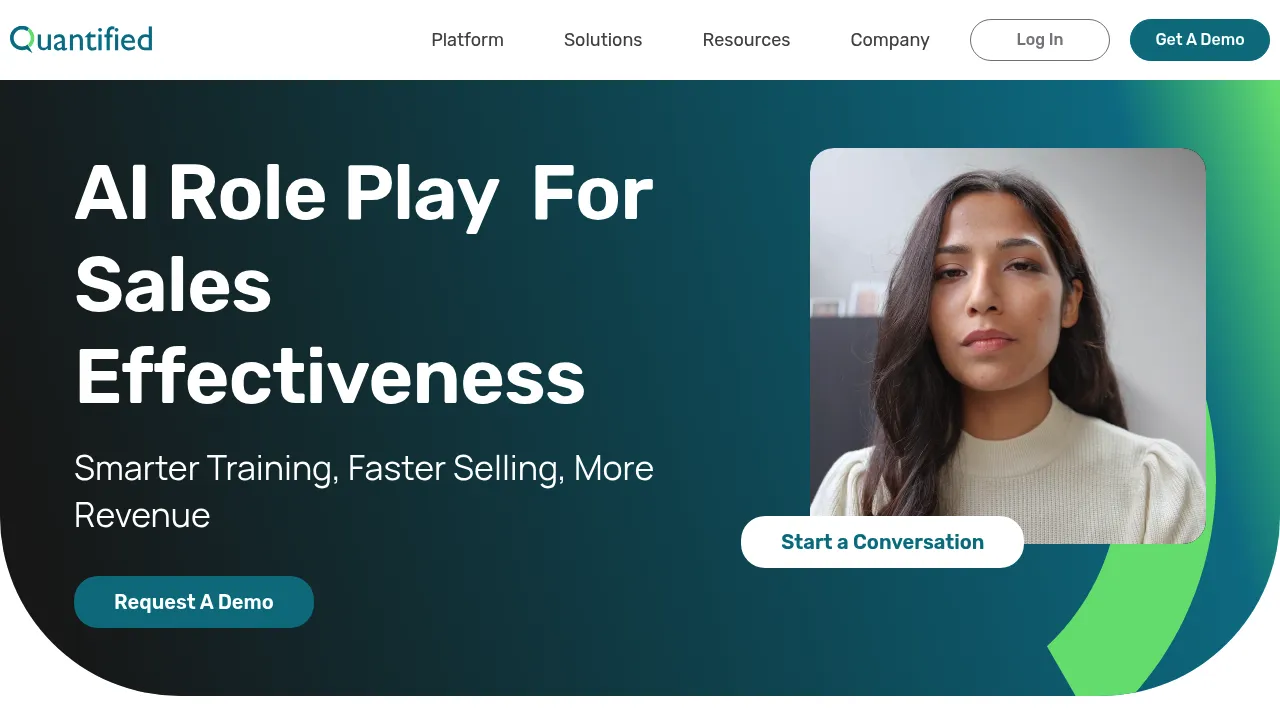
    Quantified AI screenshot
    FirmCompareTractionAnalysisAdvocates

    Insights

    All insightsAccountingFinanceSoftwareCustomer experience

    Benchmarks

    The Software LeaderboardMethodology

    Tools & data

    Market ExplorerStudioRegistry

    Company

    AboutCareers

    Legal

    Privacy PolicyTerms of Service

    © 2026 Airframe, Inc. All rights reserved.

      Published Oct 15, 2026

      01Common complaints

      - An organization requires instant, minimal-setup value: If the organization cannot invest in scenario building, rubric governance, and enablement operations, adoption may stall. - An organization needs roleplay embedded directly into Zoom or Teams as the primary workflow: Some customers report a preference for tighter meeting-platform integration rather than a separate application. - The requirement is a broad enablement suite (content, learning paths, gamification, and coaching workflows in one platform): Competitors offering wider readiness suites may be a better fit. - The use case is low-regulation and informal: Lighter-weight AI roleplay tools may provide adequate results with lower cost and faster experimentation. - Security and compliance evidence must be fully verified upfront: If an independently completed SOC 2 Type II report or other certifications are required prior to engagement, confirm current status via vendor documentation and auditor letters because public pages contain mixed phrasing.

      Deal disqualifiers (poor fit)

      • Very small teams seeking self-serve pricing and minimal setup
      • Organizations unwilling to allocate enablement resources to build and maintain scenarios
      • Buyers requiring publicly posted pricing, self-serve onboarding, or a consumer-style product-led experience

      Limitations acknowledged by users and reviewers

      • Conversation branching and dynamic dialogue depth may be limited relative to human roleplayers.
      • Objection handling practice capabilities are an area of user-requested improvement.
      • Adoption and engagement can be low without process alignment and manager involvement.

      Vendor-acknowledged constraints

      • Public messaging about SOC 2 Type II appears inconsistent; the vendor describes both an ongoing audit and an attestation in different places. Buyers should request current audit documentation.

      Roadmap visibility

      No clear public product roadmap with dated milestones was found in the reviewed sources.

      02Why they buy

      Differentiators supported by sources

      • Positioning for regulated industries with compliance-related scoring, audit trails, and certification workflows (based on vendor materials and product pages).
      • Emphasis on roleplay simulations designed to resemble typical field interactions (vendor materials and testimonials reference realism).
      • Customization and vendor responsiveness cited in multiple customer reviews and testimonials.

      Where competitors may have an edge

      • Gamification and a broader enablement suite: Some competitors are perceived to offer stronger gamification and end-to-end readiness functionality.
      • Product-led trial experiences: Some competitors emphasize sample or trial roleplays to lower evaluation friction.

      03Field reports

      Review platform evidence (G2)

      Quantified AI has an active G2 presence with a mix of positive feedback and criticisms. Positive themes (examples from G2 reviews): - Customizability and vendor support: Reviewers noted the product can be configured to match needs and the vendor provided implementation support. - On-demand practice increases learner engagement: Some reviewers reported that learners practiced more due to on-demand availability and the ability to reflect without direct observation. - Responsiveness to modifications: Several reviews described the vendor team as responsive and willing to incorporate requested features. Negative or critical themes (examples from G2 reviews): - Limited conversational branching: Reviewers noted the avatar may not support conversations that can go many directions, which is a common limitation across the category. - Objection handling depth: Some reviewers requested improved capabilities for practicing objection handling. - Adoption and engagement over time: Some reviews reported that sustained engagement can be low if the tool is not integrated into workflows, and suggested tighter integrations with tools like Teams/Zoom. - Usability and support concerns: At least one review described the platform as not user-friendly and criticized support availability. - Transparency concerns: Some reviewers asked for more detailed explanations of AI models and algorithms, indicating trust questions about reliability.

      Community / social proof on the vendor site

      The vendor site includes curated testimonials from customers, for example comments from a lending technology stakeholder and quotes from training managers at large enterprise clients.

      Caution: Website testimonials are vendor-curated and do not represent the full distribution of customer sentiment.

      Reasons cited for selecting Quantified (as implied by reviews and positioning)

      Common selection factors include:

      • Compliance readiness (audit trails, approved messaging/rubrics)
      • Ability to scale training for large field teams without requiring managers to perform repeated live roleplays
      • Consistency and speed in certification and onboarding processes
      • Simulated interactions that align with real-world scenarios

      Reasons for potential churn (inferred)

      Potential churn drivers suggested by reviews and competitor comparisons include:

      • Low adoption if managers and learners do not integrate the tool into regular workflows
      • Integration gaps (preference for embedded feedback in existing meeting platforms)
      • Feature gaps (e.g., objection handling, deeper analytics, or gamification)
      • Scenario setup burden (effort required to build scenarios and rubrics before realizing value)

      Vendor-published case study (large pharmaceutical client)

      The vendor reports a large pharmaceutical client used AI simulations to accelerate onboarding and certification: - Reported outcome: assessment scores improved according to vendor materials - Business problem: accelerate onboarding and certification without pulling field leaders into assessments - Quoted stakeholder: a training manager at the client described close collaboration on custom rubrics and rollout support Critical evaluation: - These metrics are vendor-published; the methodology (baseline, sample size, statistical controls) is not fully visible in the summary materials. - "Improved assessment scores" may measure performance within the vendor system and may not directly indicate real-world selling effectiveness without further validation.

      Other case studies listed by the vendor

      The vendor publishes additional case studies with other enterprise clients. Buyers should request full case study documents and validate:

      • Whether improvements are self-reported
      • Whether results reflect pilot cohorts or full deployments
      • Whether outcomes are leading indicators (practice volume, certification speed) or lagging indicators (quota attainment, win rate)

      04Best fit

      Company size

      • Best fit: Mid-market to enterprise organizations with large customer-facing teams where instructor-led roleplay is operationally expensive.

      Industries / verticals

      Most aligned:

      • Life Sciences / Pharma commercial organizations (HCP conversations, MLR-approved language, certification)
      • Financial Services (objection handling, regulated product messaging)
      • Insurance
      • Global enterprise sales organizations where messaging consistency is important

      Roles and personas

      Decision makers:

      • VP/Director of Sales Enablement
      • Head of Commercial Excellence (Life Sciences)
      • L&D leadership
      • Compliance / Legal / Regulatory stakeholders in regulated organizations
      • IT/Security for vendor risk management

      End users:

      • Sales representatives and account managers
      • Front-line sales managers and coaches
      • Trainers and enablement program owners

      Pain points addressed

      • Inconsistent roleplay quality and limited manager bandwidth
      • Slow onboarding and certification cycles
      • Compliance and audit-readiness gaps
      • Difficulty measuring representative readiness at scale

      Qualification criteria (good fit)

      • Need to certify large groups quickly with consistent scoring
      • High value on audit trails and compliance guardrails
      • Willingness to invest in scenario and rubric design plus rollout change management

      05The pitch

      What the product does (objective value proposition)

      Quantified AI is an AI roleplay and simulation platform for training, coaching, and certifying customer-facing teams (particularly sales) through simulated practice conversations. The vendor positions the product for enterprise use in regulated industries, emphasizing compliance, repeatable certification, and readiness analytics rather than practice without measurable outcomes. In practical terms, Quantified provides: - On-demand practice via simulated conversations (for example, HCP interactions in pharma and objection handling in financial services) - Objective scoring using rubrics and competencies for consistent evaluation - Certification workflows with transcripts, timestamps, and scoring designed to support audits - Analytics for managers to coach on representative performance and readiness

      Target market and positioning

      Quantified primarily targets:

      • Enterprise and upper mid-market organizations
      • Regulated, compliance-heavy industries (life sciences/pharma, financial services, insurance)
      • Sales enablement, L&D, and commercial excellence leaders responsible for onboarding, product launch readiness, and compliance certification

      The vendor’s marketing highlights AI-driven roleplay for life sciences, finance, insurance, and global organizations.

      Get a comprehensive analysis of Quantified AI including market position, competitive landscape, adoption trends, and peer benchmarks.

      Download full report →
      • An organization requires instant, minimal-setup value: If the organization cannot invest in scenario building, rubric governance, and enablement operations, adoption may stall.
      • An organization needs roleplay embedded directly into Zoom or Teams as the primary workflow: Some customers report a preference for tighter meeting-platform integration rather than a separate application.
      • The requirement is a broad enablement suite (content, learning paths, gamification, and coaching workflows in one platform): Competitors offering wider readiness suites may be a better fit.
      • The use case is low-regulation and informal: Lighter-weight AI roleplay tools may provide adequate results with lower cost and faster experimentation.
      • Security and compliance evidence must be fully verified upfront: If an independently completed SOC 2 Type II report or other certifications are required prior to engagement, confirm current status via vendor documentation and auditor letters because public pages contain mixed phrasing.

      Quantified AI has an active G2 presence with a mix of positive feedback and criticisms.

      Positive themes (examples from G2 reviews):

      • Customizability and vendor support: Reviewers noted the product can be configured to match needs and the vendor provided implementation support.
      • On-demand practice increases learner engagement: Some reviewers reported that learners practiced more due to on-demand availability and the ability to reflect without direct observation.
      • Responsiveness to modifications: Several reviews described the vendor team as responsive and willing to incorporate requested features.

      Negative or critical themes (examples from G2 reviews):

      • Limited conversational branching: Reviewers noted the avatar may not support conversations that can go many directions, which is a common limitation across the category.
      • Objection handling depth: Some reviewers requested improved capabilities for practicing objection handling.
      • Adoption and engagement over time: Some reviews reported that sustained engagement can be low if the tool is not integrated into workflows, and suggested tighter integrations with tools like Teams/Zoom.
      • Usability and support concerns: At least one review described the platform as not user-friendly and criticized support availability.
      • Transparency concerns: Some reviewers asked for more detailed explanations of AI models and algorithms, indicating trust questions about reliability.

      The vendor reports a large pharmaceutical client used AI simulations to accelerate onboarding and certification:

      • Reported outcome: assessment scores improved according to vendor materials
      • Business problem: accelerate onboarding and certification without pulling field leaders into assessments
      • Quoted stakeholder: a training manager at the client described close collaboration on custom rubrics and rollout support

      Critical evaluation:

      • These metrics are vendor-published; the methodology (baseline, sample size, statistical controls) is not fully visible in the summary materials.
      • "Improved assessment scores" may measure performance within the vendor system and may not directly indicate real-world selling effectiveness without further validation.

      Quantified AI is an AI roleplay and simulation platform for training, coaching, and certifying customer-facing teams (particularly sales) through simulated practice conversations. The vendor positions the product for enterprise use in regulated industries, emphasizing compliance, repeatable certification, and readiness analytics rather than practice without measurable outcomes.

      In practical terms, Quantified provides:

      • On-demand practice via simulated conversations (for example, HCP interactions in pharma and objection handling in financial services)
      • Objective scoring using rubrics and competencies for consistent evaluation
      • Certification workflows with transcripts, timestamps, and scoring designed to support audits
      • Analytics for managers to coach on representative performance and readiness