- What the product does (core value proposition in objective terms)
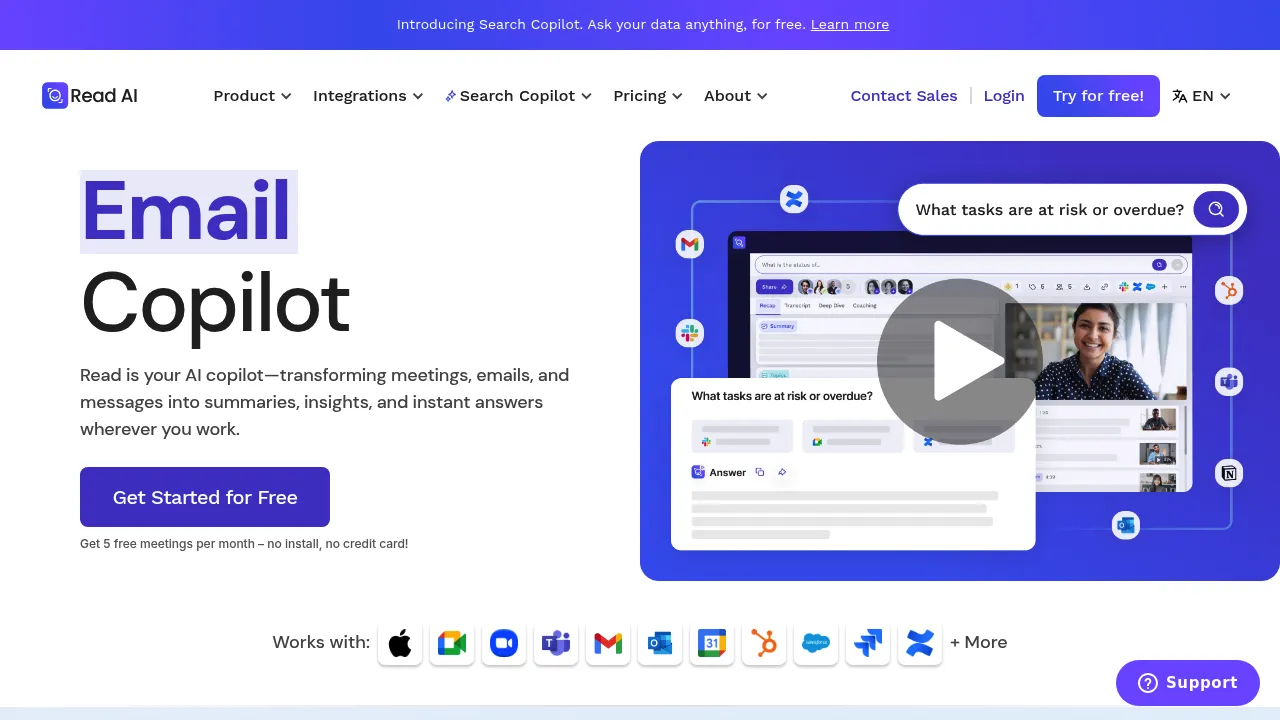
- Read AI positions itself as an “AI copilot” focused on meeting capture (joining calls or recording audio), transcription, summaries, insights, and follow-on workflows across meetings, email, and messages. It also markets cross-platform “enterprise search” / “Search Copilot” over meeting and connected-work-app content.
- A newer product direction is “Digital Twin” (Ada), an email-based assistant that can help schedule meetings, draft/reply to emails, and answer questions using connected context.
- Target market and market positioning
- Primary: knowledge workers and teams who run frequent meetings and want automated notes + action items.
- Secondary: IT and operations stakeholders who need governance controls around meeting capture, sharing, retention, and permissions.
- Read positions itself against meeting assistants like Otter, Fireflies, and others by emphasizing cross-tool context (email + meetings + integrations) and “privacy-first” framing.
- Company background (founding year, HQ, key leadership)
- Founded: 2021.
- Headquarters: Seattle, Washington (vendor-stated).
- Founders/leadership: CEO David Shim; co-founders Robert Williams and Elliott Waldron (vendor-stated).
- Funding and growth
- Funding (press-reported): TechCrunch reported (Feb 26, 2026) that Read AI “has raised over $81 million” (figure attributed in the article). This is not independently validated in this report beyond TechCrunch’s reporting.
- Usage (press-reported): TechCrunch reported Read AI claimed “over 5 million monthly active users” and “50,000 sign-ups every day” around the Digital Twin launch (Feb 26, 2026). These are vendor-claimed metrics reported by media; methodology is not disclosed.
- VentureBeat (2024) reported Read AI raised $21M and included additional growth claims (e.g., “12x increase in monthly active users” and “15x increase in recorded meetings”), attributed to the CEO.
- Pricing model with specific tiers and costs where available
- Read AI’s official site indicates multiple plans and a free tier, but the research crawl did not reliably capture the full official tier table in-text.
- Third-party pricing roundups commonly cite:
- Free plan (limited meetings).
- Pro: around $19.75/user/month (monthly) with lower annual effective rate.
- Enterprise: around $29.75/user/month (monthly) with lower annual effective rate.
- Enterprise+: around $39.75/user/month with a minimum seat requirement (often cited as 10-user minimum).
- TrustRadius lists “Starting at $19.75 per user per month” for Read AI.
- Note: Because third-party pricing pages can drift from official pricing, buyers should verify current pricing directly on read.ai.
- Total cost of ownership (TCO) considerations
- Implementation / rollout
- End-user onboarding can be lightweight for individuals, but organizational deployment can be non-trivial due to identity, permissions, bot behavior, and meeting/tenant controls.
- Admin time may be required to define policy, user education, meeting-host guidance (admit/deny bots), and incident response for “uninvited bot” scenarios.
- Training & change management
- Teams often need norms around consent, confidentiality, distribution of summaries, and internal vs external meetings.
- Hidden/indirect costs frequently mentioned in community discussions
- Time spent removing/blocking bots from meetings, dealing with auto-emails to attendees, and clarifying whether users inadvertently granted permissions.
- Risk management overhead (privacy reviews, legal review, DPA negotiation) for regulated meetings.
- Key competitors in the space (4–6 direct alternatives)
- Otter.ai
- Fireflies.ai
- Fathom
- Microsoft Teams Premium / Copilot (native ecosystem option)
- Zoom AI Companion (native ecosystem option)
- Circleback (competitor with strong marketing against Read; claims should be scrutinized)