#### Publicly stated strengths
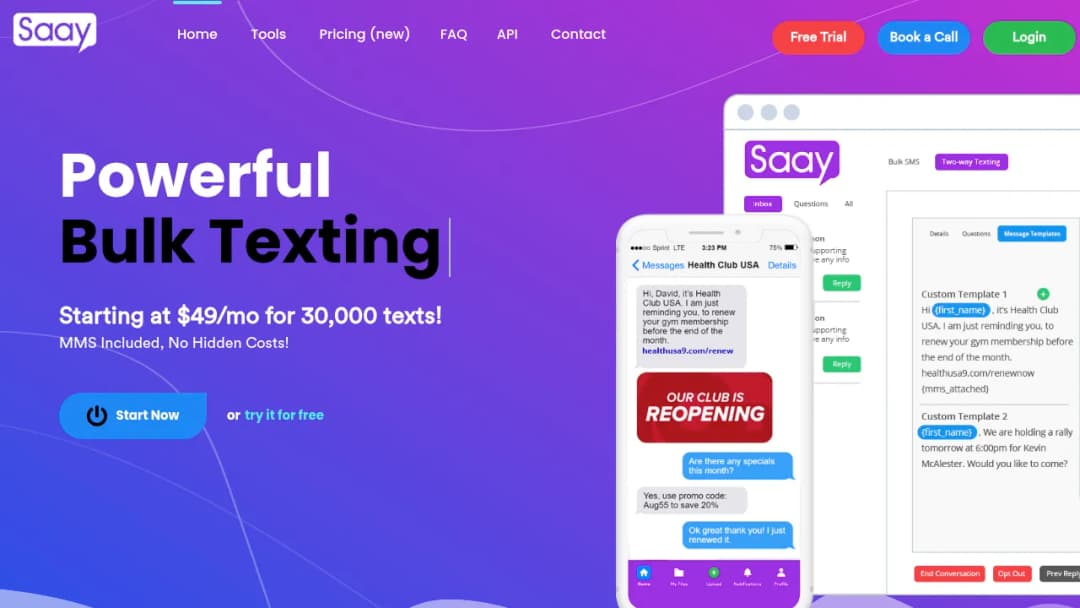
- Saay’s public pricing indicates a low per-message cost at the bundle level.
- Saay provides detailed compliance documentation and a list of restricted words and categories.
- Saay combines bulk and P2P capabilities in a single offering, per vendor materials.
#### Areas where competitors may offer advantages
- Trust and transparency: More established vendors often have larger public review footprints, clearer security/compliance documentation, and more predictable enterprise procurement.
- Ecommerce-focused automation: Vendors oriented to ecommerce (e.g., Postscript) typically offer deeper lifecycle automations and attribution.
- Developer flexibility and scale: Twilio provides granular control and global scale, albeit with development overhead.
- Feature maturity: Other SMB vendors often have more extensive onboarding materials, documented support SLAs, and broader marketing automation features.
#### Pricing context
- Saay: published bundle pricing suggests low unit economics, with stated overage pricing for exceeding daily caps.
- SimpleTexting/SlickText/EZ Texting: entry tiers typically provide modest monthly message volumes at low monthly prices, rather than tens of thousands of messages.
- TextMagic: pay-as-you-go pricing can be higher per SMS in the US compared with bundle-based vendors.
- Postscript: pricing typically includes per-message fees and platform tiers, optimized for ecommerce merchants.
Summary: Saay competes primarily on unit economics as presented on public pages, while mainstream platforms compete on feature depth, support, and public trust indicators.