Workspace
    • Briefing
    • Ask Airframe
    Transformation
    • Audit
    Your Stack
    • Registry
    • Finance
    • Context
    Discover
    Powered by Airframe
    1. Research
    2. /
    3. Products
    4. /
    5. Sana
    Sana

    Sana

    Leader

    Superintelligence for work

    Est 2016|Valuation $1.1B|Raised $139.9M|58 Ref Customers
    LinkedIn 99K|Web traffic 172K|FTEs 250|HQ Stockholm, 01, SE
    MarketsLearning Management System (LMS)Agent Builder Platforms
    Platform CoversCustomer Education & EnablementKnowledge ManagementAI Assistant
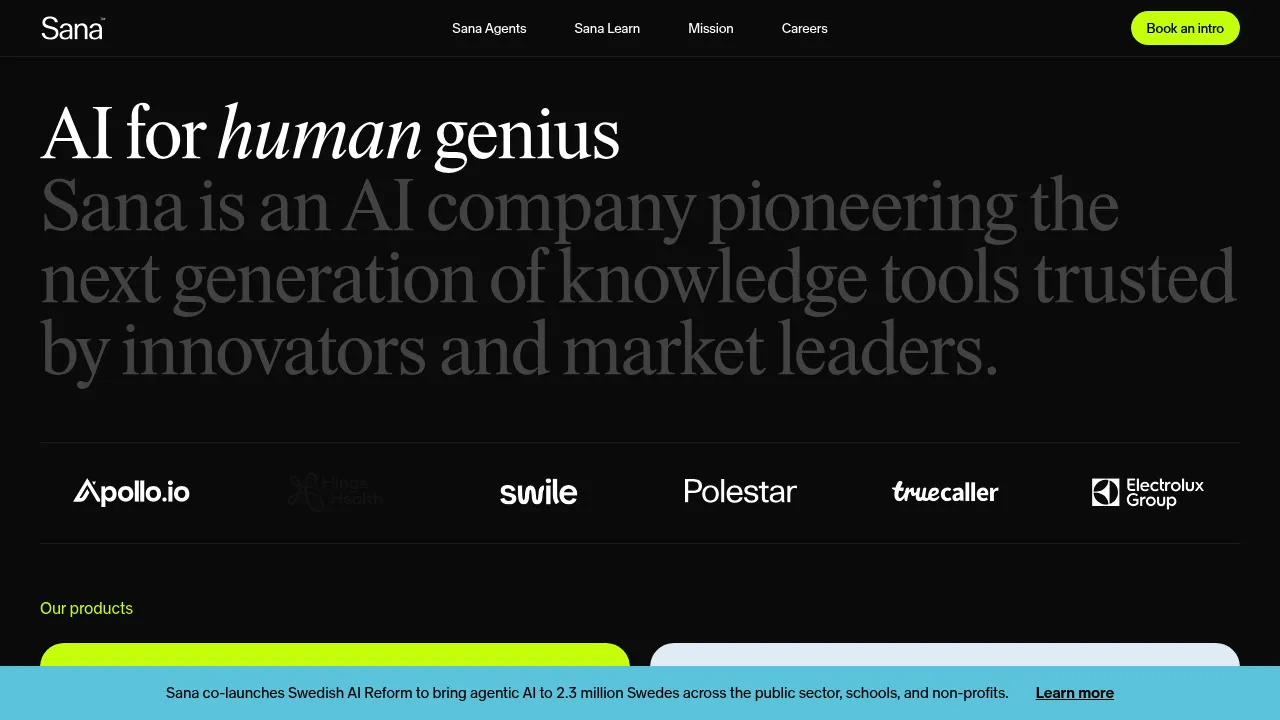
    Sana screenshot
    FirmCompareTractionAnalysisAdvocates

    Insights

    All insightsAccountingFinanceSoftwareCustomer experience

    Benchmarks

    The Software LeaderboardMethodology

    Tools & data

    Market ExplorerStudioRegistry

    Company

    AboutCareers

    Legal

    Privacy PolicyTerms of Service

    © 2026 Airframe, Inc. All rights reserved.

      Published Oct 23, 2026

      01Common complaints

      - Company sizes or stages where this product is overkill or insufficient - Very small teams without requirements for cross-application integrations or governance may find the implementation overhead outweighs benefits, even if entry-level tiers are available. - Industries or use cases where competitors are more appropriate - Highly regulated training and compliance environments that depend on deep, legacy-LMS compliance workflows may prefer older LMS vendors that provide those specific, mature capabilities. - Technical requirements that the product may not meet - If independently verifiable security artifacts (public audit reports) are required without vendor engagement, the publicly available documentation may be insufficient; a formal security review and NDA-based documentation request is recommended. - Budget constraints that make alternatives more appropriate - If the vendor's packaging or marketplace entitlements introduce additional entitlements or credits, organizations should compare the incremental cost against incumbent productivity-suite copilots or other horizontal assistants. - Specific workflows or integrations where the product may not be the best fit - If the primary system of action is ServiceNow for ITSM, a native ITSM automation solution may provide deeper integration and less custom work. - Red flags in the buying process - Organizations should avoid commitments that do not include a defined pilot, success criteria, and documented SLA terms. Procurement and legal reviews should validate SKU inclusion and entitlements in marketplace offerings. - Current limitations acknowledged by the vendor - The vendor's public materials do not include a dedicated limitations page; most public messaging focuses on capabilities. - Features on the roadmap (not yet available) - Public analyst coverage and vendor communications indicate ongoing expansion of use-case coverage, including ITSM and other workflow areas; dates and general availability timelines should be validated with the vendor. - Scale limitations - Public documentation does not disclose precise scale boundaries; organizations with very large-scale ingestion or throughput requirements should validate performance and rate-limiting behavior with the vendor. - Security or compliance gaps - Publicly available certification artifacts and scope were not located in this research. Purchasers should request SOC 2, ISO 27001, and any other relevant certification documentation during security review. - Technical debt or architectural limitations mentioned in reviews - No widely reported technical debt items were identified in the public community discussions accessible to this research team. - API limitations or integration constraints - The vendor advertises a large number of integrations and a client SDK for custom work. Community signals suggest some integration capabilities may be gated by specific SKUs or marketplace packaging; purchasers should verify connector coverage, rate limits, and supported write-actions for target systems.

      Deal disqualifiers: what makes a poor fit

      • Organizations seeking fully public, independently verifiable certification artifacts without engaging the vendor
      • L&D teams that require mature, legacy-LMS style authoring and standards workflows without validation
      • Organizations unable to allocate resources for data governance and content quality improvements

      Why some customers left for competitors (churn reasons)

      • No comprehensive churn narratives were located in public sources for this research. Practitioner critiques about fit for mature production teams indicate a possible driver for churn if those requirements are not met.

      02Why they buy

      - Capabilities and customer-reported strengths - Public review excerpts and vendor material emphasize usability in onboarding and a simplified learner experience in some deployments. - Features and capabilities that differentiate the product - The vendor describes flexibility to select different language models and offers tooling for building custom integrations; purchasers should validate model selection constraints and integration maturity during technical evaluation. - Differentiation from competitors based on available review evidence - The accessible review evidence highlights interface usability and perceived improvements in onboarding and content navigation more than deep admin or compliance features. - Areas where competitors have advantages - Major platform vendors have deep distribution within their productivity suites and may be more cost-effective for organizations already committed to those ecosystems. - Established LMS vendors often provide more comprehensive compliance and certification tracking workflows.

      Why customers chose this product over alternatives

      • Based on vendor messaging and review excerpts: integrated search, combined learning and authoring capabilities, and a focus on reducing authoring time and improving onboarding experience.

      03Field reports

      Direct quotes from platforms and community discussions

      #### Gartner Peer Insights - Listings for this vendor were not accessible in the research environment (Gartner Peer Insights often requires authentication). Searches also returned results for unrelated companies named "Sana" (different vendors), which can cause confusion. #### G2 (vendor seller page / Sana Learn reviews) - Public G2 listings show a high overall rating based on user reviews; several reviews visible in this research include statements that praise usability and onboarding. Some reviews are labeled as "Seller invite" or incentivized, which can bias review distributions. - Example excerpts visible on G2 include: - "Very user-friendly and straightforward. It really helped me during my onboarding process and made everything feel simpler." (labeled as a validated reviewer and incentivized in some listings) - "The lessons are very easy to follow and track your progress." (labeled as a validated reviewer) - Context: many vendor-affiliated reviews can skew toward positive sentiment; these should be treated as directional evidence about user experience rather than definitive proof of outcomes. #### Reddit (corporate learning / LMS) - Community posts include mixed perspectives. Some participants describe the product as promising for content building and interactivity, while one practitioner offered a strongly negative assessment for organizations with experienced eLearning teams: "Do not recommend if you employ training professionals/eLearning builders. If you have those in place, please look elsewhere." This reflects that practitioner's view and suggests validation against detailed authoring requirements is warranted. #### Reddit (Workday ecosystem) - Community threads discuss packaging, cost, and perceived accuracy. Comments reference contracting complexity (credits and SKUs), questions about answer accuracy, and concerns about how the product is being packaged within the Workday ecosystem. These signals reflect post-acquisition product and go-to-market considerations. #### HackerNews - No clearly relevant public discussion threads for this vendor were located in the accessible search results for this research.

      Common criticisms and complaints (support issues, bugs, missing features)

      #### LMS/learning-side criticism (community) - Some practitioner comments suggest the platform may not meet the needs of established eLearning production teams that expect mature SCORM/xAPI tooling and specialized workflows. #### Workday/Sana ecosystem criticism (community) - Common themes include concerns about answer accuracy (hallucination risk), contracting complexity related to credits and SKUs, and uncertainty about product boundaries following acquisition.

      Specific outcomes customers achieved (with metrics when available)

      • The vendor publishes anonymized customer impact metrics such as time savings and faster access to information. Examples include vendor-published claims of time saved and faster information access for specific customer cases; methodologies and baselines are not disclosed in public sources.

      Case Studies

      - Detailed customer success stories with metrics - The vendor publishes customer logos and at least one named testimonial quote from an L&D leader. Vendor-published case examples include quantifications such as time savings and reductions in preparation time for specific customers; these are anonymized in many instances. - Specific results and quantified business impact - Reported metrics are presented on vendor pages. These metrics were not independently verified in this research; methodologies and baselines are not publicly disclosed. - Implementation details and time to value - Detailed implementation timelines and technical steps are not publicly documented in accessible sources. - Challenges faced during adoption and how they were resolved - Public documentation on adoption challenges is limited. Community threads suggest accuracy and packaging are notable adoption factors in some deployments. - Critical note on vendor-published metrics - All quantitative outcomes in the public material reviewed for this report are vendor-published or acquirer-published and were not independently audited as part of this analysis.

      04Best fit

      Company sizes: specific employee counts and revenue ranges

      • Best fit appears to be mid-market to enterprise organizations, particularly those needing to integrate multiple SaaS systems and centralized HR/finance systems.
      • Organizations with existing investments in Workday may find tighter integration and packaged experiences especially relevant.

      Industries and verticals where adoption is strongest (with customer examples)

      • Public marketing materials and logo placement suggest adoption across technology platforms, consumer brands, manufacturing, and professional services.
      • Vendor-cited examples reference firms in technology, finance, manufacturing, and professional services. Public logos are indicative but not definitive proof of production scope.

      Roles and personas: decision makers AND end users

      - Sana Agents - Decision makers: CIO / Head of IT; Head of Operations; HRIS / Workday product owners; Security/Compliance leaders - End users: HR, Finance, IT service teams, operations, and knowledge workers who need cross-application search and drafting/analysis assistance - Sana Learn - Decision makers: Head of L&D; HR leadership; enablement leaders (sales enablement, customer education) - End users: Learners across the organization; course creators, admins, and group managers

      Pain points and challenges the product addresses

      • Dispersed knowledge across many tools making it difficult to find authoritative answers
      • Manual effort in drafting, reporting, and repetitive processes
      • Slow content creation and inconsistent onboarding/training experiences

      Qualification criteria: what makes a good fit

      • An organization with appetite for AI adoption and willingness to invest in governance and change management
      • A SaaS stack that benefits from cross-application retrieval and action triggers
      • Enterprises using Workday where tighter coupling to HR/finance workflows is a priority

      Real customer examples with company names when available

      • The vendor references customers and partners in public materials; examples include firms cited on marketing pages. Logos and testimonial placement should be validated for scope and production usage during procurement.

      05The pitch

      - What the product does (core value proposition in objective terms) - Sana describes its offering as an enterprise AI platform (Sana) paired with a learning platform (Sana Learn). The vendor frames the combined offering as tools to search organizational knowledge, generate content, and automate workflows using large language models and associated tooling. - Sana (enterprise AI platform) - Core functional pillars described by the vendor - Find: Search and retrieval of company knowledge across connected sources - Act: Execute actions and automate tasks across integrated applications - Build: Generate documents, analyses, and dashboards with AI-assisted authoring - Automate: Configure and run multi-step workflows - Product packaging visible on the vendor site includes an "Agents" concept and an iOS app for mobile access. - Sana Learn (learning platform) - Described as combining LMS, LXP, authoring, and virtual classroom capabilities. - Core functional pillars described by the vendor - Create: Build learning content with AI assistance - Learn: Provide AI-based tutoring/assistance for learners - Manage: Administrative automation - Analyze: Analytics and insights - Target market and market positioning - Sana Agents / Sana platform - Positioned as an enterprise AI layer that integrates across workplace applications and data sources, oriented toward knowledge retrieval, execution of tasks within systems, and workflow automation. - The public pricing page indicates availability of both self-serve (Free/Team) and Enterprise engagements. - Sana Learn - Positioned primarily for enterprise learning and development (L&D) and corporate training organizations seeking to modernize training and content creation with AI-enabled features. - Company background (founding year, HQ, key leadership) - Founding year - 2016 (as shown on vendor profiles and referenced in acquisition communications). - Locations / HQ indicators - Public profiles list Stockholm, Sweden as a principal location, with additional teams in London and New York and office addresses in Stockholm and New York. - Leadership - Founder/CEO: Joel Hellermark (named in acquisition communications). - Funding and growth: investment rounds, acquisitions, estimated customer count/revenue if public - Funding (pre-acquisition) - Tech reporting noted a late-2022 venture round of several tens of millions of dollars with a reported post-money valuation in the high tens to low hundreds of millions at that time; reporting referenced notable ARR growth and an early customer base of modest size. - Vendor communications described the event as a Series B. - Some vendor-supplied profiles reference cumulative funding figures that were not independently audited during this research. - Acquisition by Workday - Workday announced a definitive agreement in late 2025 to acquire Sana for a reported price in the billion-dollar range and later announced completion of the acquisition later that year. - Workday later introduced offerings under combined branding and differentiated product packaging for Workday-focused and cross-system versions. - Reported adoption scale - Public statements by Workday and vendor-authored pages reference Sana product usage metrics at scale; these are vendor or acquirer-published figures and were not independently audited in this research. - Pricing model with specific tiers and costs where available - Sana (Agents / enterprise AI platform) pricing page (public) - Free - Published free tier with limited members per workspace, a limited number of meetings per month, and limited document ingestion allowances per integration. - Team - Published per-seat/team tier (vendor lists per-seat pricing on the public page); includes a higher member cap, a subset of integrations and model selection options (vendor lists external LLM providers), and larger document ingestion allowances per integration. - Enterprise - Custom / quote-based enterprise pricing - Includes SAML SSO, SCIM, analytics dashboard, SLA, dedicated success resources, a client SDK for building integrations, and support for a broader set of models (per vendor descriptions). - Sana Learn pricing - Sana Learn appears to be primarily enterprise/quote-driven on the product page; public per-user or per-seat pricing was not clearly documented in the sources reviewed for this report. - Note: Third-party pricing estimate sites exist but were not used as primary evidence without vendor confirmation. - Total cost of ownership considerations (implementation, training, hidden costs) - Likely TCO drivers for Sana (Agents) - Integration work - The vendor lists a large number of integrations; in practice, enablement commonly requires permissions, data mapping, connector configuration, and ongoing maintenance. - Governance and enablement - Effective accuracy and reliability of AI outputs typically requires content curation, access control, and content lifecycle management; otherwise retrieval and automated actions can propagate outdated or incorrect information. - AI usage / credits models - In the Workday context, community comments indicate potential additional costs and contracting complexity related to credits and add-on SKUs; these reports are user-reported and not vendor-confirmed in this research. - Change management - The vendor offers professional services including AI strategy and change management as part of enterprise engagements, indicating non-trivial adoption effort for many organizations. - Likely TCO drivers for Sana Learn - Content migration and redesign - Migrating from an incumbent LMS often requires re-authoring, metadata mapping, and governance updates. - Authoring team fit - Community comments from an individual identifying as a course creator suggest the authoring experience may not meet the expectations of mature eLearning production teams that require advanced authoring and standards tooling. - Key competitors in the space (list 4-6 direct alternatives) - Learning platform (LMS/LXP + AI authoring) - Docebo - Cornerstone OnDemand (CSOD) - Degreed - 360Learning - Absorb LMS - Enterprise AI assistants / enterprise search + automation - Microsoft 365 Copilot - Google Gemini for Workspace - ServiceNow (Now Assist) / Moveworks (now part of ServiceNow) - Glean
      Get a comprehensive analysis of Sana including market position, competitive landscape, adoption trends, and peer benchmarks.

      Download full report →
      • Company sizes or stages where this product is overkill or insufficient

        • Very small teams without requirements for cross-application integrations or governance may find the implementation overhead outweighs benefits, even if entry-level tiers are available.
      • Industries or use cases where competitors are more appropriate

        • Highly regulated training and compliance environments that depend on deep, legacy-LMS compliance workflows may prefer older LMS vendors that provide those specific, mature capabilities.
      • Technical requirements that the product may not meet

        • If independently verifiable security artifacts (public audit reports) are required without vendor engagement, the publicly available documentation may be insufficient; a formal security review and NDA-based documentation request is recommended.
      • Budget constraints that make alternatives more appropriate

        • If the vendor's packaging or marketplace entitlements introduce additional entitlements or credits, organizations should compare the incremental cost against incumbent productivity-suite copilots or other horizontal assistants.
      • Specific workflows or integrations where the product may not be the best fit

        • If the primary system of action is ServiceNow for ITSM, a native ITSM automation solution may provide deeper integration and less custom work.
      • Red flags in the buying process

        • Organizations should avoid commitments that do not include a defined pilot, success criteria, and documented SLA terms. Procurement and legal reviews should validate SKU inclusion and entitlements in marketplace offerings.
      • Current limitations acknowledged by the vendor

        • The vendor's public materials do not include a dedicated limitations page; most public messaging focuses on capabilities.
      • Features on the roadmap (not yet available)

        • Public analyst coverage and vendor communications indicate ongoing expansion of use-case coverage, including ITSM and other workflow areas; dates and general availability timelines should be validated with the vendor.
      • Scale limitations

        • Public documentation does not disclose precise scale boundaries; organizations with very large-scale ingestion or throughput requirements should validate performance and rate-limiting behavior with the vendor.
      • Security or compliance gaps

        • Publicly available certification artifacts and scope were not located in this research. Purchasers should request SOC 2, ISO 27001, and any other relevant certification documentation during security review.
      • Technical debt or architectural limitations mentioned in reviews

        • No widely reported technical debt items were identified in the public community discussions accessible to this research team.
      • API limitations or integration constraints

        • The vendor advertises a large number of integrations and a client SDK for custom work. Community signals suggest some integration capabilities may be gated by specific SKUs or marketplace packaging; purchasers should verify connector coverage, rate limits, and supported write-actions for target systems.
      • Capabilities and customer-reported strengths
        • Public review excerpts and vendor material emphasize usability in onboarding and a simplified learner experience in some deployments.
      • Features and capabilities that differentiate the product
        • The vendor describes flexibility to select different language models and offers tooling for building custom integrations; purchasers should validate model selection constraints and integration maturity during technical evaluation.
      • Differentiation from competitors based on available review evidence
        • The accessible review evidence highlights interface usability and perceived improvements in onboarding and content navigation more than deep admin or compliance features.
      • Areas where competitors have advantages
        • Major platform vendors have deep distribution within their productivity suites and may be more cost-effective for organizations already committed to those ecosystems.
        • Established LMS vendors often provide more comprehensive compliance and certification tracking workflows.

      Gartner Peer Insights

      • Listings for this vendor were not accessible in the research environment (Gartner Peer Insights often requires authentication). Searches also returned results for unrelated companies named "Sana" (different vendors), which can cause confusion.

      G2 (vendor seller page / Sana Learn reviews)

      • Public G2 listings show a high overall rating based on user reviews; several reviews visible in this research include statements that praise usability and onboarding. Some reviews are labeled as "Seller invite" or incentivized, which can bias review distributions.
      • Example excerpts visible on G2 include:
        • "Very user-friendly and straightforward. It really helped me during my onboarding process and made everything feel simpler." (labeled as a validated reviewer and incentivized in some listings)
        • "The lessons are very easy to follow and track your progress." (labeled as a validated reviewer)
      • Context: many vendor-affiliated reviews can skew toward positive sentiment; these should be treated as directional evidence about user experience rather than definitive proof of outcomes.

      Reddit (corporate learning / LMS)

      • Community posts include mixed perspectives. Some participants describe the product as promising for content building and interactivity, while one practitioner offered a strongly negative assessment for organizations with experienced eLearning teams: "Do not recommend if you employ training professionals/eLearning builders. If you have those in place, please look elsewhere." This reflects that practitioner's view and suggests validation against detailed authoring requirements is warranted.

      Reddit (Workday ecosystem)

      • Community threads discuss packaging, cost, and perceived accuracy. Comments reference contracting complexity (credits and SKUs), questions about answer accuracy, and concerns about how the product is being packaged within the Workday ecosystem. These signals reflect post-acquisition product and go-to-market considerations.

      HackerNews

      • No clearly relevant public discussion threads for this vendor were located in the accessible search results for this research.

      LMS/learning-side criticism (community)

      • Some practitioner comments suggest the platform may not meet the needs of established eLearning production teams that expect mature SCORM/xAPI tooling and specialized workflows.

      Workday/Sana ecosystem criticism (community)

      • Common themes include concerns about answer accuracy (hallucination risk), contracting complexity related to credits and SKUs, and uncertainty about product boundaries following acquisition.
      • Detailed customer success stories with metrics

        • The vendor publishes customer logos and at least one named testimonial quote from an L&D leader. Vendor-published case examples include quantifications such as time savings and reductions in preparation time for specific customers; these are anonymized in many instances.
      • Specific results and quantified business impact

        • Reported metrics are presented on vendor pages. These metrics were not independently verified in this research; methodologies and baselines are not publicly disclosed.
      • Implementation details and time to value

        • Detailed implementation timelines and technical steps are not publicly documented in accessible sources.
      • Challenges faced during adoption and how they were resolved

        • Public documentation on adoption challenges is limited. Community threads suggest accuracy and packaging are notable adoption factors in some deployments.
      • Critical note on vendor-published metrics

        • All quantitative outcomes in the public material reviewed for this report are vendor-published or acquirer-published and were not independently audited as part of this analysis.
      • Sana Agents
        • Decision makers: CIO / Head of IT; Head of Operations; HRIS / Workday product owners; Security/Compliance leaders
        • End users: HR, Finance, IT service teams, operations, and knowledge workers who need cross-application search and drafting/analysis assistance
      • Sana Learn
        • Decision makers: Head of L&D; HR leadership; enablement leaders (sales enablement, customer education)
        • End users: Learners across the organization; course creators, admins, and group managers
      • What the product does (core value proposition in objective terms)

        • Sana describes its offering as an enterprise AI platform (Sana) paired with a learning platform (Sana Learn). The vendor frames the combined offering as tools to search organizational knowledge, generate content, and automate workflows using large language models and associated tooling.
        • Sana (enterprise AI platform)
          • Core functional pillars described by the vendor
            • Find: Search and retrieval of company knowledge across connected sources
            • Act: Execute actions and automate tasks across integrated applications
            • Build: Generate documents, analyses, and dashboards with AI-assisted authoring
            • Automate: Configure and run multi-step workflows
          • Product packaging visible on the vendor site includes an "Agents" concept and an iOS app for mobile access.
        • Sana Learn (learning platform)
          • Described as combining LMS, LXP, authoring, and virtual classroom capabilities.
          • Core functional pillars described by the vendor
            • Create: Build learning content with AI assistance
            • Learn: Provide AI-based tutoring/assistance for learners
            • Manage: Administrative automation
            • Analyze: Analytics and insights
      • Target market and market positioning

        • Sana Agents / Sana platform
          • Positioned as an enterprise AI layer that integrates across workplace applications and data sources, oriented toward knowledge retrieval, execution of tasks within systems, and workflow automation.
          • The public pricing page indicates availability of both self-serve (Free/Team) and Enterprise engagements.
        • Sana Learn
          • Positioned primarily for enterprise learning and development (L&D) and corporate training organizations seeking to modernize training and content creation with AI-enabled features.
      • Company background (founding year, HQ, key leadership)

        • Founding year
          • 2016 (as shown on vendor profiles and referenced in acquisition communications).
        • Locations / HQ indicators
          • Public profiles list Stockholm, Sweden as a principal location, with additional teams in London and New York and office addresses in Stockholm and New York.
        • Leadership
          • Founder/CEO: Joel Hellermark (named in acquisition communications).
      • Funding and growth: investment rounds, acquisitions, estimated customer count/revenue if public

        • Funding (pre-acquisition)
          • Tech reporting noted a late-2022 venture round of several tens of millions of dollars with a reported post-money valuation in the high tens to low hundreds of millions at that time; reporting referenced notable ARR growth and an early customer base of modest size.
          • Vendor communications described the event as a Series B.
          • Some vendor-supplied profiles reference cumulative funding figures that were not independently audited during this research.
        • Acquisition by Workday
          • Workday announced a definitive agreement in late 2025 to acquire Sana for a reported price in the billion-dollar range and later announced completion of the acquisition later that year.
          • Workday later introduced offerings under combined branding and differentiated product packaging for Workday-focused and cross-system versions.
        • Reported adoption scale
          • Public statements by Workday and vendor-authored pages reference Sana product usage metrics at scale; these are vendor or acquirer-published figures and were not independently audited in this research.
      • Pricing model with specific tiers and costs where available

        • Sana (Agents / enterprise AI platform) pricing page (public)
          • Free
            • Published free tier with limited members per workspace, a limited number of meetings per month, and limited document ingestion allowances per integration.
          • Team
            • Published per-seat/team tier (vendor lists per-seat pricing on the public page); includes a higher member cap, a subset of integrations and model selection options (vendor lists external LLM providers), and larger document ingestion allowances per integration.
          • Enterprise
            • Custom / quote-based enterprise pricing
            • Includes SAML SSO, SCIM, analytics dashboard, SLA, dedicated success resources, a client SDK for building integrations, and support for a broader set of models (per vendor descriptions).
        • Sana Learn pricing
          • Sana Learn appears to be primarily enterprise/quote-driven on the product page; public per-user or per-seat pricing was not clearly documented in the sources reviewed for this report.
          • Note: Third-party pricing estimate sites exist but were not used as primary evidence without vendor confirmation.
      • Total cost of ownership considerations (implementation, training, hidden costs)

        • Likely TCO drivers for Sana (Agents)
          • Integration work
            • The vendor lists a large number of integrations; in practice, enablement commonly requires permissions, data mapping, connector configuration, and ongoing maintenance.
          • Governance and enablement
            • Effective accuracy and reliability of AI outputs typically requires content curation, access control, and content lifecycle management; otherwise retrieval and automated actions can propagate outdated or incorrect information.
          • AI usage / credits models
            • In the Workday context, community comments indicate potential additional costs and contracting complexity related to credits and add-on SKUs; these reports are user-reported and not vendor-confirmed in this research.
          • Change management
            • The vendor offers professional services including AI strategy and change management as part of enterprise engagements, indicating non-trivial adoption effort for many organizations.
        • Likely TCO drivers for Sana Learn
          • Content migration and redesign
            • Migrating from an incumbent LMS often requires re-authoring, metadata mapping, and governance updates.
          • Authoring team fit
            • Community comments from an individual identifying as a course creator suggest the authoring experience may not meet the expectations of mature eLearning production teams that require advanced authoring and standards tooling.
      • Key competitors in the space (list 4-6 direct alternatives)

        • Learning platform (LMS/LXP + AI authoring)
          • Docebo
          • Cornerstone OnDemand (CSOD)
          • Degreed
          • 360Learning
          • Absorb LMS
        • Enterprise AI assistants / enterprise search + automation
          • Microsoft 365 Copilot
          • Google Gemini for Workspace
          • ServiceNow (Now Assist) / Moveworks (now part of ServiceNow)
          • Glean

      How it compares

      • Corporate LMS market report

        Top vendors: EVERFI, Bridge, Axonify, LearnWorlds, HackerRank.