Workspace
    • Briefing
    • Ask Airframe
    Transformation
    • Audit
    Your Stack
    • Registry
    • Finance
    • Context
    Discover
    Powered by Airframe
    1. Research
    2. /
    3. Products
    4. /
    5. SAP CallidusCloud
    SAP CallidusCloud

    SAP CallidusCloud

    Leader

    We bring out the best in every business.

    Est 1972|Valuation $278.5B|Raised $495.9M|33 Ref Customers
    LinkedIn 180K|Website|Web traffic 12.5M|FTEs 2,432|HQ Walldorf, Germany
    MarketsCRMSales Performance Management (SPM)Incentive Compensation Management (ICM)Incentive Compensation Management (ICM)
    Platform CoversCPQ Software (Configure, Price, Quote)
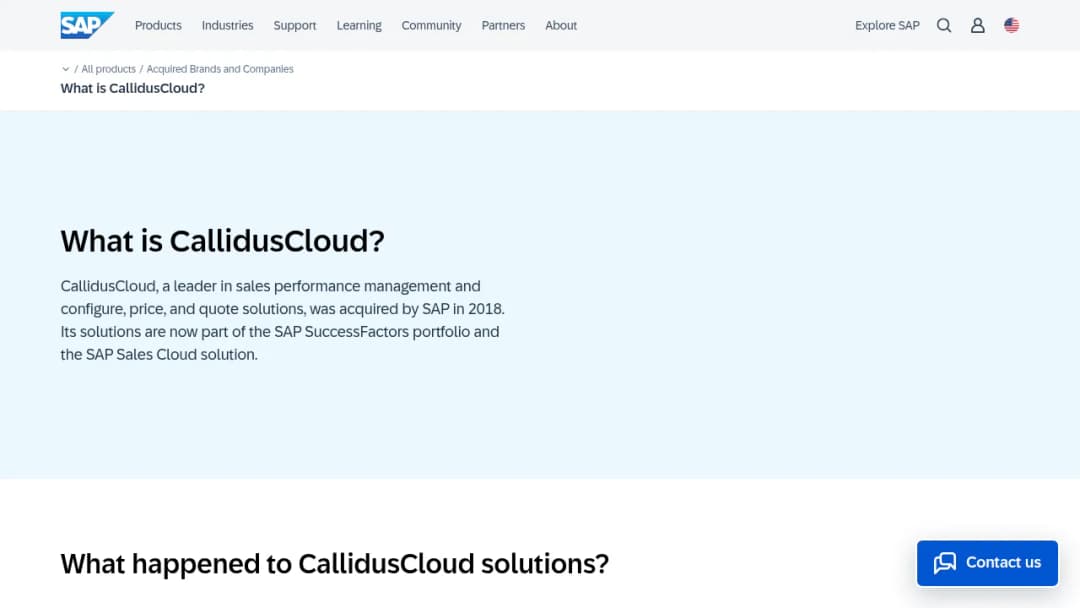
    SAP CallidusCloud screenshot
    FirmCompareTractionAnalysisAdvocates

    Insights

    All insightsAccountingFinanceSoftwareCustomer experience

    Benchmarks

    The Software LeaderboardMethodology

    Tools & data

    Market ExplorerStudioRegistry

    Company

    AboutCareers

    Legal

    Privacy PolicyTerms of Service

    © 2026 Airframe, Inc. All rights reserved.

      Published Oct 21, 2026

      01Common complaints

      - **SMB or simple commission plans**: If an organization has a small sales team with straightforward percentage-based commissions, SAP Incentive Management can be disproportionate in cost and administrative overhead. - **Fast-moving startups**: If compensation plans change frequently and business users must implement changes without specialized configuration skills, more UX-focused tools may be a better fit. - **Non-SAP-first tech stack**: Organizations standardized on Salesforce and best-of-breed finance/HR tools that require minimal custom integration may find competitors easier to integrate. - **Strict budget constraints**: Review content and market perception indicate SAP CPQ/ICM implementations can be costly when license and implementation fees are combined. - **Need for extremely flexible CPQ customization without administrator dependency**: Multiple reviews reference rigidity and the need for administrator involvement for complex customizations.

      Deal disqualifiers (poor fit)

      • Requirement for a lightweight tool for a small sales team.
      • Need for rapid, non-technical changes on a weekly basis without dedicated admin capacity.
      • A non-SAP tech stack where plug-and-play integrations are a priority.

      Common limitations from user feedback

      • Complex configuration / learning curve (Incentive Management and CPQ)
      • Performance slowness (especially CPQ)
      • Reporting limitations (Capterra review cites limited reporting capabilities)
      • Administrator dependency for advanced changes (CPQ)

      Vendor-acknowledged constraints (public)

      • SAP documents migration and platform evolution efforts (e.g., migration to SAP HANA / BTP embedding) as improvements; public materials reviewed do not provide a consolidated vendor-maintained list of known issues.

      Roadmap visibility

      • No consolidated public roadmap with dates was identified in the sources reviewed. In SAP environments, roadmap access is often provided via customer portals, account teams, or SAP community/program materials.

      02Why they buy

      Unique selling points supported by customer/reviewer evidence

      • Accuracy and automation for complex incentive calculation: Review summaries indicate automation can reduce spreadsheet reliance and disputes.
      • SAP integration: Reviewers and case materials indicate advantages when used within an SAP-centric landscape.
      • Enterprise governance: Features for approvals, hierarchical workflows, and process controls align with large-organization requirements.

      Where competitors have advantages (balanced)

      • User experience and speed: Some competitors are perceived as faster and more intuitive in administration and iterative changes.
      • Configurability without heavy admin: Several competing ICM products emphasize quicker, business-user-driven configuration.

      03Field reports

      This section includes summaries of review platform content and user-submitted feedback available publicly.

      Review platform evidence — SAP SuccessFactors Incentive Management (formerly SAP Commissions)

      **G2**: Well rated on G2. **Positive themes** - Reviewers reported the product handles complex incentive and commission structures with accuracy and transparency. - Users described automation that replaced spreadsheet-based processes and reduced dispute volumes. **Negative themes** - Reviewers frequently reported complex configuration and a significant setup effort. - Reviewers cited a notable learning curve for navigation and challenges in customizing reporting.

      Review platform evidence — SAP CPQ

      **G2**: Well rated on G2. **Positive themes** - Reviewers reported faster quote generation, more consistent pricing, and fewer manual errors after deployment. **Negative themes** - Several reviewers reported performance issues and rigidity in handling certain complex deal structures. - Customizing advanced functionality often required administrator support according to multiple reviewers. - Reviewers noted additional effort is typically required to integrate SAP CPQ with non-SAP platforms.

      Review platform evidence — SAP CPQ (Capterra)

      **Capterra**: Well rated on Capterra, with limited review volume. **Positive example** - A reviewer noted the product integrates within SAP landscapes and produces quotes efficiently and with fewer errors. **Negative / mixed examples** - Reviewers reported limitations in customizing certain objects and constraints with the reporting feature. - Some reviewers reported slow performance during certain workflows. - Initial implementation was described as difficult by some reviewers, often driven by customer-specific complexity in discounting and product configuration.

      Community / social evidence (limitations)

      Community discussion discovery for the legacy brand specifically was limited in general web searches. A practical interpretation is that the buyer/user base is more enterprise/consulting-led, and discussions may live in partner channels, private communities, or SAP customer networks.

      Vendor narrative: migration and scaling on SAP HANA

      SAP’s communications describe an evolution from the legacy CallidusCloud solutions into SAP’s SPM offerings on SAP HANA, highlighting scale and performance improvements and positioning the stack for large deployments. **Critical evaluation** - These are vendor-published claims and were not independently benchmarked in the materials reviewed. - The vendor narrative references very large scale characteristics but does not provide reproducible test methodology, named workloads, or detailed cost tradeoffs. - The positioning is consistent with SAP’s focus on large, complex deployments; organizations should validate vendor claims via proof-of-concept or pilot tests.

      “Struggled or failed” project signals

      Public materials reviewed did not surface detailed, public postmortems of failed deployments. Review content and practitioner feedback suggest common failure modes:

      • Underestimating compensation plan and discount-rule complexity, leading to additional upfront work.
      • Friction from customization limits in certain objects and reporting that can constrain specific business requirements.

      04Best fit

      Best-fit organizations

      • Size: Typically large organizations; some mid-sized firms may be a fit when commission complexity is high and budget supports a formal implementation.
      • Business profile: Organizations where incentive compensation materially impacts financial statements or where auditability and governance are priorities.

      Industries / verticals

      • Enterprises with complex sales/channel models:
        • Manufacturing/distribution
        • Financial services/insurance
        • Healthcare (agent/provider compensation structures)
        • Technology and telecom (multi-partner models)

      Roles and personas

      • Economic buyers: VP Sales Ops, CFO/Finance transformation leaders, CHRO/HRIS leaders (when packaged via SuccessFactors)
      • Champions: Sales Ops leaders, compensation analysts, RevOps, enterprise architects
      • End users: Sales representatives (commission statements), managers (dashboards), finance (accruals/reconciliation), HR (plan governance)

      Qualification criteria (great fit)

      • Organizations with complex commission logic and frequent disputes.
      • Need for auditability and consistent payout calculation at scale.
      • Organizations standardized on SAP seeking tighter integration.

      05The pitch

      What the product does (core value proposition)

      "CallidusCloud" is no longer positioned as a standalone product line; it refers to a set of historically separate sales performance management (SPM) and CPQ capabilities acquired by SAP and now delivered mainly as: - **SAP SuccessFactors Incentive Management (formerly SAP Commissions)** (SPM / incentive compensation management) - **SAP CPQ** (CPQ / quoting) - Related SPM components SAP references as part of its broader portfolio (e.g., territory/quota, agent lifecycle management), depending on customer needs and SAP packaging. SAP positions the former CallidusCloud solutions as part of the SAP SuccessFactors portfolio and the SAP Sales Cloud solution.

      Target market and positioning

      - **Primary**: Mid-market to enterprise organizations with complex variable compensation, commissions, quota/territory requirements, and/or complex quoting. - **Strong fit signal**: Companies already standardized on SAP (ERP, SuccessFactors, SAP CX stack) and seeking tighter end-to-end integration. - **Industry concentration (in practice)**: Commonly referenced in sales-heavy and channel-heavy environments (manufacturing, financial services, insurance, healthcare, FMCG), where incentive logic and auditability matter.

      Get a comprehensive analysis of SAP CallidusCloud including market position, competitive landscape, adoption trends, and peer benchmarks.

      Download full report →
      • SMB or simple commission plans: If an organization has a small sales team with straightforward percentage-based commissions, SAP Incentive Management can be disproportionate in cost and administrative overhead.
      • Fast-moving startups: If compensation plans change frequently and business users must implement changes without specialized configuration skills, more UX-focused tools may be a better fit.
      • Non-SAP-first tech stack: Organizations standardized on Salesforce and best-of-breed finance/HR tools that require minimal custom integration may find competitors easier to integrate.
      • Strict budget constraints: Review content and market perception indicate SAP CPQ/ICM implementations can be costly when license and implementation fees are combined.
      • Need for extremely flexible CPQ customization without administrator dependency: Multiple reviews reference rigidity and the need for administrator involvement for complex customizations.

      G2: Well rated on G2.

      Positive themes

      • Reviewers reported the product handles complex incentive and commission structures with accuracy and transparency.
      • Users described automation that replaced spreadsheet-based processes and reduced dispute volumes.

      Negative themes

      • Reviewers frequently reported complex configuration and a significant setup effort.
      • Reviewers cited a notable learning curve for navigation and challenges in customizing reporting.

      G2: Well rated on G2.

      Positive themes

      • Reviewers reported faster quote generation, more consistent pricing, and fewer manual errors after deployment.

      Negative themes

      • Several reviewers reported performance issues and rigidity in handling certain complex deal structures.
      • Customizing advanced functionality often required administrator support according to multiple reviewers.
      • Reviewers noted additional effort is typically required to integrate SAP CPQ with non-SAP platforms.

      Capterra: Well rated on Capterra, with limited review volume.

      Positive example

      • A reviewer noted the product integrates within SAP landscapes and produces quotes efficiently and with fewer errors.

      Negative / mixed examples

      • Reviewers reported limitations in customizing certain objects and constraints with the reporting feature.
      • Some reviewers reported slow performance during certain workflows.
      • Initial implementation was described as difficult by some reviewers, often driven by customer-specific complexity in discounting and product configuration.

      SAP’s communications describe an evolution from the legacy CallidusCloud solutions into SAP’s SPM offerings on SAP HANA, highlighting scale and performance improvements and positioning the stack for large deployments.

      Critical evaluation

      • These are vendor-published claims and were not independently benchmarked in the materials reviewed.
      • The vendor narrative references very large scale characteristics but does not provide reproducible test methodology, named workloads, or detailed cost tradeoffs.
      • The positioning is consistent with SAP’s focus on large, complex deployments; organizations should validate vendor claims via proof-of-concept or pilot tests.

      "CallidusCloud" is no longer positioned as a standalone product line; it refers to a set of historically separate sales performance management (SPM) and CPQ capabilities acquired by SAP and now delivered mainly as:

      • SAP SuccessFactors Incentive Management (formerly SAP Commissions) (SPM / incentive compensation management)
      • SAP CPQ (CPQ / quoting)
      • Related SPM components SAP references as part of its broader portfolio (e.g., territory/quota, agent lifecycle management), depending on customer needs and SAP packaging.

      SAP positions the former CallidusCloud solutions as part of the SAP SuccessFactors portfolio and the SAP Sales Cloud solution.

      • Primary: Mid-market to enterprise organizations with complex variable compensation, commissions, quota/territory requirements, and/or complex quoting.
      • Strong fit signal: Companies already standardized on SAP (ERP, SuccessFactors, SAP CX stack) and seeking tighter end-to-end integration.
      • Industry concentration (in practice): Commonly referenced in sales-heavy and channel-heavy environments (manufacturing, financial services, insurance, healthcare, FMCG), where incentive logic and auditability matter.