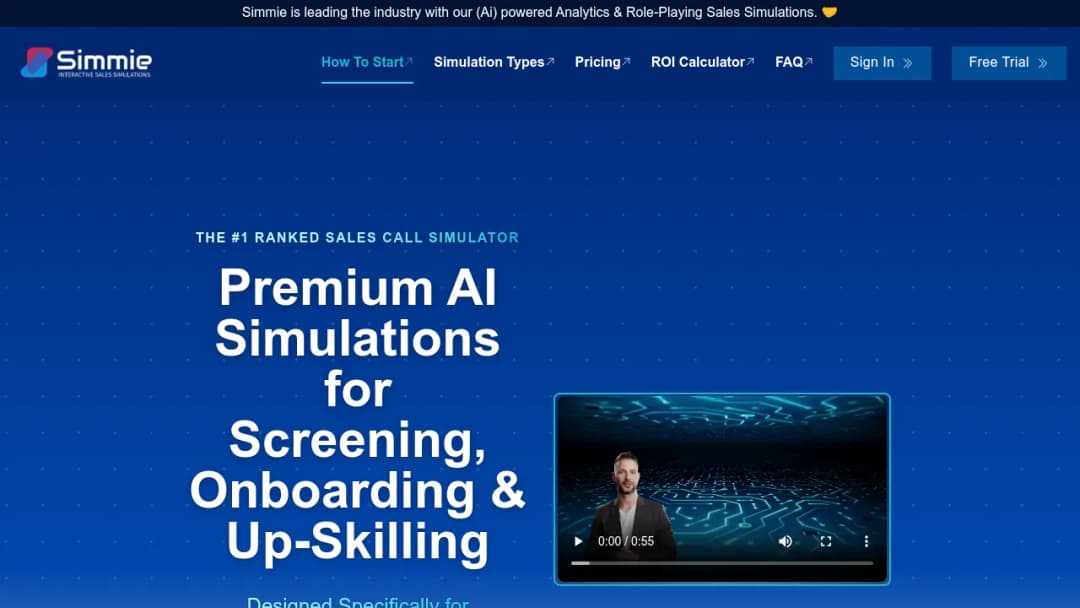
| Aspect | Simmie | Hyperbound | Second Nature |
|--------|--------|------------|---------------|
| Starting Price | Not publicly disclosed for Teams/Enterprise (annual platform fee + shared credits; Practice entry includes a small free credit allocation) | Not clearly disclosed on public homepage (demo-led) | Third-party sources commonly report published per-user monthly pricing available from vendors or aggregators |
| Best For | Teams seeking rubric-based, voice roleplay with infrastructure integration capabilities (MCP/assistants/CRM) and regulated-readiness records | Organizations pursuing AI roleplay and coaching with an established vendor presence | Larger enterprise L&D and enablement programs focused on conversational training |
| Key Strength | Infrastructure orientation: embedding roleplay and coaching as callable tools inside other assistants and workflows; vendor states SOC 2 Type II compliance; focus on records for regulated-readiness use cases | Market visibility and category recognition; community discussion presence | Broader enterprise orientation and market visibility; more commonly evaluated for large-scale programs |
| Key Weakness | Limited independent reviews and third-party validation; pricing opacity for Teams/Enterprise; early-stage company size may increase roadmap risk | Pricing and implementation details often require engagement with sales; dependent on vendor roadmap | Community complaints in public forums about some feature implementations have been noted for certain competitors |
- Direct competitors and their key differentiators
- Hyperbound: Competes in AI sales roleplay and coaching and has greater mindshare in community discussions relative to newer entrants.
- Second Nature: Established brand in conversational AI training, widely sold into enterprise L&D and enablement functions; commonly evaluated with per-user licensing models.
- SalesHood: Broad enablement platform where roleplay may be one component of a larger content and coaching workflow.
- Feature comparison: where Simmie excels vs lags behind
- Potential strengths vs competitors
- The MCP server/infrastructure approach is a distinctive technical positioning: exposing simulations, rubric scoring, readiness checks, and coaching assignments as callable tools usable by other assistants.
- Focus on audit records and readiness checks targeted at regulated contexts.
- Potential weaknesses vs competitors
- Lower observable third-party social proof and few independently verifiable case studies.
- Less transparent pricing for Teams and Infrastructure tiers.
- Smaller company size implies higher product/roadmap risk for large enterprise buyers.
- Pricing comparison: value proposition vs alternatives
- A model without per-seat licensing may benefit some large organizations if usage is predictable; however, the credit-based model requires careful forecasting to avoid unexpected costs.
- Per-seat competitors can be straightforward to budget but may become more expensive as headcount scales.
- Customer testimonials comparing this product to competitors
- No credible, independent customer quotes directly comparing Simmie to competitors were identified in the public sources reviewed.
- Market share and adoption trends
- Public data is insufficient to estimate market share. Available evidence suggests Simmie is earlier-stage compared with the most recognized roleplay vendors, based on team size and limited presence on major review platforms.