Workspace
    • Briefing
    • Ask Airframe
    Transformation
    • Audit
    Your Stack
    • Registry
    • Finance
    • Context
    Discover
    Powered by Airframe
    1. Research
    2. /
    3. Products
    4. /
    5. Talkdesk
    Talkdesk

    Talkdesk

    Leader

    Customer Experience. Automated.

    Est 2011|Valuation $10.4B|Raised $576.1M|262 Ref Customers
    LinkedIn 367K|Web traffic 90K|FTEs 1,316|HQ San Francisco, California, US
    MarketsContact Center as a Service (CCaaS)CS AI Agent
    Platform CoversCS AI AgentCS Quality Management & CoachingInteractive Voice Response (IVR)Conversation Intelligence
    Talkdesk screenshot
    FirmCompareTractionAnalysisAdvocates

    Insights

    All insightsAccountingFinanceSoftwareCustomer experience

    Benchmarks

    The Software LeaderboardMethodology

    Tools & data

    Market ExplorerStudioRegistry

    Company

    AboutCareers

    Legal

    Privacy PolicyTerms of Service

    © 2026 Airframe, Inc. All rights reserved.

      Published Oct 23, 2026

      01Common complaints

      - Budget constraints / price sensitivity - Organizations that require predictable all-in pricing and wish to avoid usage-based metering for AI/analytics/add-ons should consider alternatives with simpler bundled pricing or evaluate the vendor with careful TCO modeling. - Lightweight call center needs - Operations that primarily require basic inbound calling with minimal routing complexity may find the configuration and governance requirements disproportionate to their needs. - Organizations that cannot tolerate support friction - Community and consumer review signals indicate some buyers experience frustration with documentation, support, or billing processes. Organizations with low tolerance for operational friction should validate support SLAs, escalation paths, and local partner options. - Highly specialized CTI / Salesforce environments - If Salesforce CTI or other specific CTI integrations are mission-critical, conduct a detailed bake-off with strict acceptance tests (including failover) given community reports of integration pain in some contexts. - Known limitations inferred from sources - Out-of-the-box fit vs real-world complexity - Some reviewers indicate the product requires significant setup and customization to match production requirements. - Support/documentation quality variance - Practitioner threads point to variability in documentation clarity and support responsiveness for specific integrations. - Complexity creep - Highly configurable IVR and routing can be difficult to govern without dedicated administrative discipline. - Roadmap / recently announced items - Vendor marketing references new features and product components; GA dates and general availability should be confirmed with the vendor. - Scale considerations - Scale limits were not explicitly documented in the materials reviewed; buyers should request performance and scale documentation relevant to their expected workloads. - Security/compliance caveats - Certifications are advertised, but buyers must confirm the scope, regional applicability, product edition boundaries, subprocessor list, data residency, retention policies, and model training/data usage details.
      Deal disqualifiers (poor fit)

      • Organizations requiring a very low all-in cost per seat with minimal add-ons may find metered features increase total cost of ownership.
      • Organizations lacking implementation and change-management capacity.
      • Buyers requiring fully documented data residency and subprocessor details that cannot be provided to satisfaction during security review.

      02Why they buy

      - Vendor-stated focus on automated CX workflows and multi-agent AI orchestration - The vendor emphasizes autonomous and coordinated AI workflows alongside human agents as part of its product narrative; independent evidence of consistent, large-scale autonomous execution was not identified in the materials reviewed. - Compliance posture for regulated sectors - The vendor advertises multiple certifications and a FedRAMP-authorized edition for government use; buyers should validate the scope and applicability to their deployment. - Integration ecosystem and routing configurability - Review platform summaries and practitioner feedback indicate extensive IVR and routing configuration capabilities and a broad catalogue of integration options. - Where competitors have advantages (balanced) - Genesys: documented pricing resources for AI experiences and broad enterprise capabilities may simplify cost forecasting for some buyers. - NICE: perception of broad enterprise suite breadth, with pricing typically handled via custom quoting. - Five9: mature market presence and multiple contract models; buyers should compare TCO and feature fit.

      Why customers chose the vendor (as suggested by reviews)

      • Common cited reasons include configurable routing/IVR, omnichannel capabilities, and a comprehensive integrations ecosystem.
      • Some buyers cite a cleaner cloud-native user experience compared with legacy on-prem systems.

      03Field reports

      Review ecosystem notes (how to interpret)

      • Different review platforms use different verification and invitation mechanisms (for example, some gate reviewers by email/role while others are self-selected), which affects the signal quality of reviews.

      Positive feedback themes (examples)

      • Aggregate review summaries on major review platforms highlight ease of use, interface quality, CRM integrations, and responsive support as common positive themes.
      • Some review sites emphasize configurable IVR/routing capabilities and a broad ecosystem of integrations, noting suitability for complex, global contact centers.
      • Peer-review platforms and analyst summaries sometimes cite perceived operational efficiencies after deployment.

      Negative feedback themes (examples)

      • Some consumer-facing review sites display low satisfaction scores driven by billing/cancellation/support complaints; these sources are self-selected and should be considered alongside enterprise-focused reviews.
      • Community forums contain practitioner complaints about documentation or support in specific integrations (for example, CTI/Salesforce scenarios); these threads are anecdotal but indicate operational risk areas that merit validation in pilots.

      Why some customers left / considered leaving

      • Recurring themes for churn or dissatisfaction include perceived gaps in support responsiveness, documentation quality, and the effort required for customization to achieve desired outcomes.

      Case Studies

      #### Vendor-published outcomes (marketing, not independently verified) - Vendor case study excerpts provide metrics reported by customers (for example, abandonment rate, service-level improvements, containment rates). These are customer-reported figures presented in vendor materials. - Critical evaluation - Reported metrics are typically provided without disclosed methodology, sample sizes, baseline definitions, seasonality controls, or independent verification. Buyers should request: - A written case study with baseline and post-implementation measurements and defined metrics - A clear definition of terms such as "containment" and measurement boundaries - Reporting periods and whether reported results were sustained - Information about downstream contact volumes (for example, whether automated containment resulted in repeat contacts) #### Third-party partner-hosted reports - Partner-hosted research materials that include vendor co-branded content should be treated as marketing unless the partner discloses a transparent methodology and independent analysis.

      04Best fit

      Company sizes

      • Likely better fit: mid-market to enterprise contact centers (a broad range of agent counts) with multiple queues, channels, and integration requirements.
      • Potential small-business fit: vendor literature and third-party review platforms reference a smaller-scale offering for small businesses; availability and eligibility may vary by region.

      Industries and verticals

      • Vendor materials and compliance claims suggest suitability for regulated industries such as financial services, healthcare, retail, and travel, depending on edition and compliance posture.

      Roles and personas

      • Decision makers: VP/Director of Contact Center, IT Directors for Unified Communications/Enterprise Apps, Security & Compliance leaders, Procurement/Finance leaders.
      • End users: contact center agents, supervisors, WFM/QA analysts, administrators, and integration engineers.

      Pain points the product addresses

      • Consolidating telephony and digital channels into an omnichannel CCaaS
      • Reducing live-agent workload through automation and virtual agents
      • Improving agent efficiency via copilot-style summaries and assistive features (vendor claims; validate in pilot)

      Qualification criteria (good fit)

      • Organizations that can staff ongoing administration or retain professional services for configuration and governance.
      • Organizations with clear KPIs and measurement frameworks to track containment/deflection without degrading customer experience.
      • Organizations requiring a documented compliance posture (HIPAA/PCI/FedRAMP) for specific editions.

      05The pitch

      What the product does (core value proposition in objective terms)

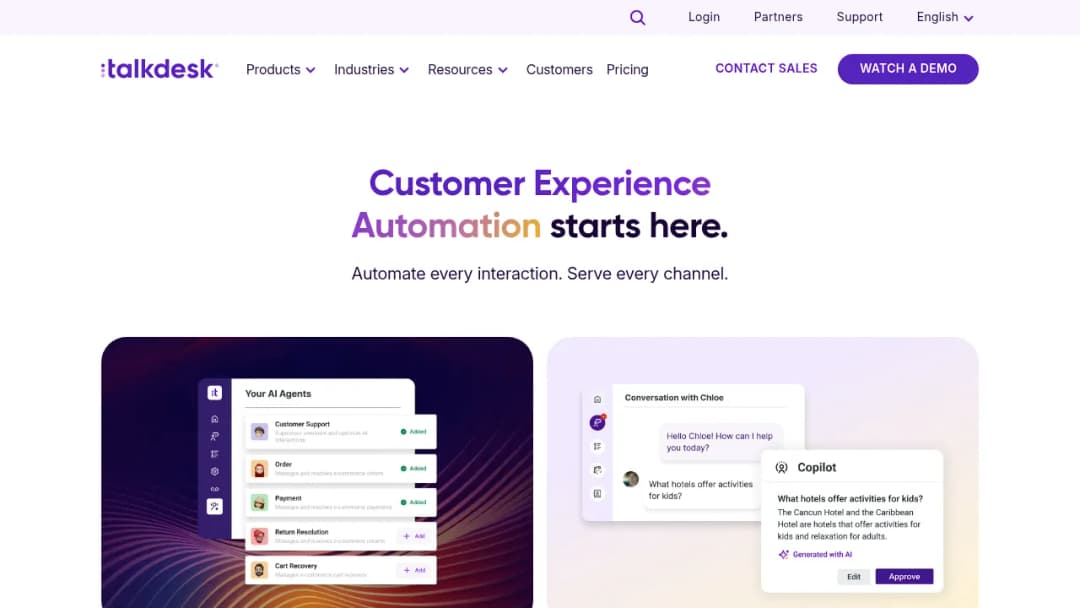
      • Talkdesk is a cloud contact center platform (CCaaS) that includes a vendor-branded capability for Customer Experience Automation (CXA) which leverages AI agents for specific customer experience tasks.
      • The vendor frames a model in which human agents handle judgment and empathy while AI agents perform routine CX tasks at scale (vendor examples include appointment handling, order-status updates, proactive travel notifications, and card/payment workflows).

      Target market and market positioning

      • Target customers are mid-market to enterprise contact centers seeking omnichannel routing combined with automation and advanced AI capabilities.
      • Vendor materials indicate a focus on regulated and industry-specific deployments and reference certifications and compliance programs such as ISO, SOC, HIPAA, PCI, and FedRAMP for certain editions.

      Get a comprehensive analysis of Talkdesk including market position, competitive landscape, adoption trends, and peer benchmarks.

      Download full report →
      • Budget constraints / price sensitivity

        • Organizations that require predictable all-in pricing and wish to avoid usage-based metering for AI/analytics/add-ons should consider alternatives with simpler bundled pricing or evaluate the vendor with careful TCO modeling.
      • Lightweight call center needs

        • Operations that primarily require basic inbound calling with minimal routing complexity may find the configuration and governance requirements disproportionate to their needs.
      • Organizations that cannot tolerate support friction

        • Community and consumer review signals indicate some buyers experience frustration with documentation, support, or billing processes. Organizations with low tolerance for operational friction should validate support SLAs, escalation paths, and local partner options.
      • Highly specialized CTI / Salesforce environments

        • If Salesforce CTI or other specific CTI integrations are mission-critical, conduct a detailed bake-off with strict acceptance tests (including failover) given community reports of integration pain in some contexts.
      • Known limitations inferred from sources

        • Out-of-the-box fit vs real-world complexity
          • Some reviewers indicate the product requires significant setup and customization to match production requirements.
        • Support/documentation quality variance
          • Practitioner threads point to variability in documentation clarity and support responsiveness for specific integrations.
        • Complexity creep
          • Highly configurable IVR and routing can be difficult to govern without dedicated administrative discipline.
      • Roadmap / recently announced items

        • Vendor marketing references new features and product components; GA dates and general availability should be confirmed with the vendor.
      • Scale considerations

        • Scale limits were not explicitly documented in the materials reviewed; buyers should request performance and scale documentation relevant to their expected workloads.
      • Security/compliance caveats

        • Certifications are advertised, but buyers must confirm the scope, regional applicability, product edition boundaries, subprocessor list, data residency, retention policies, and model training/data usage details.
      • Vendor-stated focus on automated CX workflows and multi-agent AI orchestration
        • The vendor emphasizes autonomous and coordinated AI workflows alongside human agents as part of its product narrative; independent evidence of consistent, large-scale autonomous execution was not identified in the materials reviewed.
      • Compliance posture for regulated sectors
        • The vendor advertises multiple certifications and a FedRAMP-authorized edition for government use; buyers should validate the scope and applicability to their deployment.
      • Integration ecosystem and routing configurability
        • Review platform summaries and practitioner feedback indicate extensive IVR and routing configuration capabilities and a broad catalogue of integration options.
      • Where competitors have advantages (balanced)
        • Genesys: documented pricing resources for AI experiences and broad enterprise capabilities may simplify cost forecasting for some buyers.
        • NICE: perception of broad enterprise suite breadth, with pricing typically handled via custom quoting.
        • Five9: mature market presence and multiple contract models; buyers should compare TCO and feature fit.

      Vendor-published outcomes (marketing, not independently verified)

      • Vendor case study excerpts provide metrics reported by customers (for example, abandonment rate, service-level improvements, containment rates). These are customer-reported figures presented in vendor materials.
      • Critical evaluation
        • Reported metrics are typically provided without disclosed methodology, sample sizes, baseline definitions, seasonality controls, or independent verification. Buyers should request:
          • A written case study with baseline and post-implementation measurements and defined metrics
          • A clear definition of terms such as "containment" and measurement boundaries
          • Reporting periods and whether reported results were sustained
          • Information about downstream contact volumes (for example, whether automated containment resulted in repeat contacts)

      Third-party partner-hosted reports

      • Partner-hosted research materials that include vendor co-branded content should be treated as marketing unless the partner discloses a transparent methodology and independent analysis.

      How it compares

      • Customer Support AI market report

        Top vendors: Gorgias, Intercom, Minimal AI, Glia, LivePerson.