TealBook
The most trusted source for supplier data
The most trusted source for supplier data
Published Oct 15, 2026
The vendor documented a migration and retirement timeline for a legacy application in favor of the SDP. This creates an operational risk for customers that must be managed via migration planning, contractual protections, and validation of feature parity.
The vendor presents ROI, cost-avoidance, and other quantified outcomes in marketing materials without public methodology details. Buyers should request underlying models and references.
Public review-platform coverage for the product is limited in volume and detail, which increases diligence burden.
Employment-review site entries raise potential concerns about layoffs and strategic direction; treat these as operational risk signals to validate during procurement, not as direct evidence of product failure.
Vendor materials include customer quotes referencing proof-of-concept ROI and maintenance savings. These are vendor-published testimonials; methodology and baseline assumptions for ROI claims are not disclosed publicly and should be examined as part of procurement diligence.
Searches of community forums returned limited substantive user discussion about product experience; results were primarily job postings rather than detailed user conversations.
Employee reviews are an indirect signal and should not be treated as customer outcome evidence. Some employment-review entries allege layoffs, lack of transparency, and product direction concerns. Use these as risk signals to validate during diligence (for example: ask about roadmap stability, support staffing, retention, and SLAs), rather than as direct evidence of customer failure.
Public partnership announcements confirm TealBook is used in enterprise transformations alongside major S2P suites. The announcements primarily describe go-live status and integration but do not provide quantified post-implementation outcomes.
Vendor pages present ROI and cost-avoidance figures for cleansing and normalizing supplier sets and estimates of incremental small and diverse spend. These figures are presented without detailed methodology in the public material reviewed; prospective buyers should request a written ROI model that discloses assumptions and references.
Vendor-hosted research includes a headline figure for the average cost to enrich and maintain a single supplier record. While the research firm may be independent, the asset appears as a vendor-hosted resource; procurement should confirm sample, definitions, and whether figures are averages or modeled estimates across industries before relying on them for budgeting.
Best fit: mid-to-large enterprises with fragmented vendor masters (multiple ERPs, M&A history, shared services). Messaging and materials target organizations with significant supplier counts and enterprise-scale procurement operations.
Practical ICP range (inferred): large organizations with multi-region operations and extensive vendor master complexity.
Vendor and press materials reference contexts such as retail, manufacturing, healthcare, and other large enterprise procurement environments.
Get a comprehensive analysis of TealBook including market position, competitive landscape, adoption trends, and peer benchmarks.
Download full report →Organizations that require abundant peer reviews and crowd-validation.
Organizations seeking transparent, self-serve pricing and rapid purchase.
Organizations expecting a full Source-to-Pay suite rather than a data foundation.
Organizations highly sensitive to migration risk.
Organizations that require publicly verifiable security certifications as a gating procurement requirement.
A notable challenge in evaluating TealBook is the low volume of end-user reviews on mainstream software review platforms.
This low review volume increases buyer risk because it reduces the ability to validate claims, support quality, and implementation experience via peer feedback.
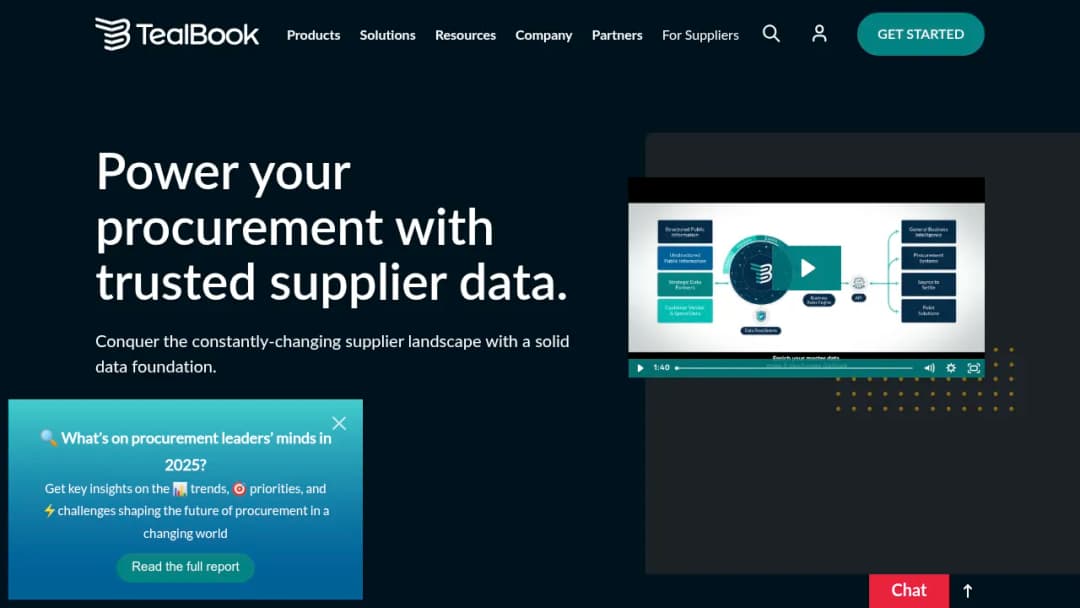
TealBook is a B2B Supplier Data Platform (SDP) focused on improving the accuracy, completeness, and usability of enterprise supplier/vendor master data. Its primary objective is to resolve supplier records to verified legal entities, map corporate hierarchies (parent/child relationships), and continuously enrich supplier profiles with attributes (e.g., IDs, classifications, diversity certifications) so procurement teams can make faster sourcing, compliance, risk, and reporting decisions using data the vendor describes as "trusted." The vendor emphasizes this positioning on its site.
Key functional themes: