Theta Lake
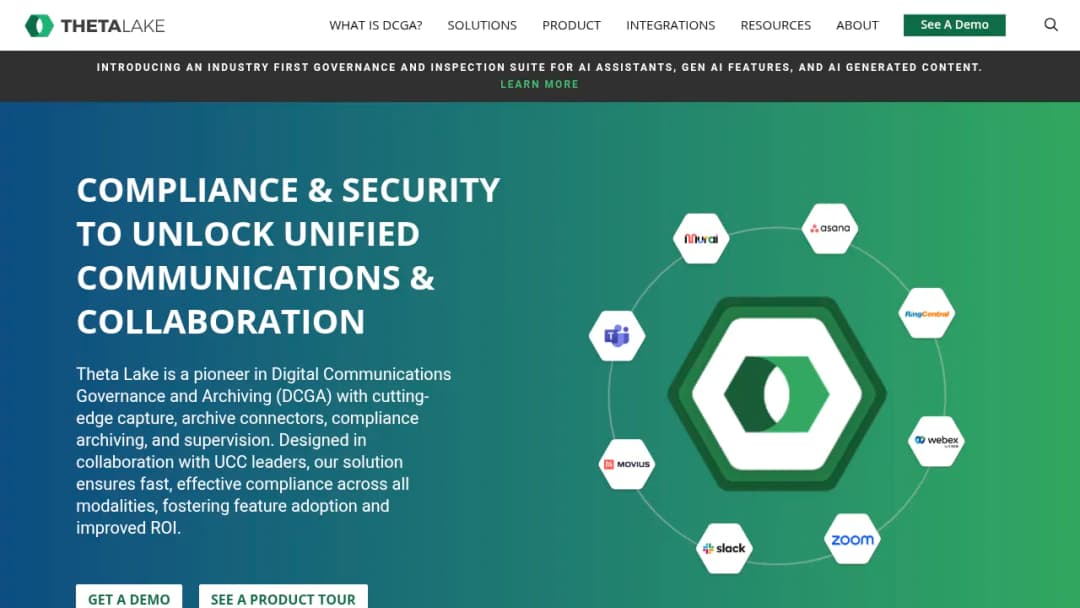
Compliance & Security for Unified Communications and Collaboration Platforms like MS Teams, Zoom, Webex & RingCentral
Compliance & Security for Unified Communications and Collaboration Platforms like MS Teams, Zoom, Webex & RingCentral
Published Oct 15, 2026
No explicit public "known issues" list was found in the vendor documentation reviewed.
The vendor announces new capabilities periodically via press releases. Because the vendor does not publish a detailed public roadmap with firm dates in the materials reviewed, claims about new or unique features should be validated during product evaluation and in a sandbox or proof-of-concept.
No public SLA, uptime history, or outage postmortems were located in the retrieved sources. Buyers should request SLA terms and historical uptime metrics during procurement.
Vendor-selected testimonial content highlights rapid implementation of a compliance suite to capture and record meeting activity for a major collaboration platform. This content is vendor-selected and should be validated in reference calls for implementation detail and scope.
Direct end-user negative quotes on major review aggregator sites (G2/TrustRadius/Capterra) were not available in the retrieved sources for this research pass. One workplace review source reported employee ratings and sales performance metrics, which relate to go-to-market and employee experience rather than product functionality.
Public materials and vendor statements commonly cite the following reasons:
These are vendor-described value propositions; buyers should validate capabilities in a proof-of-concept and by speaking with references.
The research set includes vendor testimonial pages and press releases but not detailed third-party case studies that include independently verified ROI analyses. Customer names appearing in vendor materials are vendor-attributed and should be validated in reference calls.
Vendor and partner press releases sometimes cite reduced fines, improved compliance posture, and efficiency gains, but these materials do not provide audited ROI methodology. Company-level growth statistics reflected in vendor materials should be treated as vendor performance claims rather than verified customer ROI outcomes.
Best fit appears to be mid-market to large enterprise organizations with formal compliance programs and notable collaboration usage.
Practical sizing guidance:
Strongest fit:
Get a comprehensive analysis of Theta Lake including market position, competitive landscape, adoption trends, and peer benchmarks.
Download full report →Situations where Theta Lake may be a poor choice:
Because public negative product reviews were not retrieved in this research pass, inferred churn reasons are based on typical DCGA buying patterns and should be validated in reference calls:
These differentiators are presented in vendor materials and press coverage; buyers should validate capability depth and integration maturity in a proof-of-concept and through reference calls.
The review footprint in public review aggregators was limited in the retrieved sources during this research pass:
These signals suggest limited publicly visible crowd-sourced review data in general aggregator websites in this research pass; buyers should request references and examine licensed analyst reports where available.
Good fit when:
Deal disqualifiers / Poor fit when:
Theta Lake is a Digital Communications Governance and Archiving (DCGA) platform designed to capture, archive, search, supervise, and detect compliance and security-related risks across modern collaboration modalities, including video meetings, voice, chat/persistent messaging, files, and visual collaboration artifacts (e.g., whiteboards). The vendor positions the product as a unified governance layer for Unified Communications & Collaboration (UCC) data and uses machine learning and other automated detection methods to identify potential regulatory, privacy, and security issues across content that is shared, shown, spoken, or typed.
Key functional areas described by the vendor include:
Theta Lake primarily targets:
The vendor states that legacy email-centric archiving and supervision tools do not adequately cover modern collaboration modalities and emphasizes broader modality coverage via integrations and automated detections.