Workspace
    • Briefing
    • Ask Airframe
    Transformation
    • Audit
    Your Stack
    • Registry
    • Finance
    • Context
    Discover
    Powered by Airframe
    1. Research
    2. /
    3. Products
    4. /
    5. Trae
    Trae

    Trae

    AI Native

    The Real AI Engineer.

    Est 2023|2 Ref Customers
    LinkedIn 3K|Web traffic 2.8M|FTEs 51
    MarketsCode Editors & IDEsAI Coding Assistants
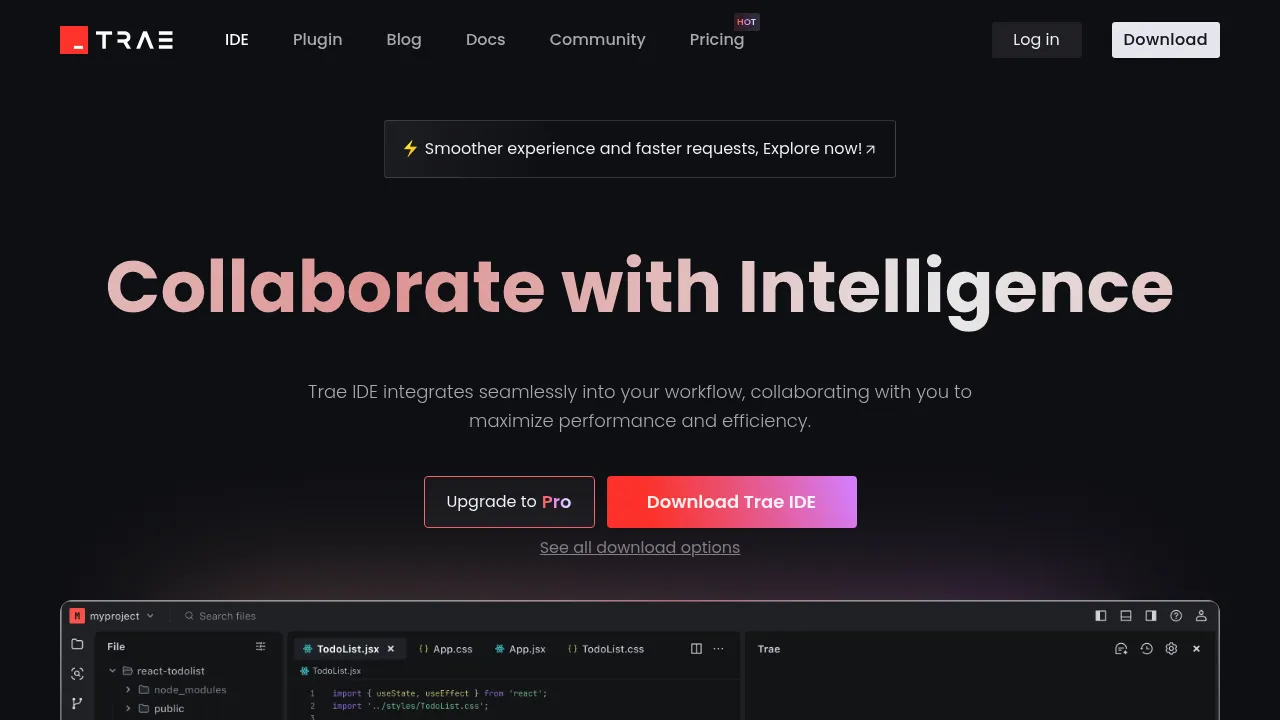
    Trae screenshot
    FirmCompareTractionAnalysisAdvocates

    Insights

    All insightsAccountingFinanceSoftwareCustomer experience

    Benchmarks

    The Software LeaderboardMethodology

    Tools & data

    Market ExplorerStudioRegistry

    Company

    AboutCareers

    Legal

    Privacy PolicyTerms of Service

    © 2026 Airframe, Inc. All rights reserved.

      Published Oct 15, 2026

      01Common complaints

      - Company sizes or stages where Trae is overkill or insufficient - Very early beginners may be better served by simpler assistants embedded in existing editors or by free tiers of other tools. - Large enterprises typically require stronger contractual assurances, documentation, and administrative controls than are publicly documented for Trae. - Industries or use cases where competitors are clearly superior - Regulated environments: competitors with clear enterprise/compliance postures or local-only solutions are typically safer choices. - Technical requirements Trae may not meet - Requirements for provable telemetry disablement and demonstrable data minimization. - Internal policies that forbid engaging with vendors from certain jurisdictions or that require on-premise/local-only model execution. - Budget constraints - Organizations that cannot tolerate variable monthly spend may face cost variability due to token billing and agent workflows. - Workflows/integrations where it may fall short - Air-gapped or local-only LLM workflows: community reports indicate limitations or changing support for local providers. - Red flags in the buying process - Numerous user reports of billing surprises and difficulties obtaining refunds. - Ambiguity around the scope of telemetry toggles and what components collect data. - Current limitations acknowledged by the vendor - Vendor-facing documentation accessible in this research did not present a consolidated "known issues" page covering all limitations. - Roadmap / not-yet-available features - Roadmap details are not reliably documented in the publicly accessible sources reviewed. - Scale limitations - Community discussions and press reports suggest performance and resource usage concerns in some versions or configurations. - Security or compliance gaps - No clear public SOC 2 / ISO 27001 attestations were located. - Telemetry-related reports raise potential risks for organizations with strict policies. - API limitations / integration constraints - Users have reported model removals and plan changes that reduced previously available functionality or value.

      Deal disqualifiers (poor fit)

      • Requirement for formal compliance certifications or documentation (e.g., SOC 2, ISO 27001) that cannot be met.
      • Strict data residency or governance requirements.
      • Low tolerance for billing disputes or delayed support responses.

      Why some customers left for competitors (churn reasons)

      • Some reviewers report that alternatives (e.g., Cursor) performed better for debugging and real development tasks.
      • Community discussions emphasize pricing changes (token-based billing), removal of local-LLM options, and reduction of perceived plan value.
      • Privacy concerns lead some security-conscious users to prefer local models or vendors viewed as more transparent.

      02Why they buy

      - Competitive advantages validated by customer feedback (not just vendor claims) - Some users report favorable price-to-capability ratios, describing Trae as less expensive than certain alternatives for comparable outputs in their use cases. - Product Hunt and community reviewers have noted a relatively polished interface and frequent updates. - Unique features and capabilities competitors may lack - Trae’s SOLO branding and workflow packaging provide a specific product framing for agent-driven development; functionally, similar agent workflows exist in competing products. - Differentiation based on reviews - Differentiation appears driven primarily by price and packaging rather than by a capability that competitors cannot replicate. - Areas where competitors clearly have advantages - Trust and transparency: the telemetry controversy is a meaningful disadvantage for some buyers. - Enterprise readiness: competitors with published compliance documentation and administrative controls are stronger choices for procurement.

      Why customers chose this product over alternatives

      • Lower starting price points and prior unlimited or high-usage framing in earlier plans.
      • An integrated AI IDE experience as an alternative to combining multiple extensions.
      • Familiar VS Code–like interface which eases migration.

      03Field reports

      Note on review quality: AI tooling review ecosystems can be noisy. For Trae specifically, sentiment diverges sharply by channel: Product Hunt shows strong positivity (maker/early adopter skew), while Trustpilot is heavily negative (billing/support skew). This divergence is relevant for interpreting overall satisfaction.

      Review platforms and aggregates

      - Trustpilot showed a low overall score in the captured snapshot, with a substantial share of 1-star reviews; many focus on billing, support, and performance issues. - G2 has a product page for Trae AI, but localized pros/cons pages indicate review volume may be insufficient to draw broad buyer conclusions. - Product Hunt showed strong ratings in the captured snapshot; commentary described Trae positively on several fronts while also noting hallucinations, retention limitations, and privacy concerns.

      Direct quotes (positive and negative)

      - Trustpilot (negative; billing/support): - "Shady billing: Charged BEFORE the trial ended & support ghosted me." - "Avoid these cowboys… Poor product and terrible customer services. My account was locked… and they still kept billing me." - Trustpilot (negative; value vs Cursor): - "Trae pro doesn’t resolve my problems… when i tried cursor free it was so much better… so I don’t really recommend trae" - Trustpilot (positive; value) — paraphrased from user text: - A user review characterized the product as having features not present in many other AI IDEs and perceived favorable pricing. - Reddit (negative; pricing change): - "[DISCUSSION] Trae AI just killed the ‘Unlimited Flash’ value. It’s now a token drain." - Reddit (negative; billing incident): - "Trae.ai charged me multiple times in one day and refuses to refund, claiming an ‘On-Demand Usage’ glitch!" - Product Hunt (mixed summary; quality and privacy): - Product Hunt summaries note users praising perceived value and interface, while also reporting hallucinations and privacy concerns.

      Common criticisms and complaints (as evidenced across sources)

      - Billing disputes, unexpected charges, and refund difficulties (Trustpilot; Reddit; GitHub issue threads include billing/refund/usage lock topics). - Perceived value decline following pricing/plan changes (discussed in recent forum threads). - Reported slowness and queuing delays compared to some competitors. - Model availability and selection changes (users reporting removal or reduced access to preferred models). - Privacy and telemetry concerns (news coverage, Hacker News discussions, community threads).

      Specific outcomes customers achieved (with metrics when available)

      • Vendor or third-party claims of productivity gains and large-scale code volume exist, but methodologies are unclear and not independently validated.
      • Product Hunt reviewers commonly describe time savings and improved handling of repetitive tasks, typically without consistent quantified metrics.

      Deal-breakers and reasons customers didn’t purchase

      • Requirements for SOC 2/ISO certifications or a clear trust center can be blockers for procurement.
      • Organizations with strict data governance may avoid Trae due to telemetry reports.
      • Developers who require predictable monthly spend may find token-based billing challenging if usage is difficult to forecast.

      Public case studies

      • No robust, independently verified enterprise case studies were located in the accessed sources.
      • Product Hunt includes customer anecdotes and maker testimonials, but these are not structured or audited case studies with verifiable metrics.

      Benchmark/leaderboard claims (critical evaluation)

      • A tutorial and some third-party materials noted a claim that Trae ranked highly on a coding-task benchmark (SWE-bench) in a recent timeframe. Benchmarks provide directional evidence on coding-task performance but do not necessarily predict outcomes on large, complex internal codebases.
      • Benchmarks do not address governance, security, or cost predictability and should be treated accordingly.

      Vendor-published metrics caveat

      • Growth or "lines of code generated" metrics from third-party teardown-style articles are generally non-audited and should be corroborated by primary sources before being used in procurement decisions.

      04Best fit

      Company sizes

      • Strongest fit appears to be:
        • Solo developers and very small engineering teams.
        • Budget-constrained startups.
      • More challenging fit:
        • Mid-market and enterprise teams with formal security and compliance procurement processes.

      Industries and verticals

      • Strongest fit: software startups, agencies, indie development, prototyping-focused teams.
      • Poor fit: regulated industries (finance, healthcare, government contracting) unless Trae can provide contractual assurances and compliance evidence.

      Roles and personas

      • Decision makers: founders and senior technical leads in small organizations.
      • End users: full-stack developers, front-end developers, and hobbyists moving toward professional workflows.

      Pain points addressed

      • Faster scaffolding and repetitive code generation.
      • Multi-file changes from natural language specifications.
      • Consolidation of editing and AI assistance into a single integrated IDE experience.

      Qualification criteria (strong fit)

      • Comfortable experimenting with evolving AI workflows.
      • Low compliance burden.
      • Willingness to monitor usage and manage token or usage consumption.

      05The pitch

      What the product does (core value proposition in objective terms)

      - Trae (often styled TRAE, sometimes expanded as “The Real AI Engineer”) is an IDE derived from the VS Code/Code-OSS codebase that integrates chat, inline assistance, multi-file edits (agent-driven changes), and autonomous/spec-driven workflows (marketed under SOLO / “Builder” concepts). It can be described as a Cursor-like AI IDE with lower entry pricing tiers and access to multiple model providers. - Trae’s value proposition centers on: - In-editor conversational assistance for coding tasks - Multi-file / repository-aware changes via an agent workflow - Onboarding familiarity for VS Code users via extension compatibility and a similar user interface

      Target market and market positioning

      • Primary users: individual developers, indie hackers, and small teams seeking an AI-first editor experience similar to Cursor but with lower initial cost.
      • Secondary users: non-traditional developers (product managers, founders) who rely more heavily on agent-driven workflows.
      • Enterprise positioning appears limited due to publicly discussed telemetry/privacy concerns and the absence of widely published compliance attestations.

      Get a comprehensive analysis of Trae including market position, competitive landscape, adoption trends, and peer benchmarks.

      Download full report →
      • Company sizes or stages where Trae is overkill or insufficient

        • Very early beginners may be better served by simpler assistants embedded in existing editors or by free tiers of other tools.
        • Large enterprises typically require stronger contractual assurances, documentation, and administrative controls than are publicly documented for Trae.
      • Industries or use cases where competitors are clearly superior

        • Regulated environments: competitors with clear enterprise/compliance postures or local-only solutions are typically safer choices.
      • Technical requirements Trae may not meet

        • Requirements for provable telemetry disablement and demonstrable data minimization.
        • Internal policies that forbid engaging with vendors from certain jurisdictions or that require on-premise/local-only model execution.
      • Budget constraints

        • Organizations that cannot tolerate variable monthly spend may face cost variability due to token billing and agent workflows.
      • Workflows/integrations where it may fall short

        • Air-gapped or local-only LLM workflows: community reports indicate limitations or changing support for local providers.
      • Red flags in the buying process

        • Numerous user reports of billing surprises and difficulties obtaining refunds.
        • Ambiguity around the scope of telemetry toggles and what components collect data.
      • Current limitations acknowledged by the vendor

        • Vendor-facing documentation accessible in this research did not present a consolidated "known issues" page covering all limitations.
      • Roadmap / not-yet-available features

        • Roadmap details are not reliably documented in the publicly accessible sources reviewed.
      • Scale limitations

        • Community discussions and press reports suggest performance and resource usage concerns in some versions or configurations.
      • Security or compliance gaps

        • No clear public SOC 2 / ISO 27001 attestations were located.
        • Telemetry-related reports raise potential risks for organizations with strict policies.
      • API limitations / integration constraints

        • Users have reported model removals and plan changes that reduced previously available functionality or value.
      • Competitive advantages validated by customer feedback (not just vendor claims)

        • Some users report favorable price-to-capability ratios, describing Trae as less expensive than certain alternatives for comparable outputs in their use cases.
        • Product Hunt and community reviewers have noted a relatively polished interface and frequent updates.
      • Unique features and capabilities competitors may lack

        • Trae’s SOLO branding and workflow packaging provide a specific product framing for agent-driven development; functionally, similar agent workflows exist in competing products.
      • Differentiation based on reviews

        • Differentiation appears driven primarily by price and packaging rather than by a capability that competitors cannot replicate.
      • Areas where competitors clearly have advantages

        • Trust and transparency: the telemetry controversy is a meaningful disadvantage for some buyers.
        • Enterprise readiness: competitors with published compliance documentation and administrative controls are stronger choices for procurement.
      • Trustpilot showed a low overall score in the captured snapshot, with a substantial share of 1-star reviews; many focus on billing, support, and performance issues.
      • G2 has a product page for Trae AI, but localized pros/cons pages indicate review volume may be insufficient to draw broad buyer conclusions.
      • Product Hunt showed strong ratings in the captured snapshot; commentary described Trae positively on several fronts while also noting hallucinations, retention limitations, and privacy concerns.
      • Trustpilot (negative; billing/support):
        • "Shady billing: Charged BEFORE the trial ended & support ghosted me."
        • "Avoid these cowboys… Poor product and terrible customer services. My account was locked… and they still kept billing me."
      • Trustpilot (negative; value vs Cursor):
        • "Trae pro doesn’t resolve my problems… when i tried cursor free it was so much better… so I don’t really recommend trae"
      • Trustpilot (positive; value) — paraphrased from user text:
        • A user review characterized the product as having features not present in many other AI IDEs and perceived favorable pricing.
      • Reddit (negative; pricing change):
        • "[DISCUSSION] Trae AI just killed the ‘Unlimited Flash’ value. It’s now a token drain."
      • Reddit (negative; billing incident):
        • "Trae.ai charged me multiple times in one day and refuses to refund, claiming an ‘On-Demand Usage’ glitch!"
      • Product Hunt (mixed summary; quality and privacy):
        • Product Hunt summaries note users praising perceived value and interface, while also reporting hallucinations and privacy concerns.
      • Billing disputes, unexpected charges, and refund difficulties (Trustpilot; Reddit; GitHub issue threads include billing/refund/usage lock topics).
      • Perceived value decline following pricing/plan changes (discussed in recent forum threads).
      • Reported slowness and queuing delays compared to some competitors.
      • Model availability and selection changes (users reporting removal or reduced access to preferred models).
      • Privacy and telemetry concerns (news coverage, Hacker News discussions, community threads).
      • Trae (often styled TRAE, sometimes expanded as “The Real AI Engineer”) is an IDE derived from the VS Code/Code-OSS codebase that integrates chat, inline assistance, multi-file edits (agent-driven changes), and autonomous/spec-driven workflows (marketed under SOLO / “Builder” concepts). It can be described as a Cursor-like AI IDE with lower entry pricing tiers and access to multiple model providers.
      • Trae’s value proposition centers on:
        • In-editor conversational assistance for coding tasks
        • Multi-file / repository-aware changes via an agent workflow
        • Onboarding familiarity for VS Code users via extension compatibility and a similar user interface