Unique
AI NativeEnterprise AI for Finance
Enterprise AI for Finance
Published Sep 19, 2026
No single consolidated public roadmap with dates was found in the reviewed materials. Buyers should request a roadmap and feature-release cadence during procurement.
Implication: public user review signal for the product is weak. For enterprise procurement, this is not uncommon; many buyers rely on reference calls, pilots, and security/compliance evaluations rather than public review aggregates.
The vendor publishes testimonials and reported outcomes from referenced clients. Vendor materials include statements of time savings and adoption rates attributed to customers. These are vendor-provided claims and are not independently validated in the materials reviewed.
Direct discussions specifically about this vendor were limited in public forums during this research. There are broader community discussions about review-site integrity that may be relevant when interpreting claims based on aggregated reviews.
Takeaway: the absence of public product reviews increases the importance of reference checks, pilot evaluations, and direct procurement diligence.
Employer review sites indicate generally positive employee sentiment for the company’s local entity, which can be a signal of hiring and retention but does not substitute for customer feedback on product maturity or outcomes.
Vendor materials describe a partnership that included launching an internal assistant to support employees across routine tasks and decision support. The published material does not include independent performance metrics or detailed before/after analyses.
Critical evaluation: partnership announcements typically describe intent and scope rather than measured outcomes; procurement diligence should seek quantifiable ROI and compliance-related metrics.
Industry press reported that a large private bank deployed the platform to a broad employee base and referenced reported efficiency gains. The press item appears aligned with vendor-published figures but does not include a detailed ROI methodology.
Critical evaluation: third-party press coverage can corroborate vendor statements at a high level, but buyers should request methodology and measurement details for procurement decisions.
Best fit appears to be mid-market to enterprise financial institutions with regulated operations and sufficient scale to justify integration and governance investment. Public and vendor-published materials reference deployments at larger institutions.
Wealth management, asset management, private banking, hedge funds, insurance, and financial infrastructure providers.
Decision makers: CIO/CTO, CDO, Head of Innovation, Head of Compliance/Risk, COO, Security leadership. Users: relationship managers, analysts, operations, and KYC/compliance teams.
Get a comprehensive analysis of Unique including market position, competitive landscape, adoption trends, and peer benchmarks.
Download full report →The vendor describes a deployment with a major market infrastructure firm involving enterprise chat, document analysis, and multilingual capabilities, and cites a reported scale of usage among employees. These are vendor-published metrics and the methodology for measurements (for example, definitions of "active use") is not disclosed.
Critical evaluation: deployment-scale metrics from vendor case descriptions are helpful signals but should be validated with the customer and corroborated where possible.
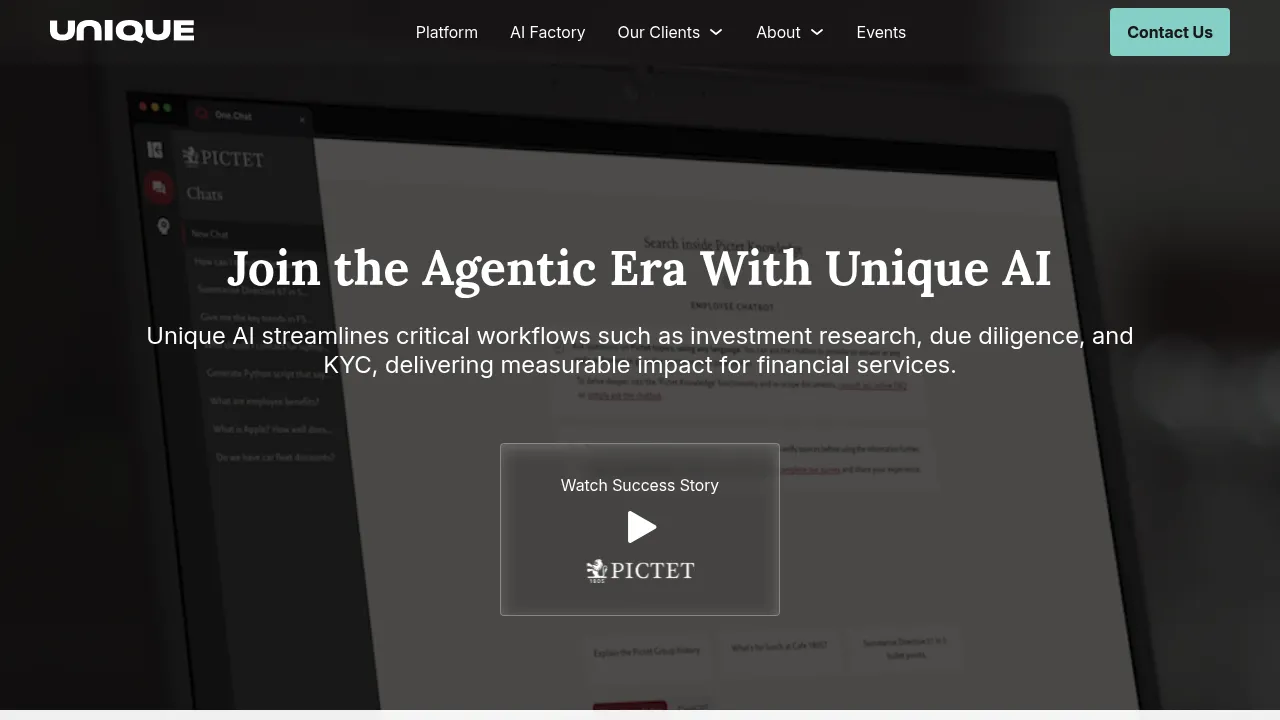
Unique (Unique AI) is an enterprise agentic AI platform designed for financial institutions. The platform combines:
The platform supports both a modular approach (integrating components into an existing AI stack) and a bundled deployment (user interface, agents, connectors, orchestration).