UserEvidence
AI NativeUserEvidence is the customer evidence platform for GTM teams.
MarketsCustomer Advocacy
UserEvidence is the customer evidence platform for GTM teams.
Published Oct 15, 2026
Public review excerpts also identified concrete gaps and feature requests:
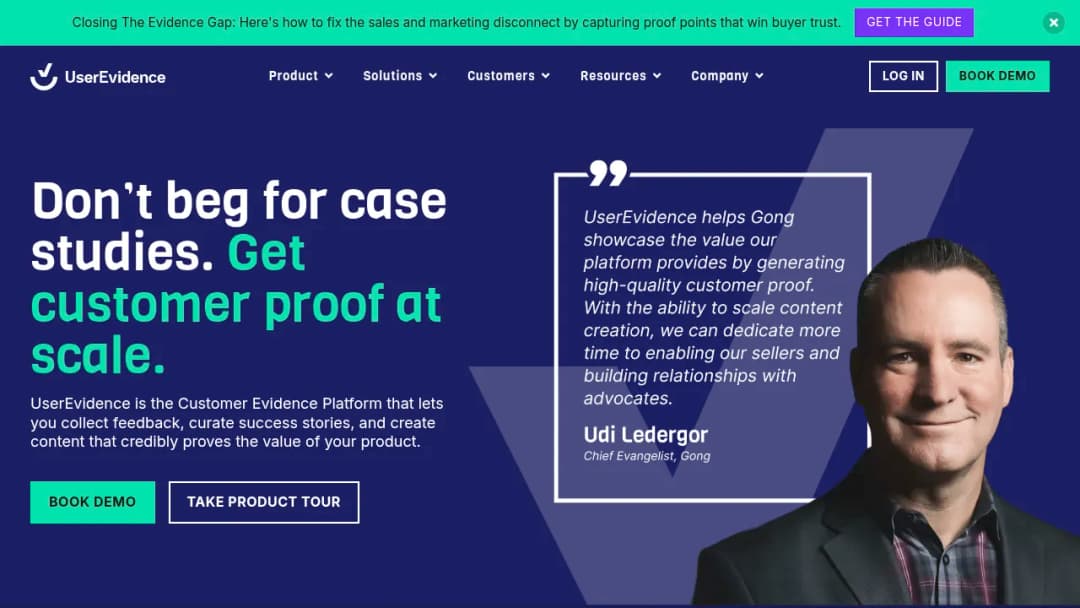
The vendor homepage includes endorsements from customer marketing and product leaders at several brands. These vendor-selected testimonials illustrate positioning but should not be treated as representative of the full customer base.
No substantive public discussions were found on Reddit or Hacker News in the accessible results. This may indicate limited public discussion in those forums, private community discussion, or discoverability limitations during the research run.
Implication: Buyers seeking candid feedback beyond review platforms may consider reference calls or sampling peer communities focused on customer marketing and revenue operations.
Vendor blog content describes internal sales enablement use of evidence assets (e.g., Slack integration and bundling testimonials with proposals).
Critical evaluation:
Based on positioning and third-party pricing signals, the best fit appears to be mid-market to enterprise B2B SaaS organizations. The vendor’s stated heuristic suggests organizations with a substantive base of end users supply a meaningful pool for ongoing feedback collection.
Decision makers and champions:
End users:
Get a comprehensive analysis of UserEvidence including market position, competitive landscape, adoption trends, and peer benchmarks.
Download full report →Organizations prioritizing a community-first advocacy program. If the core strategy depends on a robust customer community, engagement mechanics, and gamification, a community-focused platform may be preferable.
Teams requiring transparent, self-serve pricing and a free trial. The vendor does not publish pricing or offer apparent self-serve trials based on reviewed sources.
Buyers whose primary need is strict reference management governance rather than evidence content. For organizations needing complex reference routing and approvals, a dedicated reference management tool may be more suitable (although the vendor’s acquisition of Zealot indicates movement into this space).
Research teams requiring advanced survey features. If matrix questions, complex branching logic, and extensive cross-tab analysis are primary needs, a dedicated VoC or research platform may be a better fit.
Buyers who will not accept vendor-commissioned research without independent validation. In some regulated or highly risk-averse purchase contexts, prospects may prefer independent analyst reports, third-party audits, or peer references.
Where competitors have advantages: community engagement, reference governance, and long-established survey-to-asset validation workflows remain competitive strengths for other vendors.
The following are neutral summaries of reviewer comments captured on public review platforms:
A partner-supplied case study references UserEvidence and includes claims that streamlining compliance operations led to cost savings and that achieving SOC 2 enabled enterprise sales. The case study includes vendor-provided quotes.
Critical evaluation:
UserEvidence publishes a research methodology page that states identity verification using corporate email domain checks and bot/AI deflection, transparency with reported sample sizes, and access to de-identified raw data behind statistics. The vendor also publishes playbooks for sales enablement.
Critical evaluation:
UserEvidence is a customer evidence platform for B2B go-to-market teams. The primary functions are to collect customer feedback via surveys, imported third‑party reviews, and call transcripts; select and organize relevant proof points (quotes, statistics, ROI claims, competitive-switching stories); and distribute those assets to Sales, Marketing, and Customer Success systems and workflows (e.g., Slack, Seismic, Highspot, Salesforce).
In practice, the product operates at the intersection of:
UserEvidence primarily targets B2B software companies with a substantial installed base. The vendor focuses on organizations selling higher-value products in competitive markets, where buyer confidence and deal evidence are recurring sales friction points. It also targets teams that must support numerous permutations of industry, geography, persona, and use case without producing bespoke case studies for each instance.
The vendor website lists suggested customer criteria, including working at a B2B software company, selling higher-priced products in competitive markets, and having a minimum base of end users to support ongoing feedback collection.