Workspace
    • Briefing
    • Ask Airframe
    Transformation
    • Audit
    Your Stack
    • Registry
    • Finance
    • Context
    Discover
    Powered by Airframe
    1. Research
    2. /
    3. Products
    4. /
    5. Yellow.ai
    Yellow.ai

    Yellow.ai

    Leader

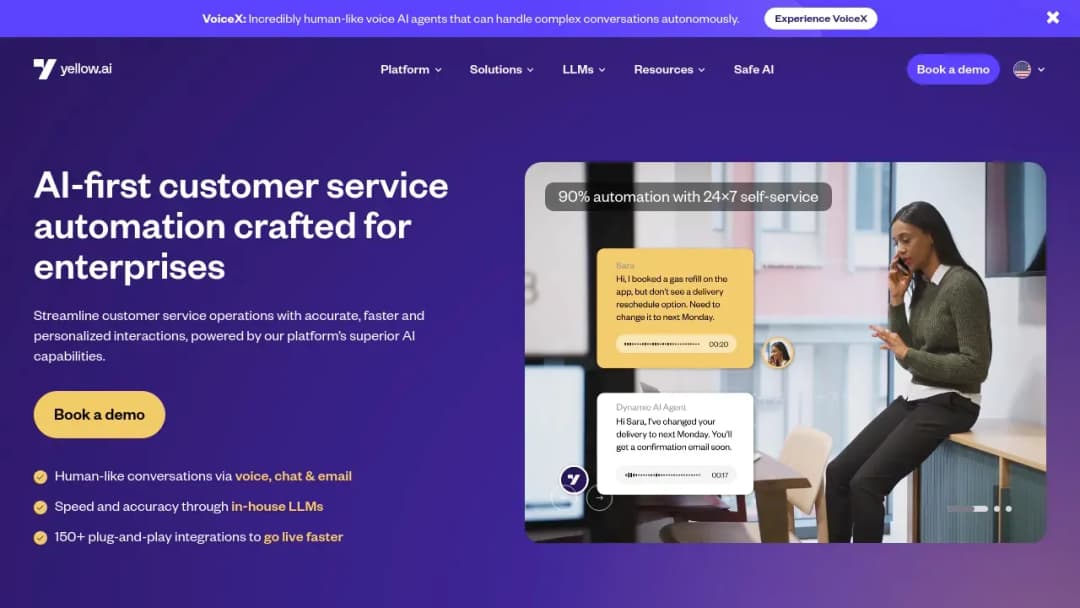
    AI-first customer service automation crafted for enterprises

    Est 2015|Valuation $550M|Raised $132.9M|165 Ref Customers
    LinkedIn 186K|Web traffic 395K|FTEs 1,055|HQ San Mateo, CA
    MarketsVoice AI AgentsAgent Builder Platforms
    Platform CoversContact Center as a Service (CCaaS)CS AI AgentCS Knowledge Management System (KMS)Interactive Voice Response (IVR)AI Assistant
    Yellow.ai screenshot
    FirmCompareTractionAnalysisAdvocates

    Insights

    All insightsAccountingFinanceSoftwareCustomer experience

    Benchmarks

    The Software LeaderboardMethodology

    Tools & data

    Market ExplorerStudioRegistry

    Company

    AboutCareers

    Legal

    Privacy PolicyTerms of Service

    © 2026 Airframe, Inc. All rights reserved.

      Published Oct 16, 2026

      01Common complaints

      - If the organization is a small team with low ticket volume - A full conversational AI platform can be disproportionate to needs; lighter tools or helpdesk-native AI may provide similar results with lower implementation overhead. - If highly deterministic, tightly governed workflows with minimal drift are required - Review reports of incorrect journey matching and instability in some deployments indicate careful testing is required for deterministic workflows. - If maximum pricing transparency and contractual terms are required upfront - Enterprise tier requires engagement with sales for detailed pricing, making immediate budget certainty difficult. - If extensive, community-driven implementation knowledge is required - Compared with larger ecosystems (e.g., Intercom/Zendesk), public implementation artifacts and community content for Yellow.ai appear more limited; buyers may rely more on vendor references. - If the organization already relies on a contact center suite with integrated AI - Adding a separate platform may increase integration overhead and complexity. - Limitations observed in reviews - Stability and change-management issues in complex bots have been reported by some users. - Limited customization for specific edge-case enterprise requirements has been noted in review summaries. - Learning curve and implementation complexity are recurring themes. - Roadmap and feature availability - No specific, independently verified public roadmap dates were retrieved in this run; buyers should request roadmap details in procurement conversations. - Scale limitations - The vendor markets enterprise scale, but independent evidence for maximum concurrent sessions, latency under load, and rate limits was not found in this research run; validate with performance testing and SLAs. - Security/compliance gaps - Certifications are vendor-claimed; request audit artifacts and verify scope and control coverage. - API limitations or integration constraints - Validate listed integrations for write-back support, real-time eventing, error handling, retries, and observability rather than assuming all listed integrations satisfy enterprise requirements.

      02Why they buy

      - Multi-LLM architecture (vendor claim) - Vendor states the platform supports multiple LLM providers, which may allow routing tasks to different models for cost or performance reasons. Buyers should validate operational details: model routing, evaluation tools, BYO-model support, and data handling per provider. - Omnichannel and multi-modal support (vendor positioning) - The platform is positioned to support voice, chat, and email while maintaining conversational context across channels. - Testing and debugging tooling (vendor claim) - The vendor highlights automated testing and tools intended to assist debugging; buyers should validate the robustness of regression testing and other tooling in product demos and evaluation trials. - Balance note - Some purported advantages are positioning statements and should be validated in trials and reference checks; competing platforms also market multi-LLM and omnichannel capabilities.

      03Field reports

      - Review platforms (G2, Gartner Peer Insights, TrustRadius) - G2 - Rating snapshot: a positive rating with a moderate review footprint on the product reviews page at time of access. - Positive themes from reviews: reported ease of use for flow design, integration capabilities, and instances of supportive customer support. - Negative themes from reviews: limited customization in some cases, learning curve, and implementation challenges reported by some customers. - Example user quote (G2 review excerpt): - "The best part is building the flow of conversation using flow diagrams…" (user-generated comment). - Reported dislikes in some reviews include bot dysfunction, backend instability, incorrect journey matching, and slow media uploads. - Gartner Peer Insights - Gartner’s vendor page lists Yellow.ai in the Conversational AI Platforms market with a consistently positive rating and a moderate number of reviews visible in summaries; detailed content may require login. - TrustRadius - Limited data for Yellow.ai in the retrieved comparison views; some pages require contacting the vendor for pricing and detailed information. - Community/social (Reddit, Hacker News) - Reddit contains limited high-signal implementation retrospectives for Yellow.ai compared with more widely discussed vendors; posts are typically questions or short evaluation notes rather than detailed production case studies. - Hacker News searches did not surface prominent discussion threads in accessible results; community visibility appears limited. - Reasons customers reported selecting the product (as suggested by reviews) - Visual/flow-based conversation design and low-code options are recurring positive points in reviews. - Integration breadth is emphasized in vendor material and appears in review summaries. - Reasons some customers migrated to competitors (churn drivers suggested by reviews) - Direct churn narratives were not strongly present in accessible sources; however, complaints such as backend instability, incorrect routing/matching, and tooling issues are plausible reasons for platform changes. - Specific outcomes customers reported (vendor-published) - Vendor case studies claim outcomes such as high automation/containment rates and cost savings in customer deployments. These are vendor-published outcomes without independently published methodology in the sources retrieved; treat them as directional and validate via reference calls. - Vendor-published case studies (examples) - InteleTravel - Vendor quote: onboarding and implementation described as smooth and on-time. - Critical take: qualitative testimonial that lacks quantitative metrics (containment rate, CSAT change, baseline) in the public case study. - VIPdesk - Vendor claim: launched in six weeks and automated a large share of interactions (vendor-reported as a high proportion). - Critical take: the metric is material if accurate, but methodology (what constitutes an interaction, escalation rules, time window) is not described publicly and should be validated. - Waste Connections - Vendor claim: substantial cost savings over a year and high customer satisfaction. - Critical take: large savings claims are plausible for large contact centers but require the business case model, assumptions, and distinction between hard-dollar reductions and avoided hires to be validated. - Summary - Case studies provide directional evidence of potential outcomes; buyers should request reference calls and detailed methodology for claimed metrics.

      04Best fit

      Ideal Customer Profile

      - Company sizes - Typical fit (inferred from positioning and procurement patterns): mid-market to large enterprise — organizations ranging from hundreds to many thousands of employees; contact centers or service organizations with substantial ticket volumes where automation materially affects cost. - Industries and verticals where adoption is strongest - Based on vendor case studies and reviewer filters: logistics, travel/hospitality, utilities, financial services, BPO/outsourcing, and large support organizations. - Roles and personas - Decision makers: VP/Head of Customer Support, Contact Center Director, CIO/CTO, Head of Digital/Automation/AI. - End users: conversation designers, CX operations analysts, support team leads, integration engineers, and platform administrators. - Pain points and challenges the product addresses - High ticket volumes with repetitive queries, after-hours coverage via voice automation, omnichannel fragmentation, and the need for faster deployment via prebuilt connectors. - Qualification criteria (what indicates a good fit) - Organizations that require voice, chat, and email automation in a single platform; those able to invest in ongoing bot lifecycle management (testing, analytics, and optimization); and those with established KPIs (containment, deflection, CSAT, AHT) and baseline measurements. - Deal disqualifiers (what indicates a poor fit) - Organizations seeking fully transparent enterprise pricing without a sales process; organizations lacking owners for conversational design and knowledge upkeep; workflows that are simple enough that a helpdesk-native bot or smaller chatbot solution would be more appropriate.
      05The pitch

      What the product does (core value proposition in objective terms)

      - Yellow.ai is an enterprise conversational automation platform the vendor describes using the term "agentic AI" for customer experience (CX) and employee experience (EX). - It focuses on building, testing, deploying, and optimizing AI agents that can handle conversations across channels (voice, chat, email) and connect to business systems via pre-built integrations. - Vendor claims include: - Multi-LLM architecture (vendor states use of multiple LLMs) to select models by task and reduce dependence on a single LLM provider. - Omnichannel support (voice, chat, email) with conversations intended to approximate human agents. - Numerous prebuilt integrations to accelerate deployments. - Vendor-provided customer count claims; these are vendor statements and should be validated independently.

      Target market and market positioning

      • Marketed primarily to enterprises and larger organizations running contact centers / customer service operations, and to internal service desks (EX) where automation can reduce manual volume.
      • Competes in the "Conversational AI Platforms / AI agent platforms / customer service automation" category alongside Kore.ai, Cognigy, Ada, IBM watsonx Assistant, Google CCAI, and others.

      Get a comprehensive analysis of Yellow.ai including market position, competitive landscape, adoption trends, and peer benchmarks.

      Download full report →
      • If the organization is a small team with low ticket volume

        • A full conversational AI platform can be disproportionate to needs; lighter tools or helpdesk-native AI may provide similar results with lower implementation overhead.
      • If highly deterministic, tightly governed workflows with minimal drift are required

        • Review reports of incorrect journey matching and instability in some deployments indicate careful testing is required for deterministic workflows.
      • If maximum pricing transparency and contractual terms are required upfront

        • Enterprise tier requires engagement with sales for detailed pricing, making immediate budget certainty difficult.
      • If extensive, community-driven implementation knowledge is required

        • Compared with larger ecosystems (e.g., Intercom/Zendesk), public implementation artifacts and community content for Yellow.ai appear more limited; buyers may rely more on vendor references.
      • If the organization already relies on a contact center suite with integrated AI

        • Adding a separate platform may increase integration overhead and complexity.
      • Limitations observed in reviews

        • Stability and change-management issues in complex bots have been reported by some users.
        • Limited customization for specific edge-case enterprise requirements has been noted in review summaries.
        • Learning curve and implementation complexity are recurring themes.
      • Roadmap and feature availability

        • No specific, independently verified public roadmap dates were retrieved in this run; buyers should request roadmap details in procurement conversations.
      • Scale limitations

        • The vendor markets enterprise scale, but independent evidence for maximum concurrent sessions, latency under load, and rate limits was not found in this research run; validate with performance testing and SLAs.
      • Security/compliance gaps

        • Certifications are vendor-claimed; request audit artifacts and verify scope and control coverage.
      • API limitations or integration constraints

        • Validate listed integrations for write-back support, real-time eventing, error handling, retries, and observability rather than assuming all listed integrations satisfy enterprise requirements.
      • Multi-LLM architecture (vendor claim)
        • Vendor states the platform supports multiple LLM providers, which may allow routing tasks to different models for cost or performance reasons. Buyers should validate operational details: model routing, evaluation tools, BYO-model support, and data handling per provider.
      • Omnichannel and multi-modal support (vendor positioning)
        • The platform is positioned to support voice, chat, and email while maintaining conversational context across channels.
      • Testing and debugging tooling (vendor claim)
        • The vendor highlights automated testing and tools intended to assist debugging; buyers should validate the robustness of regression testing and other tooling in product demos and evaluation trials.
      • Balance note
        • Some purported advantages are positioning statements and should be validated in trials and reference checks; competing platforms also market multi-LLM and omnichannel capabilities.
      • Review platforms (G2, Gartner Peer Insights, TrustRadius)

        • G2
          • Rating snapshot: a positive rating with a moderate review footprint on the product reviews page at time of access.
          • Positive themes from reviews: reported ease of use for flow design, integration capabilities, and instances of supportive customer support.
          • Negative themes from reviews: limited customization in some cases, learning curve, and implementation challenges reported by some customers.
          • Example user quote (G2 review excerpt):
            • "The best part is building the flow of conversation using flow diagrams…" (user-generated comment).
            • Reported dislikes in some reviews include bot dysfunction, backend instability, incorrect journey matching, and slow media uploads.
        • Gartner Peer Insights
          • Gartner’s vendor page lists Yellow.ai in the Conversational AI Platforms market with a consistently positive rating and a moderate number of reviews visible in summaries; detailed content may require login.
        • TrustRadius
          • Limited data for Yellow.ai in the retrieved comparison views; some pages require contacting the vendor for pricing and detailed information.
      • Community/social (Reddit, Hacker News)

        • Reddit contains limited high-signal implementation retrospectives for Yellow.ai compared with more widely discussed vendors; posts are typically questions or short evaluation notes rather than detailed production case studies.
        • Hacker News searches did not surface prominent discussion threads in accessible results; community visibility appears limited.
      • Reasons customers reported selecting the product (as suggested by reviews)

        • Visual/flow-based conversation design and low-code options are recurring positive points in reviews.
        • Integration breadth is emphasized in vendor material and appears in review summaries.
      • Reasons some customers migrated to competitors (churn drivers suggested by reviews)

        • Direct churn narratives were not strongly present in accessible sources; however, complaints such as backend instability, incorrect routing/matching, and tooling issues are plausible reasons for platform changes.
      • Specific outcomes customers reported (vendor-published)

        • Vendor case studies claim outcomes such as high automation/containment rates and cost savings in customer deployments. These are vendor-published outcomes without independently published methodology in the sources retrieved; treat them as directional and validate via reference calls.
      • Vendor-published case studies (examples)

        • InteleTravel
          • Vendor quote: onboarding and implementation described as smooth and on-time.
          • Critical take: qualitative testimonial that lacks quantitative metrics (containment rate, CSAT change, baseline) in the public case study.
        • VIPdesk
          • Vendor claim: launched in six weeks and automated a large share of interactions (vendor-reported as a high proportion).
          • Critical take: the metric is material if accurate, but methodology (what constitutes an interaction, escalation rules, time window) is not described publicly and should be validated.
        • Waste Connections
          • Vendor claim: substantial cost savings over a year and high customer satisfaction.
          • Critical take: large savings claims are plausible for large contact centers but require the business case model, assumptions, and distinction between hard-dollar reductions and avoided hires to be validated.
      • Summary

        • Case studies provide directional evidence of potential outcomes; buyers should request reference calls and detailed methodology for claimed metrics.
      • Company sizes

        • Typical fit (inferred from positioning and procurement patterns): mid-market to large enterprise — organizations ranging from hundreds to many thousands of employees; contact centers or service organizations with substantial ticket volumes where automation materially affects cost.
      • Industries and verticals where adoption is strongest

        • Based on vendor case studies and reviewer filters: logistics, travel/hospitality, utilities, financial services, BPO/outsourcing, and large support organizations.
      • Roles and personas

        • Decision makers: VP/Head of Customer Support, Contact Center Director, CIO/CTO, Head of Digital/Automation/AI.
        • End users: conversation designers, CX operations analysts, support team leads, integration engineers, and platform administrators.
      • Pain points and challenges the product addresses

        • High ticket volumes with repetitive queries, after-hours coverage via voice automation, omnichannel fragmentation, and the need for faster deployment via prebuilt connectors.
      • Qualification criteria (what indicates a good fit)

        • Organizations that require voice, chat, and email automation in a single platform; those able to invest in ongoing bot lifecycle management (testing, analytics, and optimization); and those with established KPIs (containment, deflection, CSAT, AHT) and baseline measurements.
      • Deal disqualifiers (what indicates a poor fit)

        • Organizations seeking fully transparent enterprise pricing without a sales process; organizations lacking owners for conversational design and knowledge upkeep; workflows that are simple enough that a helpdesk-native bot or smaller chatbot solution would be more appropriate.
      • Yellow.ai is an enterprise conversational automation platform the vendor describes using the term "agentic AI" for customer experience (CX) and employee experience (EX).
      • It focuses on building, testing, deploying, and optimizing AI agents that can handle conversations across channels (voice, chat, email) and connect to business systems via pre-built integrations.
      • Vendor claims include:
        • Multi-LLM architecture (vendor states use of multiple LLMs) to select models by task and reduce dependence on a single LLM provider.
        • Omnichannel support (voice, chat, email) with conversations intended to approximate human agents.
        • Numerous prebuilt integrations to accelerate deployments.
        • Vendor-provided customer count claims; these are vendor statements and should be validated independently.