Workspace
    • Briefing
    • Ask Airframe
    Transformation
    • Audit
    Your Stack
    • Registry
    • Finance
    • Context
    Discover
    Powered by Airframe
    1. Research
    2. /
    3. Products
    4. /
    5. Cust
    Cust

    Cust

    AI Native

    AI for retention

    Est 2023|Raised $110K
    LinkedIn 542|Website|FTEs 4|HQ Vilnius, lt
    MarketsCustomer Success Platforms (CSP)Customer Health ScoringRenewals & Expansion Management
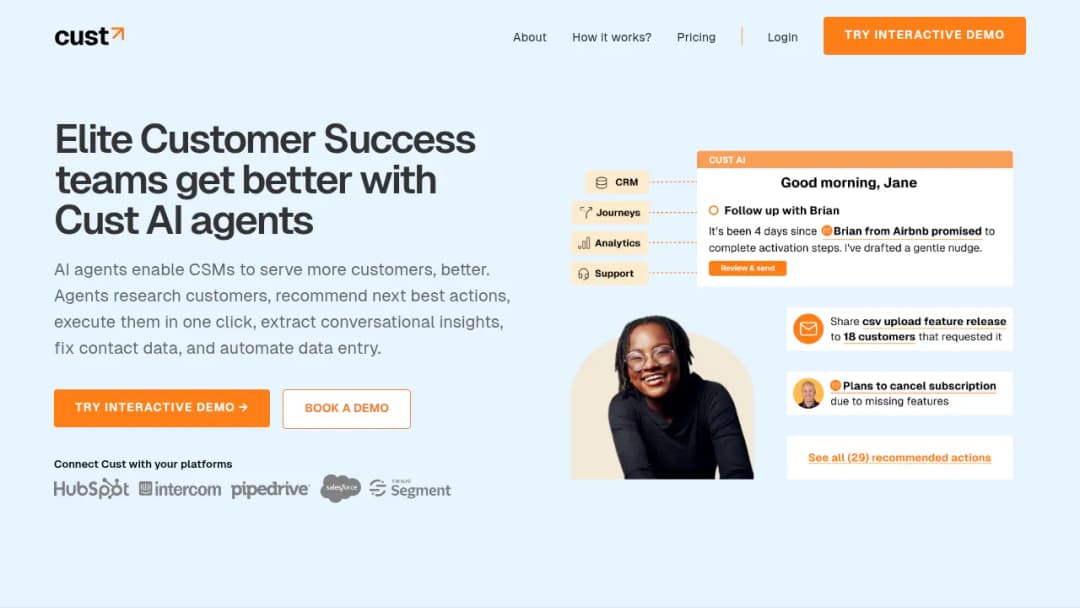
    Cust screenshot
    FirmCompareTractionAnalysisAdvocates

    Insights

    All insightsAccountingFinanceSoftwareCustomer experience

    Benchmarks

    The Software LeaderboardMethodology

    Tools & data

    Market ExplorerStudioRegistry

    Company

    AboutCareers

    Legal

    Privacy PolicyTerms of Service

    © 2026 Airframe, Inc. All rights reserved.

      Published Sep 24, 2026

      01Common complaints

      - Company sizes or stages where this product is overkill or insufficient - Overkill: - Very early startups with fewer than ~50–100 paying customers where founders or a small team can manage retention manually. - Potentially insufficient (buyers should validate): - Large enterprises that require mature governance, rigorous audit trails, and extensive global compliance documentation; these buyers may prefer vendors with a long enterprise track record. - Industries or use cases where competitors are clearly superior - Heavily regulated industries with extensive vendor risk requirements may prefer vendors with publicly documented enterprise compliance portfolios and broad reference bases. - Technical requirements that this product may not meet (validation required) - Buyers should validate availability and configuration of SSO/SAML and SCIM, audit log detail and retention, explicit data residency guarantees, and API coverage and rate limits. - Budget constraints that make alternatives more appropriate - Teams that find $500/month for 100 monitored accounts unaffordable may consider lighter-weight combinations of CRM + analytics + support tooling, or lower-cost CSPs targeted at SMBs. - Specific workflows or integrations where the product may fall short - Organizations that require complex, deterministic multi-step orchestration with strict programmatic controls may find established CSPs more appropriate depending on feature parity and integration depth. - Red flags in the buying process (procurement items to confirm) - Confirm contract terms, service-level agreements (SLAs), data processing addenda, and proof of security certifications during procurement. - Current limitations acknowledged by the vendor - No explicit public list of product "known issues" was located in accessible materials. - Features on the roadmap (not yet available) - No public roadmap items with estimated dates were located in the sources accessed. - Scale limitations (at what volume/size does it break down?) - Not documented in publicly accessible sources. The vendor states large numbers of monitored end customers but does not publish methodology or scaling benchmarks publicly. - Security or compliance gaps - While the vendor references SOC 2 Type II and GDPR/HIPAA compliance in materials, specific operational controls (SSO/SCIM, audit log depth, data residency specifics) were not publicly evidenced in the sources accessed and should be validated through the vendor trust portal or contract review. - Technical debt or architectural limitations mentioned in reviews - Not available due to limited public review volume. - API limitations or integration constraints - Integration depth and API constraints (e.g., two-way sync, rate limits, historical backfill) were not documented in the public materials for this research and should be tested during technical evaluation.
      Deal disqualifiers: what makes a POOR fit

      • Very small customer bases where manual, high-touch coverage is feasible
      • Organizations with strict policies against processing customer communications with AI or that require on-premise-only controls
      • Teams that require fully deterministic, rule-driven playbooks and resist automated recommendations

      Why some customers left for competitors (churn reasons)

      • No public evidence in accessible sources about reasons customers left Cust for competitors.

      02Why they buy

      - Competitive advantages supported by customer feedback (not just vendor claims) - Public feedback is limited; Gartner reviewer comments indicate the product can produce less template-oriented and more personalized outputs and that AI integration is perceived as helpful. - Unique features and capabilities (vendor positioning) - The vendor emphasizes automated agents that research customer accounts and generate recommended actions and artifacts; buyers should validate the capability and its operational limits during trials. - Differentiation from competitors based on reviews - There is insufficient comparative review text to establish stable differentiation in the market beyond vendor positioning. - Value propositions with evidence from case studies - Vendor-published metrics exist but lack transparent methodology and third-party validation; buyers should request methodology and references. - Areas where competitors have advantages - Established CSPs (e.g., Gainsight, ChurnZero) generally have larger ecosystems, more public references, and mature patterns for enterprise CS operations.

      Why customers chose this product over alternatives

      • Inferred from vendor positioning and available review text:
        • Preference for more personalized automated output rather than rigid templates
        • Interest in AI-assisted identification of account issues

      03Field reports

      Direct quotes from Gartner Peer Insights, Reddit, TrustRadius, G2, HackerNews

      - Gartner Peer Insights (very limited public review sample) - Positive/neutral excerpts: - "I like that Cust gives the option to be less template oriented, less robotic and more personalized." - "I also love the use of AI integration. This assists with identifying any issues that a client may have and tailoring to better suit their needs." - Negative excerpt: - "The main thing that I dislike about the product is the pricing. It also takes a little time to learn and catch on to how to use the product." - G2 - The vendor has a seller page indicating some public reviews and an average rating visible in public snippets; full-text review content was limited in the accessible snippets for this research. - At least some reviews on the platform are identified as invited reviews, which can indicate vendor-driven review collection; this is a context factor rather than a binary validity determination. - Reddit / HackerNews / TrustRadius - No high-signal Cust-specific discussion threads or review pages were surfaced in the public search results during this research run.

      Balance and sample-size limitations

      • Publicly accessible review volume for Cust is very limited, constraining the ability to weight positive and negative feedback by frequency. Several vendor-published claims exist but lack independent verification in the accessible sources.

      Common criticisms and complaints (support issues, bugs, missing features)

      • From the available Gartner feedback and platform snippets:
        • Pricing is a concern surfaced in the limited Gartner feedback.
        • A learning curve / onboarding time is also mentioned.
      • No broad pattern of bugs or product stability issues was identified in the accessible sources.

      Specific outcomes customers achieved (with metrics when available)

      • Vendor-published performance claims include improvements in net revenue retention and a short time-to-value. These appear in vendor materials and are not accompanied by methodological descriptions or independent validation in the accessible sources.

      Customer pain points and frustrations mentioned in reviews

      • Pricing and onboarding/learning curve are the primary concerns surfaced in the limited public feedback.

      Deal-breakers and reasons customers didn't purchase

      • Not available in accessible public sources.

      Detailed customer success stories with metrics

      - No third-party, independently validated case studies with named customers and methodology were identified in the accessible sources for this research. - The vendor publishes metric claims including: - a large number of end customers monitored - an uplift in net revenue retention (NRR) - very short time-to-value (on the order of days) - These vendor-published metrics do not include methodological details in publicly accessible materials.

      Specific results and quantified business impact

      • Metrics cited by the vendor are not accompanied by an explicit methodology, control groups, or third-party validation in the public materials reviewed.

      Implementation details and time to value

      • Vendor messaging emphasizes rapid go-live and low administrative overhead; independent verification of typical implementation timelines was not located in accessible sources.

      Challenges faced during adoption and how they were resolved

      • No documented third-party accounts of adoption challenges and remediation steps were identified.

      Notes on vendor-published metrics

      • The claims above are vendor-published. Buyers should request methodology, sample sizes, and audit evidence when evaluating marketing metrics.

      04Best fit

      Company sizes: specific employee counts and revenue ranges

      • Based on vendor positioning and pricing model (inference):
        • Likely fit: organizations with small dedicated CS/RevOps teams up through mid-market CS organizations, or small-to-mid-market SaaS vendors where a compact CS team manages a large number of accounts.
        • Rough revenue fit: lower- to mid-market recurring-revenue businesses (varies with customer counts and retention economics).

      Industries and verticals where adoption is strongest (with customer examples)

      • No clear vertical concentration was identified in public sources.
      • An isolated reviewer listed Healthcare / Biotech as their industry, but this appears to be a single data point rather than a trend.

      Roles and personas: decision makers AND end users

      • Decision makers:
        • Head of Customer Success / VP CS
        • RevOps / CS Ops
        • COO (for mid-market buyers)
        • Security/IT for compliance evaluation
      • End users:
        • Customer Success Managers (CSMs) / Account Managers
        • Support leadership (if ticketing is integrated)
        • Renewal managers

      Pain points and challenges the product addresses

      • Providing proactive coverage for many lower-touch accounts
      • Reducing time CSMs spend on manual research and synthesis
      • Consolidating fragmented customer context across CRM, support, email, and product analytics

      Qualification criteria: what makes a GOOD fit

      • A large book of business with many lower-touch accounts
      • Willingness to adopt AI-assisted drafting with human review workflows
      • Sufficient telemetry and CRM/support data to enable signal generation

      Real customer examples with company names when available

      • No named customers were identified in the accessible public sources for this research.

      05The pitch

      What the product does (core value proposition in objective terms)

      - Cust is an AI-focused customer retention / customer success platform that uses automated "agents" to ingest customer data (CRM, email, calendar, support, product analytics, warehouses) to: - Identify signals associated with churn risk and account expansion - Generate recommended actions and artifacts (e.g., QBR briefs, renewal proposals, outreach drafts) - Provide a mechanism to execute multi-step actions from within the tool via a single user action, according to vendor materials - The vendor frames the product as emphasizing automated research, reasoning, and generated work output rather than being primarily a dashboard and rules engine. These are vendor positioning statements and were not independently validated in this research.

      Target market and market positioning

      • Cust targets B2B companies that manage many lower-touch or "long-tail" accounts where customer success (CS) bandwidth is insufficient for proactive coverage of all accounts.
      • The vendor positions Cust as an alternative to established customer success platforms (CSPs) such as Gainsight, Totango, and ChurnZero, and states it offers faster implementation and reduced administrative maintenance. These claims were not independently validated.

      Get a comprehensive analysis of Cust including market position, competitive landscape, adoption trends, and peer benchmarks.

      Download full report →
      • Company sizes or stages where this product is overkill or insufficient

        • Overkill:
          • Very early startups with fewer than ~50–100 paying customers where founders or a small team can manage retention manually.
        • Potentially insufficient (buyers should validate):
          • Large enterprises that require mature governance, rigorous audit trails, and extensive global compliance documentation; these buyers may prefer vendors with a long enterprise track record.
      • Industries or use cases where competitors are clearly superior

        • Heavily regulated industries with extensive vendor risk requirements may prefer vendors with publicly documented enterprise compliance portfolios and broad reference bases.
      • Technical requirements that this product may not meet (validation required)

        • Buyers should validate availability and configuration of SSO/SAML and SCIM, audit log detail and retention, explicit data residency guarantees, and API coverage and rate limits.
      • Budget constraints that make alternatives more appropriate

        • Teams that find $500/month for 100 monitored accounts unaffordable may consider lighter-weight combinations of CRM + analytics + support tooling, or lower-cost CSPs targeted at SMBs.
      • Specific workflows or integrations where the product may fall short

        • Organizations that require complex, deterministic multi-step orchestration with strict programmatic controls may find established CSPs more appropriate depending on feature parity and integration depth.
      • Red flags in the buying process (procurement items to confirm)

        • Confirm contract terms, service-level agreements (SLAs), data processing addenda, and proof of security certifications during procurement.
      • Current limitations acknowledged by the vendor

        • No explicit public list of product "known issues" was located in accessible materials.
      • Features on the roadmap (not yet available)

        • No public roadmap items with estimated dates were located in the sources accessed.
      • Scale limitations (at what volume/size does it break down?)

        • Not documented in publicly accessible sources. The vendor states large numbers of monitored end customers but does not publish methodology or scaling benchmarks publicly.
      • Security or compliance gaps

        • While the vendor references SOC 2 Type II and GDPR/HIPAA compliance in materials, specific operational controls (SSO/SCIM, audit log depth, data residency specifics) were not publicly evidenced in the sources accessed and should be validated through the vendor trust portal or contract review.
      • Technical debt or architectural limitations mentioned in reviews

        • Not available due to limited public review volume.
      • API limitations or integration constraints

        • Integration depth and API constraints (e.g., two-way sync, rate limits, historical backfill) were not documented in the public materials for this research and should be tested during technical evaluation.
      • Competitive advantages supported by customer feedback (not just vendor claims)
        • Public feedback is limited; Gartner reviewer comments indicate the product can produce less template-oriented and more personalized outputs and that AI integration is perceived as helpful.
      • Unique features and capabilities (vendor positioning)
        • The vendor emphasizes automated agents that research customer accounts and generate recommended actions and artifacts; buyers should validate the capability and its operational limits during trials.
      • Differentiation from competitors based on reviews
        • There is insufficient comparative review text to establish stable differentiation in the market beyond vendor positioning.
      • Value propositions with evidence from case studies
        • Vendor-published metrics exist but lack transparent methodology and third-party validation; buyers should request methodology and references.
      • Areas where competitors have advantages
        • Established CSPs (e.g., Gainsight, ChurnZero) generally have larger ecosystems, more public references, and mature patterns for enterprise CS operations.
      • Gartner Peer Insights (very limited public review sample)
        • Positive/neutral excerpts:
          • "I like that Cust gives the option to be less template oriented, less robotic and more personalized."
          • "I also love the use of AI integration. This assists with identifying any issues that a client may have and tailoring to better suit their needs."
        • Negative excerpt:
          • "The main thing that I dislike about the product is the pricing. It also takes a little time to learn and catch on to how to use the product."
      • G2
        • The vendor has a seller page indicating some public reviews and an average rating visible in public snippets; full-text review content was limited in the accessible snippets for this research.
        • At least some reviews on the platform are identified as invited reviews, which can indicate vendor-driven review collection; this is a context factor rather than a binary validity determination.
      • Reddit / HackerNews / TrustRadius
        • No high-signal Cust-specific discussion threads or review pages were surfaced in the public search results during this research run.
      • No third-party, independently validated case studies with named customers and methodology were identified in the accessible sources for this research.
      • The vendor publishes metric claims including:
        • a large number of end customers monitored
        • an uplift in net revenue retention (NRR)
        • very short time-to-value (on the order of days)
      • These vendor-published metrics do not include methodological details in publicly accessible materials.
      • Cust is an AI-focused customer retention / customer success platform that uses automated "agents" to ingest customer data (CRM, email, calendar, support, product analytics, warehouses) to:
        • Identify signals associated with churn risk and account expansion
        • Generate recommended actions and artifacts (e.g., QBR briefs, renewal proposals, outreach drafts)
        • Provide a mechanism to execute multi-step actions from within the tool via a single user action, according to vendor materials
      • The vendor frames the product as emphasizing automated research, reasoning, and generated work output rather than being primarily a dashboard and rules engine. These are vendor positioning statements and were not independently validated in this research.