| Aspect | Cust | Gainsight | ChurnZero |
|--------|------|-----------|-----------|
| Starting Price | Published entry pricing for a monitored-account tier (vendor-published; entry tier covers a specified number of monitored accounts) | Sales-led / custom pricing (available on request) | Sales-led / custom pricing (available on request) |
| Suggested fit | Teams seeking automated, AI-based retention insights and transparent entry pricing tied to monitored accounts (as positioned by the vendor) | Larger or more mature CS organizations needing configurable customer data models, playbooks, scorecards, dashboards, surveys and enterprise governance | CS organizations seeking mature operations tooling with real-time workflows and established vendor support models |
| Key Strength | Emphasis on automated analysis and generated artifacts (vendor positioning); public entry pricing | Platform depth, established customer base, and mature enterprise feature set | Established CSP product with operational workflow capabilities and integrations |
| Key Weakness | Limited independent validation, limited public review footprint, and potential governance questions regarding automated recommendations | Reported complexity and higher implementation/admin requirements in community and vendor discussions | Public pricing is sales-led; real-world total cost can vary based on modules and implementation |
Narrative analysis
- Direct competitors and their key differentiators
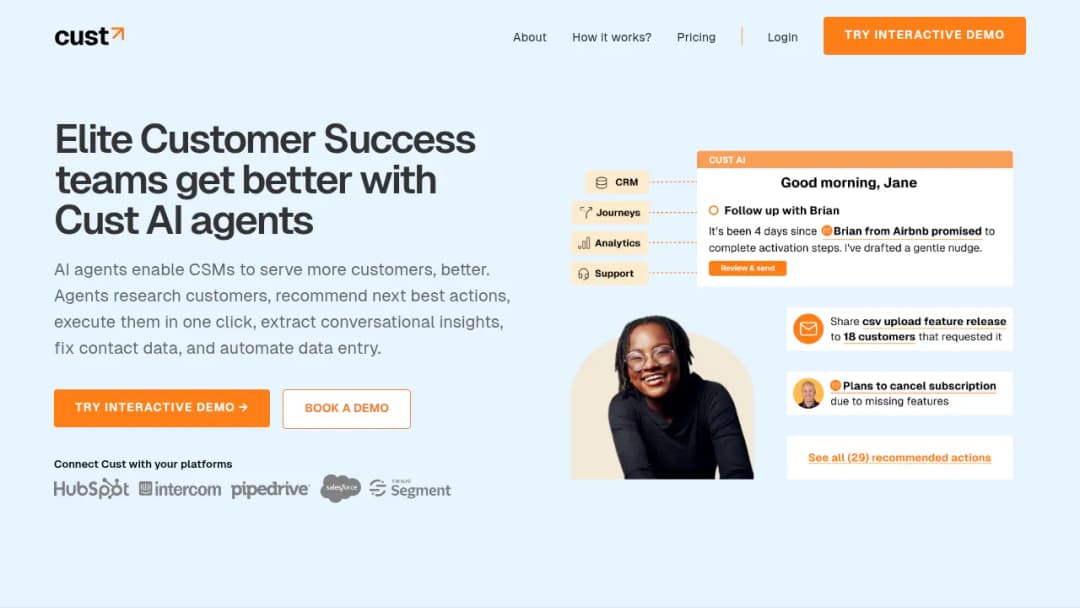
- Cust differentiates in vendor messaging by highlighting automated research/analysis and generated work artifacts rather than only dashboards and rule engines. These are vendor positioning claims that should be validated in trials.
- Gainsight emphasizes a broad platform with extensive enterprise governance, customer 360, and community/ecosystem support.
- ChurnZero emphasizes operational workflows and real-time tooling for CS teams.
- Feature comparison: where this product appears to excel vs where it may lag
- Potential strengths (based on vendor design and limited customer comments):
- Automated generation of written artifacts (QBRs, renewal drafts, outreach templates) and consolidated summaries of multi-source customer context
- Entry pricing transparency for the monitored-account model
- Potential areas to validate and compare with established CSPs:
- Ability to support deeply customized enterprise workflows and complex orchestration
- Deterministic control for teams that prefer explicit rule-driven playbooks
- Depth of reporting/BI and clarity of data models
- Auditability and explainability of automated recommendations
- Pricing comparison: value proposition vs alternatives
- Cust provides public pricing for entry tiers; many established CSPs are sales-led and do not publish standard entry prices. Third-party pricing explainers suggest established CSPs can be meaningfully more expensive in many mid-market configurations, but these comparisons are directional and dependent on configuration.
- Customer testimonials comparing products
- Vendor materials include comparative messaging regarding total cost of ownership and administrative overhead versus established CSPs; these are marketing claims and should be validated with reference checks and proof points.
- Market share and adoption trends
- Publicly available data did not allow quantification of Cust's market share. Adoption indicators are limited in public sources.
- Typical reasons buyers select established competitors
- Need for proven enterprise deployments with many public references
- Preference for deterministic, rule-based orchestration and mature governance
- Availability of admins, consultants, and integration partners experienced with incumbent platforms