- What the product does (core value proposition in objective terms)
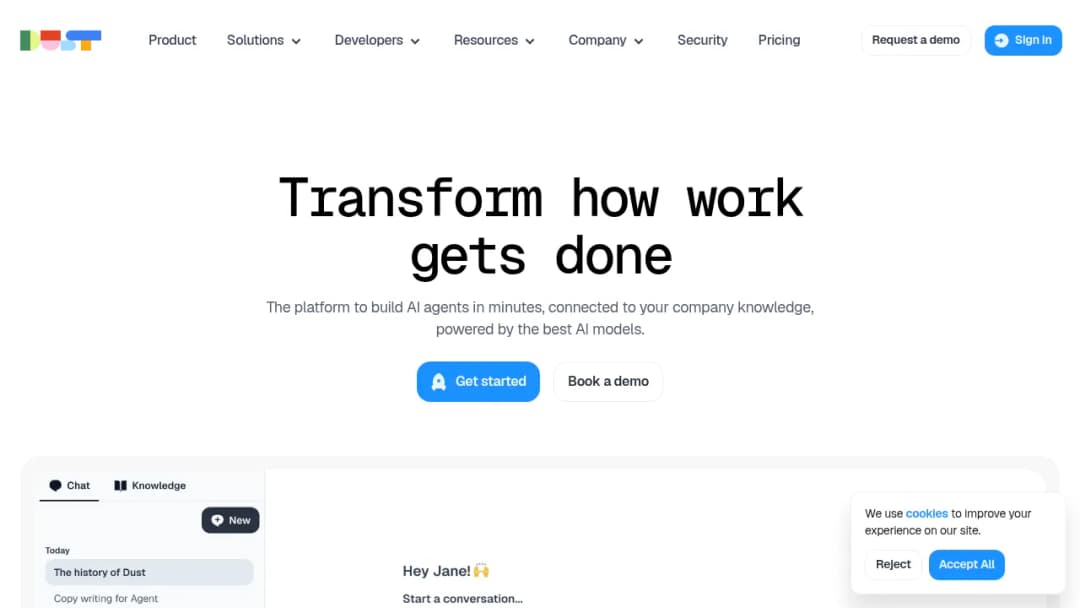
- Dust is a B2B “agent platform” for creating, deploying, and managing custom AI agents connected to internal company data (e.g., Google Drive, Notion, Slack, GitHub) and callable via a web workspace, Slack, browser extension, and API. ([dust.tt](https://dust.tt/?utm_source=openai))
- It positions itself as a shared (“multiplayer”) workspace where teams build and reuse agents (not just individual copilots). ([dust.tt](https://dust.tt/?utm_source=openai))
- Target market and market positioning
- Dust targets teams that want to operationalize internal AI assistants/agents with governance, integrations, and shareable configurations—often described as “enterprise AI assistants connected to internal data.” ([techcrunch.com](https://techcrunch.com/2024/06/27/dust-grabs-another-16-million-for-its-enterprise-ai-assistants-connected-to-internal-data/?utm_source=openai))
- The docs indicate a dividing line where “Pro” is aimed at companies under 100 employees, while larger companies are routed to Enterprise sales. ([docs.dust.tt](https://docs.dust.tt/docs/subscriptions?utm_source=openai))
- Company background (founding year, HQ, key leadership)
- Founded: 2023. ([gartner.com](https://www.gartner.com/reviews/product/dust-363291154?utm_source=openai))
- HQ: Paris, France. ([gartner.com](https://www.gartner.com/reviews/product/dust-363291154?utm_source=openai))
- Leadership: Third-party profiles and press commonly associate the company with Stanislas Polu and/or CEO/co-founder Gabriel Hubert; however, leadership details are not consistently presented across sources and should be verified directly with Dust during procurement. ([techcrunch.com](https://techcrunch.com/2024/06/27/dust-grabs-another-16-million-for-its-enterprise-ai-assistants-connected-to-internal-data/?utm_source=openai))
- Funding and growth: investment rounds, acquisitions, estimated customer count/revenue if public
- TechCrunch reported a $16M Series A led by Sequoia Capital (June 27, 2024). ([techcrunch.com](https://techcrunch.com/2024/06/27/dust-grabs-another-16-million-for-its-enterprise-ai-assistants-connected-to-internal-data/?utm_source=openai))
- A GlobeNewswire press release (May 18, 2026) claims Dust raised $40M and has raised “over $60M” total. As a press release, it should be treated as vendor/PR-distributed information rather than independent validation. ([globenewswire.com](https://www.globenewswire.com/news-release/2026/05/18/3296726/0/en/dust-raises-40m-to-make-ai-multiplayer-inside-the-enterprise.html?utm_source=openai))
- Some third-party analyst-style writeups claim strong retention and “zero churn,” but these figures are not clearly independently audited in the publicly accessible sources; treat them as directional only. ([rywalker.com](https://rywalker.com/research/dust?utm_source=openai))
- Pricing model with specific tiers and costs where available
- Pro plan
- Dust documentation states Pro is per-seat, billed monthly upfront, and includes “regular usage” via web/Slack/browser extension; API/programmatic usage is billed separately. ([docs.dust.tt](https://docs.dust.tt/docs/subscriptions?utm_source=openai))
- Dust documentation also states Pro is for companies with fewer than 100 employees, and 100+ should contact sales. ([docs.dust.tt](https://docs.dust.tt/docs/subscriptions?utm_source=openai))
- Exact per-seat price is not clearly published in the Dust docs page excerpted; some third-party directories estimate ~US$29/user/month, which should be validated with Dust because it is not a primary source. ([automationatlas.io](https://automationatlas.io/tools/dust/?utm_source=openai))
- Enterprise plan
- Appears to be custom-quoted (consistent with many enterprise agent/search vendors). Dust docs route 100+ employees to sales. ([docs.dust.tt](https://docs.dust.tt/docs/subscriptions?utm_source=openai))
- API / programmatic usage
- Dust publishes an “API Pricing” page and docs describe credits, rate limits when credits are low, and an Enterprise-only pay-as-you-go option with a spending cap and warning emails. ([dust.tt](https://dust.tt/home/api-pricing?utm_source=openai))
- Total cost of ownership considerations (implementation, training, hidden costs)
- Integration & data hygiene overhead
- User-facing outcomes depend heavily on the quality and organization of internal knowledge bases (Slack/Notion/Drive). Independent commentary notes that “assistant inherits the mess” if docs are outdated or contradictory—suggesting real TCO includes knowledge cleanup and governance. ([technologysolutions.com](https://technologysolutions.com/dust-tt-review/?utm_source=openai))
- Ongoing usage costs (token-based)
- API/programmatic usage can create variable spend; Dust includes caps/warnings for pay-as-you-go to avoid runaway charges, implicitly acknowledging the risk of “runaway workflows” or misconfigured automations. ([docs.dust.tt](https://docs.dust.tt/docs/programmatic-usage?utm_source=openai))
- Admin and enablement
- Dust launched an “Academy” to address onboarding gaps—suggesting training/enablement is non-trivial for non-trivial deployments. ([dust.tt](https://dust.tt/blog/dust-academy?utm_source=openai))
- Procurement and security reviews
- Enterprise deployments typically require security documentation review (SOC 2 report sharing, DPA, etc.). Dust highlights SOC 2 Type II and GDPR compliance, but buyers should still expect a vendor risk process and time/effort. ([dust.tt](https://dust.tt/home/security?utm_source=openai))
- Key competitors in the space (list 4-6 direct alternatives)
- Glean (enterprise search + assistant)
- Moveworks (enterprise automation/IT workflows + AI)
- Microsoft Copilot / M365 Copilot (for Microsoft-centric orgs)
- Google Gemini for Workspace (for Google-centric orgs)
- ServiceNow AI capabilities (for ServiceNow-heavy orgs)
- Atlassian Rovo (for Atlassian-centric orgs)