Workspace
    • Briefing
    • Ask Airframe
    Transformation
    • Audit
    Your Stack
    • Registry
    • Finance
    • Context
    Discover
    Powered by Airframe
    1. Research
    2. /
    3. Products
    4. /
    5. Signals
    Signals

    Signals

    Pronounced: uh-tahn-um
    Est 2018|26 Ref Customers
    LinkedIn 9K|Web traffic 2K|FTEs 132|HQ Provo, Utah, US
    MarketsInbound Lead EngagementConversational Marketing
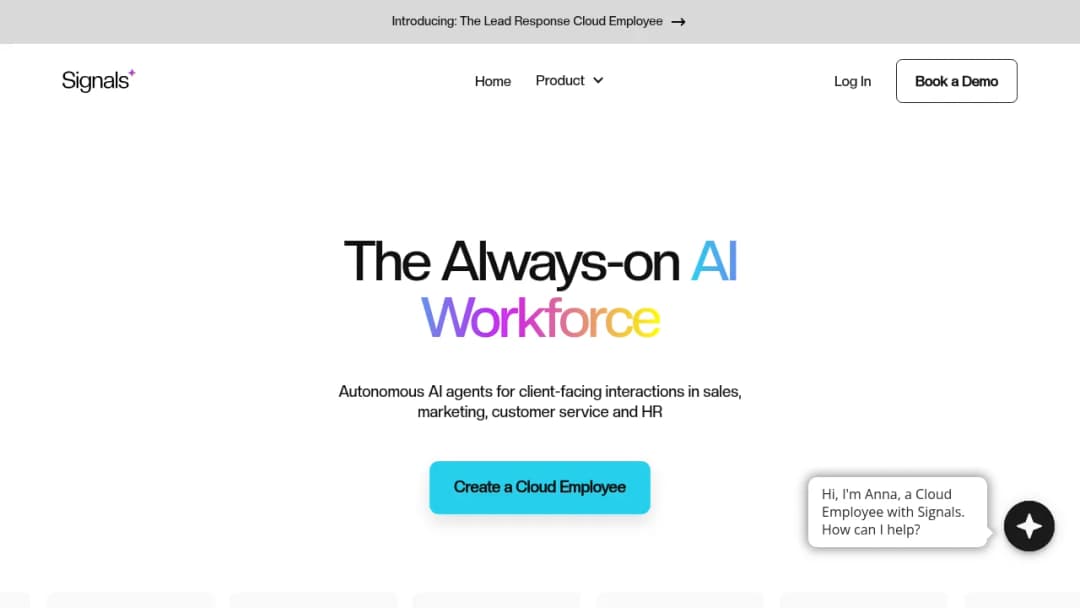
    Signals screenshot
    FirmCompareTractionAnalysisAdvocates

    Insights

    All insightsAccountingFinanceSoftwareCustomer experience

    Benchmarks

    The Software LeaderboardMethodology

    Tools & data

    Market ExplorerStudioRegistry

    Company

    AboutCareers

    Legal

    Privacy PolicyTerms of Service

    © 2026 Airframe, Inc. All rights reserved.

      Published Oct 15, 2026

      01Common complaints

      - Company sizes or stages where this product is overkill or insufficient - Very early-stage startups with low inbound volume may be better served by simpler tools (basic chat widgets or entry-level messaging platforms) rather than a multi-channel AI agent platform. - Industries or use cases where competitors are more appropriate - If the primary need is enterprise-grade intent data and ABM modeling at scale, specialist vendors such as 6sense or Bombora combined with an activation layer may be more purpose-built. - If the primary requirement is visitor identification and company-level web deanonymization, products such as Leadfeeder or Dealfront may be more direct fits. - Technical requirements that the product may not meet (not confirmed, but common risk) - If an organization requires on-premises deployment, strict data residency, or the ability to bring a proprietary model with full isolation, these capabilities were not documented in public materials and should be validated directly. - Budget constraints that make alternatives more appropriate - Metered pricing can result in increased costs as usage scales. Organizations requiring predictable, low monthly spend may prefer tools with fixed tiers. - Specific workflows or integrations where the product may fall short - If the technology stack requires deep, bespoke integrations beyond common SaaS connectors, a developer-centric automation platform or custom solution may be more appropriate. - Red flags in the buying process - Contract terms indicating non-refundable / non-cancellable fees and restrictions on reducing quantities during a subscription term are potential procurement risks. - Current limitations acknowledged by the vendor - The vendor does not publish a consolidated public list of current limitations in the materials reviewed. - Features on the roadmap (not yet available) - Roadmap details were not clearly documented in publicly accessible sources. - Scale limitations (at what volume/size does it break down?) - Scale limitations were not publicly documented in the sources reviewed. - Security or compliance gaps - Security certifications are not publicly documented, which can delay enterprise procurement and require additional vendor diligence. - Technical debt or architectural limitations mentioned in reviews - No substantive reports of technical debt or architectural constraints were identified for getsignals.ai in the accessible third-party review sources. - API limitations or integration constraints - API and integration constraints were not conclusively documented in the public materials reviewed; buyers requiring specific integration depth should obtain technical documentation and perform a proof of concept.

      Deal disqualifiers: what makes a POOR fit

      • Very low-volume environments where automation ROI is unlikely
      • Highly bespoke, consultative sales/support workflows where automation risk is significant
      • Strict procurement requirements that mandate published SOC 2/ISO evidence upfront
      • Buyers unwilling to accept annual prepayment or non-refundable fee structures

      02Why they buy

      - Competitive advantages validated by customer feedback (not just vendor claims) - Independent customer feedback is limited in the sources reviewed. Community commentary indicates perceived flexibility but also notes early-stage characteristics; these observations should be treated as anecdotal rather than broadly representative. - Unique features and capabilities competitors lack (based on vendor positioning) - The vendor packages pre-built agent templates covering multiple business functions (lead response, support, front desk scheduling, recruiting) within a single platform theme. - Emphasis on cross-channel operation (phone + email + chat + SMS) as a primary capability rather than a single-channel focus. - Differentiation from competitors based on reviews - The review base for getsignals.ai is not extensive enough in publicly accessible sources to assert strongly validated differentiation. - Areas where competitors clearly have advantages - 6sense: broader intent data, enterprise adoption, and more mature ABM ecosystem. - Intercom/Zendesk: established support ecosystems, larger marketplaces, and more mature procurement paths for enterprise customers. - Warmly/Leadfeeder: more focused signal/identification offerings that may be easier to adopt for targeted use cases.

      03Field reports

      Customer Testimonials

      - Important naming ambiguity (high risk of confusion) - "Signals" is a product name used by multiple unrelated products (visitor identification software, research projects, marketplaces, etc.). This section focuses only on getsignals.ai and excludes listings that appear to belong to other products with the same or similar names. - Major review platforms - G2/TrustRadius/Other: No clearly attributable getsignals.ai product page with verified third-party reviews was located in the sources reviewed. - Gartner Peer Insights: A product page for "Signals" in the "Visitor Identification Software" category was found, but the vendor branding and context appear to refer to a different product and is not treated as evidence about getsignals.ai in this report. - Community/Social (Reddit) mentions about getsignals.ai - Example community mention (mixed): In a community thread seeking "AI phone receptionist" tools, a commenter recommended getsignals.ai and described it as "flexible and eager to please clients," but also characterized it as a startup "constantly in beta development." This single community comment suggests a perception of flexibility alongside indications of early-stage product maturity; it should be treated as anecdotal. - Vendor-published testimonials (treated as vendor claims unless corroborated) - The vendor homepage includes attributed quotes and claimed outcomes such as a CMO citing an "event agent" with increased registrations and pipeline metrics, and other executive quotes referencing contact and conversion rates. These statements are vendor-published and methodology, baselines, and representativeness are not disclosed. - Why customers may choose this product over alternatives (inferred from positioning and limited community evidence) - Buyers may select Signals when they seek: - Multi-channel agent capabilities (voice, email, chat, SMS) rather than single-channel chatbots - Workflow integration with CRM and support systems - Inbound lead response automation with rapid response claims cited by the vendor - Why some customers may leave for competitors (churn reasons) - No direct, independently verified evidence of reasons for churn specific to getsignals.ai was found in the sources reviewed. - Deal-breakers and reasons customers may not purchase (inferred) - Contract rigidity (annual prepayment / non-refundable fees per Terms) - Lack of publicly documented security attestations (no clear SOC 2/ISO statement found) - Complex, metered pricing structure that can be difficult to forecast

      Vendor-published case-style metrics (examples)

      • Vendor-published materials (e.g., homepage and case-style pages) include outcome claims such as pipeline lift and conversion/contact rate improvements.
      • Critical evaluation:
        • These are vendor-published claims; methodology and baselines are not disclosed.
        • It is unclear whether the reported results are representative across deployments, what time periods they cover, and whether unsuccessful deployments are excluded.

      Operational "case study" signals from help documentation (what the product actually does)

      - Help center materials describe workflows such as: - Setting up ICP criteria (including optional CRM scraping for industry/company size/revenue bands) - Lead capture and reporting dashboards - Installation paths (manual, WordPress, Google Tag Manager) - Multi-tool integrations - Critical evaluation: - The breadth of documentation suggests the product supports complex operational onboarding and indicates more than a lightweight widget, but documentation breadth alone does not demonstrate consistent business outcomes.

      04Best fit

      Company sizes: specific employee counts and revenue ranges

      • Likely best fit:
        • Mid-market organizations with meaningful inbound volume but limited headcount in SDR/support/recruiting
        • Smaller teams may adopt, but contracting terms and implementation overhead can be significant for very small organizations

      Industries and verticals where adoption is strongest (with customer examples)

      • Based on vendor positioning:
        • B2B revenue teams (lead response, meeting booking)
        • E-commerce or consumer support (ticket deflection and omnichannel support)
        • Service offices (front-desk scheduling in professional services noted by vendor)
        • Recruiting operations (applicant triage)

      Roles and personas: decision makers AND end users

      • Decision makers:
        • Chief Revenue Officer / VP Sales / VP Revenue Operations
        • VP Support / Head of Customer Experience
        • Head of Recruiting / Talent Operations
        • CIO / Security / Compliance stakeholders for enterprise deals
      • End users:
        • SDRs, inbound reps
        • Support agents
        • Recruiting coordinators
        • RevOps administrators managing routing, integrations, and reporting

      Pain points and challenges the product addresses

      • Speed-to-lead and missed inbound opportunities
      • After-hours coverage without additional staff
      • Tier-1 support load and repetitive tickets
      • Scheduling friction and basic call handling
      • Recruiting bottlenecks in early-stage screening

      Qualification criteria: what makes a GOOD fit

      • High volume of repetitive interactions (calls, chats, tickets)
      • Clear playbooks and knowledge base content to configure the agent
      • Willingness to invest in integration and workflow design
      • Need for multi-channel automation rather than only web chat

      05The pitch

      What the product does (core value proposition in objective terms)

      - Signals is a platform that provides pre-built AI agents (referred to by the vendor as “Cloud Employees”) that can interact with leads and customers across channels (phone, email, chat, SMS), integrate with business systems, and execute workflows such as lead qualification, meeting booking, tier-1 support, and recruiting/screening. - Vendor materials state continuous availability and low-latency responses, and claim agents trained on a very large corpus of conversations. The vendor also describes a "Data Engine" intended to consolidate company context, buyer context, and integrations with tools to enable automated actions.

      Target market and market positioning

      • Mid-market to enterprise revenue and operations teams seeking automation for high-volume, client-facing workflows.
      • Vendor materials and documentation indicate use cases in:
        • Marketing/sales inbound lead response and conversion
        • Customer support deflection/ticket triage
        • Front desk / appointment scheduling in service businesses (e.g., medical/dental/automotive)
        • Recruiting / applicant screening and scheduling

      Get a comprehensive analysis of Signals including market position, competitive landscape, adoption trends, and peer benchmarks.

      Download full report →
      • Company sizes or stages where this product is overkill or insufficient

        • Very early-stage startups with low inbound volume may be better served by simpler tools (basic chat widgets or entry-level messaging platforms) rather than a multi-channel AI agent platform.
      • Industries or use cases where competitors are more appropriate

        • If the primary need is enterprise-grade intent data and ABM modeling at scale, specialist vendors such as 6sense or Bombora combined with an activation layer may be more purpose-built.
        • If the primary requirement is visitor identification and company-level web deanonymization, products such as Leadfeeder or Dealfront may be more direct fits.
      • Technical requirements that the product may not meet (not confirmed, but common risk)

        • If an organization requires on-premises deployment, strict data residency, or the ability to bring a proprietary model with full isolation, these capabilities were not documented in public materials and should be validated directly.
      • Budget constraints that make alternatives more appropriate

        • Metered pricing can result in increased costs as usage scales. Organizations requiring predictable, low monthly spend may prefer tools with fixed tiers.
      • Specific workflows or integrations where the product may fall short

        • If the technology stack requires deep, bespoke integrations beyond common SaaS connectors, a developer-centric automation platform or custom solution may be more appropriate.
      • Red flags in the buying process

        • Contract terms indicating non-refundable / non-cancellable fees and restrictions on reducing quantities during a subscription term are potential procurement risks.
      • Current limitations acknowledged by the vendor

        • The vendor does not publish a consolidated public list of current limitations in the materials reviewed.
      • Features on the roadmap (not yet available)

        • Roadmap details were not clearly documented in publicly accessible sources.
      • Scale limitations (at what volume/size does it break down?)

        • Scale limitations were not publicly documented in the sources reviewed.
      • Security or compliance gaps

        • Security certifications are not publicly documented, which can delay enterprise procurement and require additional vendor diligence.
      • Technical debt or architectural limitations mentioned in reviews

        • No substantive reports of technical debt or architectural constraints were identified for getsignals.ai in the accessible third-party review sources.
      • API limitations or integration constraints

        • API and integration constraints were not conclusively documented in the public materials reviewed; buyers requiring specific integration depth should obtain technical documentation and perform a proof of concept.
      • Competitive advantages validated by customer feedback (not just vendor claims)

        • Independent customer feedback is limited in the sources reviewed. Community commentary indicates perceived flexibility but also notes early-stage characteristics; these observations should be treated as anecdotal rather than broadly representative.
      • Unique features and capabilities competitors lack (based on vendor positioning)

        • The vendor packages pre-built agent templates covering multiple business functions (lead response, support, front desk scheduling, recruiting) within a single platform theme.
        • Emphasis on cross-channel operation (phone + email + chat + SMS) as a primary capability rather than a single-channel focus.
      • Differentiation from competitors based on reviews

        • The review base for getsignals.ai is not extensive enough in publicly accessible sources to assert strongly validated differentiation.
      • Areas where competitors clearly have advantages

        • 6sense: broader intent data, enterprise adoption, and more mature ABM ecosystem.
        • Intercom/Zendesk: established support ecosystems, larger marketplaces, and more mature procurement paths for enterprise customers.
        • Warmly/Leadfeeder: more focused signal/identification offerings that may be easier to adopt for targeted use cases.
      • Important naming ambiguity (high risk of confusion)

        • "Signals" is a product name used by multiple unrelated products (visitor identification software, research projects, marketplaces, etc.). This section focuses only on getsignals.ai and excludes listings that appear to belong to other products with the same or similar names.
      • Major review platforms

        • G2/TrustRadius/Other: No clearly attributable getsignals.ai product page with verified third-party reviews was located in the sources reviewed.
        • Gartner Peer Insights: A product page for "Signals" in the "Visitor Identification Software" category was found, but the vendor branding and context appear to refer to a different product and is not treated as evidence about getsignals.ai in this report.
      • Community/Social (Reddit) mentions about getsignals.ai

        • Example community mention (mixed): In a community thread seeking "AI phone receptionist" tools, a commenter recommended getsignals.ai and described it as "flexible and eager to please clients," but also characterized it as a startup "constantly in beta development." This single community comment suggests a perception of flexibility alongside indications of early-stage product maturity; it should be treated as anecdotal.
      • Vendor-published testimonials (treated as vendor claims unless corroborated)

        • The vendor homepage includes attributed quotes and claimed outcomes such as a CMO citing an "event agent" with increased registrations and pipeline metrics, and other executive quotes referencing contact and conversion rates. These statements are vendor-published and methodology, baselines, and representativeness are not disclosed.
      • Why customers may choose this product over alternatives (inferred from positioning and limited community evidence)

        • Buyers may select Signals when they seek:
          • Multi-channel agent capabilities (voice, email, chat, SMS) rather than single-channel chatbots
          • Workflow integration with CRM and support systems
          • Inbound lead response automation with rapid response claims cited by the vendor
      • Why some customers may leave for competitors (churn reasons)

        • No direct, independently verified evidence of reasons for churn specific to getsignals.ai was found in the sources reviewed.
      • Deal-breakers and reasons customers may not purchase (inferred)

        • Contract rigidity (annual prepayment / non-refundable fees per Terms)
        • Lack of publicly documented security attestations (no clear SOC 2/ISO statement found)
        • Complex, metered pricing structure that can be difficult to forecast
      • Help center materials describe workflows such as:
        • Setting up ICP criteria (including optional CRM scraping for industry/company size/revenue bands)
        • Lead capture and reporting dashboards
        • Installation paths (manual, WordPress, Google Tag Manager)
        • Multi-tool integrations
      • Critical evaluation:
        • The breadth of documentation suggests the product supports complex operational onboarding and indicates more than a lightweight widget, but documentation breadth alone does not demonstrate consistent business outcomes.
      • Signals is a platform that provides pre-built AI agents (referred to by the vendor as “Cloud Employees”) that can interact with leads and customers across channels (phone, email, chat, SMS), integrate with business systems, and execute workflows such as lead qualification, meeting booking, tier-1 support, and recruiting/screening.
      • Vendor materials state continuous availability and low-latency responses, and claim agents trained on a very large corpus of conversations. The vendor also describes a "Data Engine" intended to consolidate company context, buyer context, and integrations with tools to enable automated actions.