Krisp
Real-time Voice AI for the real world.
Real-time Voice AI for the real world.
Published Oct 15, 2026
No explicit roadmap items with dates were found in the reviewed sources. Publicly available information did not include a dated product roadmap. Buyers should request roadmap details and timelines directly from the vendor if feature timing is a procurement concern.
Common reasons include:
2. Bi-directional noise cancellation: supports call-center scenarios by filtering noise from both agent and customer sides.
Recurring triggers noted in public reviews and community threads:
Some vendor or third-party summaries reference material drops in noise complaints, measurable increases in customer satisfaction, and reductions in handle time. These metrics are presented without accompanying methodology (sample size, baseline, measurement period, or independent audit). Treat such metrics as vendor-provided claims that require validation through reference checks or documented case studies.
Get a comprehensive analysis of Krisp including market position, competitive landscape, adoption trends, and peer benchmarks.
Download full report →You only need noise suppression and nothing else, and you are sensitive to subscription pricing or feature bundling.
Your endpoints are resource-constrained (older laptops, heavy multitasking) or you have stringent performance requirements.
Your environment is already adequately served by native conferencing noise suppression.
You have NVIDIA RTX-capable Windows endpoints and prefer a GPU-accelerated, no-subscription alternative.
You need a highly advanced meeting intelligence suite with deep workflow integrations.
Validation notes: noise cancellation efficacy is frequently noted in reviews, but scale and compliance claims (for example those appearing on vendor pages or aggregator listings) should be validated during procurement with documentation and reference checks.
From G2 (examples):
From Trustpilot (examples):
From G2 (examples):
From Reddit (examples):
From Trustpilot (examples):
Press coverage describes Krisp’s expansion from noise cancellation into on-device transcription and notes that transcripts may still be sent to cloud services depending on configuration. This distinction is relevant for buyers assessing claims that audio "never leaves" a device.
Gaps: Publicly detailed, independently verifiable case studies with clear methodology were not identified in the reviewed sources. Buyers should request:
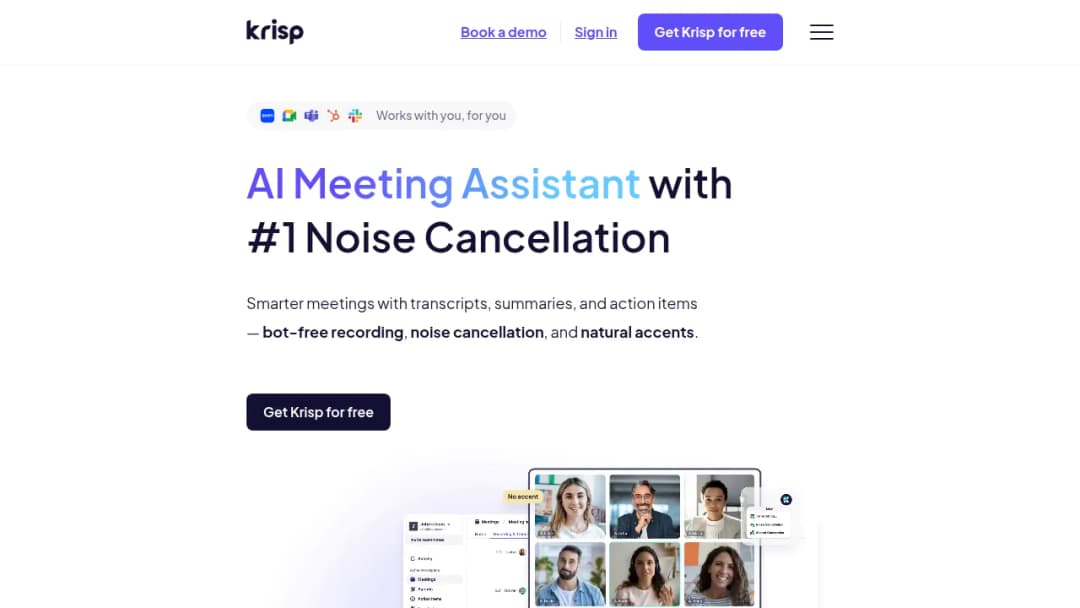
Krisp is a voice-AI audio layer that sits between a user's microphone/speakers and calling applications (Zoom, Teams, Meet, Webex, etc.) to improve call audio quality and meeting productivity. Historically it focused on real-time noise cancellation and has expanded into:
Krisp's primary architectural distinction versus some bot-based meeting note tools is that it can process audio locally and does not require a meeting bot to join (though transcripts/notes may still involve cloud components depending on configuration).
Krisp positions itself across three overlapping segments:
The product competes with standalone noise suppression tools and meeting assistant platforms. User feedback suggests bundling noise suppression with transcription and meeting assistant features increases capability but can create resource use and pricing trade-offs for users who only require noise suppression.