- What the product does (core value proposition in objective terms)
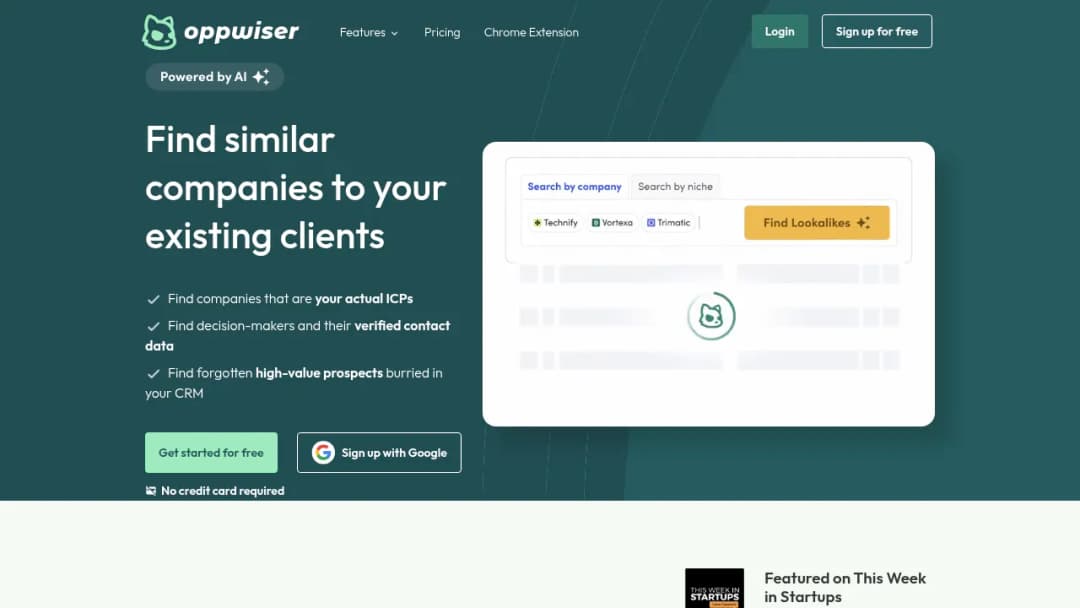
- Oppwiser is described by the vendor as an AI-driven revenue discovery and sales intelligence tool focused on:
- Finding companies that resemble existing customers (ICP discovery)
- Continuously scanning a large company database for potential opportunities (Opportunity Scanner)
- Tracking buyer signals (job postings, technographics, employee/company changes)
- Providing contact data (emails and direct dials) and enrichment/API access for CRM workflows
- A browser extension supports workflows for identifying similar companies and decision-makers from websites and LinkedIn company pages.
- Target market and market positioning
- Most suitable for SMB to mid-market revenue teams conducting outbound or ABM activities and needing:
- Faster account research
- Lookalike discovery capabilities beyond simple industry filters
- Contact discovery and enrichment for outreach
- The product is listed in the sales intelligence category on vendor review sites; common alternatives include Apollo.io and ZoomInfo Sales.
- Company background (founding year, HQ, key leadership)
- The vendor website describes the product and problem statement but does not publish a founding year, headquarters address, or full leadership roster.
- Third-party directory listings indicate a Riga, Latvia base and a 2022 founding date; this was not independently verified with the vendor.
- A product launch listing identifies the maker informally, but detailed corporate information is limited on public pages.
- Funding and growth: investment rounds, acquisitions, estimated customer count/revenue if public
- No public investor disclosures or funding rounds were found on the vendor website during this research.
- Third-party company profile pages contain funding/financial tables, but several entries appeared inconsistent and should not be treated as validated financial disclosures.
- The vendor publishes dataset and signal-scale metrics but does not provide methodology, refresh rates, or independent validation for those metrics.
- Pricing model with specific tiers and costs where available
- Published pricing includes multiple tiers:
- Free tier
- Limited results in the AI lookalike company finder
- A defined number of emails and phone numbers included
- Limited B2B search results and export cap
- Basic integrations and API access listed
- Starter tier (published entry-level paid tier)
- Unlimited results in lookalike functionality and B2B search (per the product page)
- Increased emails and phone number credits
- Higher export limit
- Same integrations and API access noted above
- Premium tier (published mid-level paid tier)
- Larger allocation of emails and phone numbers
- Higher export limit
- Same core features and integrations
- Enterprise: Custom
- Described as offering effectively unlimited emails and phone numbers subject to a fair use policy
- Very large export limits
- Free trial noted
- Credit framing
- Plans are constrained by contact credits and export limits, which can materially affect effective cost for list-building workflows.
- Total cost of ownership considerations (implementation, training, hidden costs)
- Likely cost drivers beyond subscription:
- Contact credits can be consumed quickly for list-building use cases, increasing total cost if higher volumes are required.
- Data quality assurance is commonly required in this category; while the vendor indicates contact verification steps, no published deliverability benchmarks or accuracy/error rates were found.
- Operational overhead:
- Integrations and CRM synchronization can add RevOps/admin time; the vendor lists common integrations across tiers but does not document integration depth on public pages.
- Key competitors in the space (list 4-6 direct alternatives)
- Apollo.io
- ZoomInfo Sales
- Demandbase One
- Lusha
- Cognism
- 6sense