| Aspect | Oppwiser | Apollo.io | ZoomInfo Sales |
|--------|----------|-----------|----------------|
| Starting Price | Published free entry plan | Published free entry tier; paid tiers available | Quote-based; commonly reported as higher cost and sold via quoted contracts |
| Most suitable for | Teams prioritizing lookalike account discovery and buyer-signal-informed prospecting with a lightweight credit model | SMB/mid-market teams seeking combined data and engagement capabilities | Enterprise teams that require deep data, intent signals, and enterprise packaging |
| Key Strength | Lookalike company discovery workflow; published pricing that enables self-service evaluation | Broad adoption and an integrated data+engagement offering | Data breadth and enterprise packaging; commonly used at scale |
| Key Weakness | Very limited public reviews; enterprise security posture not documented; contact coverage may be incomplete | Per-seat pricing and credit mechanics that can become costly at scale (common market complaint) | Opaque pricing and long contracts; higher total cost often criticized |
- Direct competitors and their key differentiators
- Apollo.io: Positioned as an integrated sales intelligence and engagement stack with broad adoption in SMB/mid-market segments.
- ZoomInfo: Positioned as an enterprise-grade data and intent platform, often sold as larger packages with quote-based pricing.
- Cognism: Frequently differentiated on compliance positioning and some datasets focused on verified phone coverage in specific markets.
- Feature comparison: where this product may excel vs lag behind
- Potential advantages:
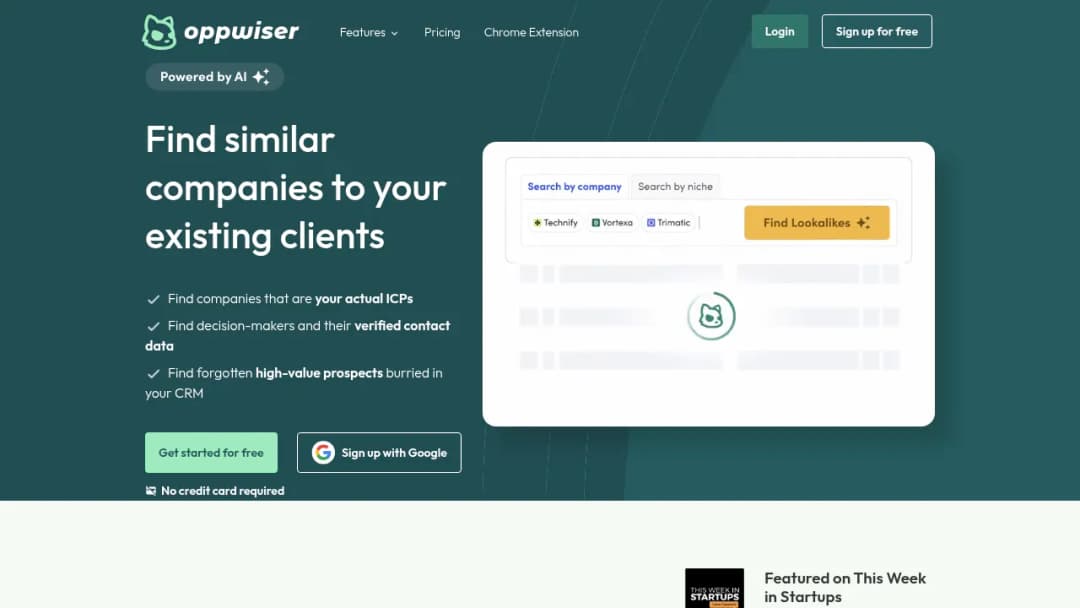
- Lookalike/competitor discovery is emphasized in the product UI and browser extension.
- Published pricing reduces the need to request a custom quote for initial evaluation.
- Potential disadvantages:
- Less public evidence of enterprise governance and security controls compared with incumbents.
- Smaller review footprint and limited public customer references.
- Pricing comparison: value proposition vs alternatives
- Published tiers and a free entry plan make initial trials accessible and potentially less costly than some enterprise incumbents for low-volume use cases.
- The primary cost consideration is effective cost per usable contact after accounting for coverage gaps, credit consumption, and data quality.
- Market share and adoption trends
- There are no authoritative sources adequate to estimate the vendor’s market share.
- Public review volume is minimal and therefore provides weak evidence of broad adoption.
- When customers choose competitors instead (and why)
- Typical category reasons (not vendor-specific due to limited data):
- Incumbent enterprise vendors are chosen when procurement requires extensive security documentation, enterprise governance, and long-term vendor relationships.
- Integrated engagement platforms are chosen when teams prefer an all-in-one outreach and sequencing capability with larger user communities.