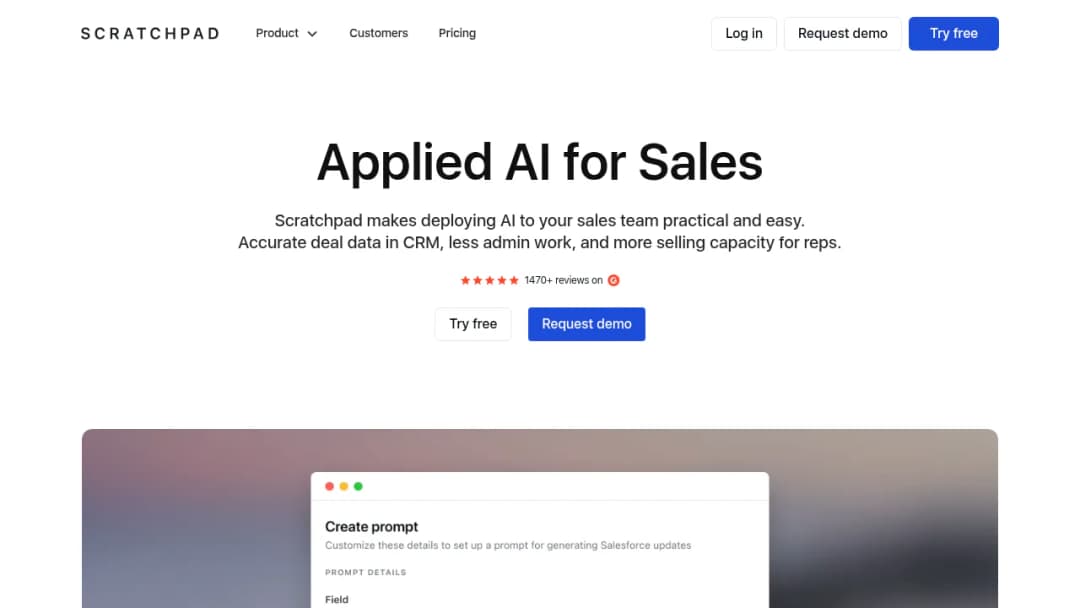
- **What the product does (objective core value proposition)**
- Scratchpad is a Salesforce workspace layer delivered as a web application and a Chrome extension. It provides an interface intended to reduce time required for Salesforce updates, improve pipeline hygiene, and streamline sales execution compared with the native Salesforce UI.
- Recent vendor positioning emphasizes an "AI Workspace" that includes call recording/notetaking, AI-generated summaries, AI-assisted suggestions for CRM field updates, and an agent-like feature that can surface information across deal history and interactions.
- **Target market and positioning**
- Primary ideal customer profile (ICP) appears to be Salesforce-centric revenue teams (AEs, SDRs, CSMs, RevOps, Sales Leadership) that face CRM adoption and data hygiene challenges and allocate significant rep time to administrative tasks.
- The product competes in or adjacent to sales enablement, revenue intelligence, CRM augmentation, conversation intelligence add-ons, and pipeline/hygiene tooling.
- **Company background (HQ, leadership)**
- Headquartered in California.
- **Funding and growth (public / vendor-reported)**
- The vendor has publicly announced multiple funding rounds. Vendor public relations materials reference broad user adoption figures; these claims are noted as vendor-reported and not independently audited.
- Third-party databases publish revenue estimates and other metrics; these sources are not audited financials and may rely on self-reporting or inference.
- **Pricing model (specific tiers where available)**
- Public pricing at the time of the snapshot includes monthly and annual billing and a free tier:
- Free: limited call recording hours per month and a monthly allocation of AI credits per user.
- Solo: per-user pricing with annual and monthly billing options; includes a defined allotment of AI credits per user.
- Team: per-user pricing with annual and monthly billing options; includes a larger AI credit pool that may be pooled at the team level per vendor documentation.
- Enterprise: custom pricing; vendor indicates options for uncapped credits and enterprise contract terms.
- Third-party pricing snapshots may be outdated; confirm current pricing on the vendor pricing page.
- **Total cost of ownership (TCO) considerations**
- Licensing: per-user pricing can be material for larger organizations and should be evaluated at scale.
- AI credit economics: usage-based credits create a budgeting consideration; forecasting credit consumption is a new planning task for procurement and finance teams.
- Admin/enablement effort: despite vendor claims of fast deployment, typical investments may include:
- developing standardized sheets/notes/templates
- governance around prompts and agents
- security reviews for browser extensions and data access
- change management and training
- Tool overlap: organizations that already pay for conversation intelligence, sales engagement, or revenue intelligence platforms may face functionality overlap and should evaluate whether Scratchpad provides incremental value or duplicates existing spend.
- **Key competitors (4–6 direct alternatives)**
- Dooly (vendor materials indicate a migration path from this competitor; status should be independently verified)
- Clari (revenue platform and forecasting; broader scope)
- Revenue Grid (activity capture and enablement)
- People.ai / PeopleGlass (sales productivity and Salesforce augmentation)
- Gong (conversation intelligence; adjacent or complementary depending on use)
- Salesforce-native approaches (Salesforce Lightning, custom layouts, Flow, in-app guidance) as a build option