Workspace
    • Briefing
    • Ask Airframe
    Transformation
    • Audit
    Your Stack
    • Registry
    • Finance
    • Context
    Discover
    Powered by Airframe
    1. Research
    2. /
    3. Products
    4. /
    5. TalentLMS
    TalentLMS

    TalentLMS

    Perfect Practice Makes Perfect
    Est 2017|112 Ref Customers
    LinkedIn 245|Web traffic 2.8M|FTEs 4|HQ Riyadh, RIY, SA
    MarketsCustomer Education & EnablementLearning Management System (LMS)
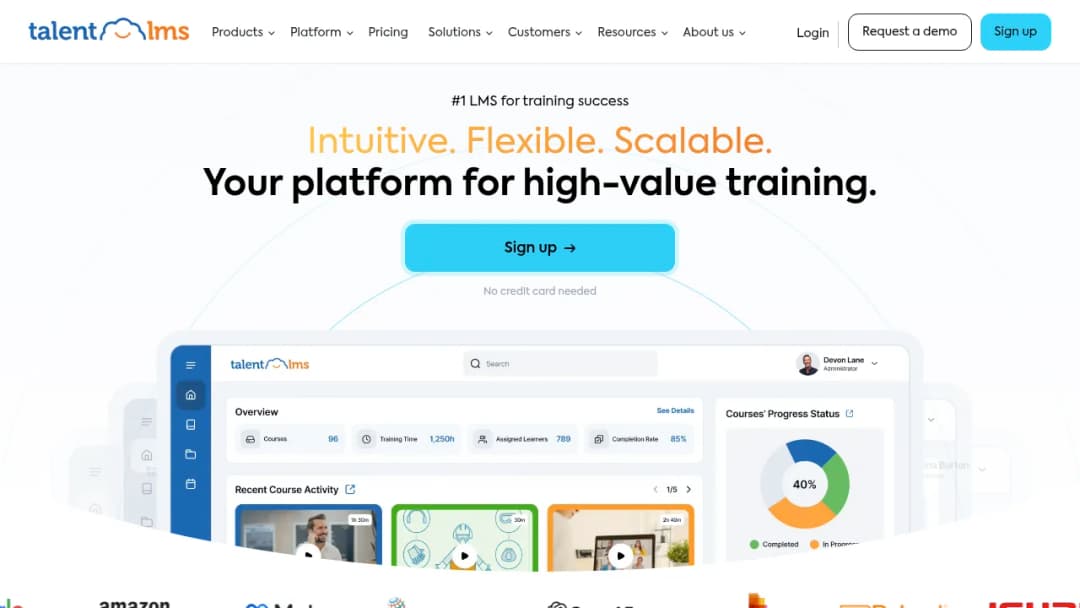
    TalentLMS screenshot
    FirmCompareTractionAnalysisAdvocates

    Insights

    All insightsAccountingFinanceSoftwareCustomer experience

    Benchmarks

    The Software LeaderboardMethodology

    Tools & data

    Market ExplorerStudioRegistry

    Company

    AboutCareers

    Legal

    Privacy PolicyTerms of Service

    © 2026 Airframe, Inc. All rights reserved.

      Published Oct 15, 2026

      01Common complaints

      - Company sizes or stages where this product is overkill or insufficient - Overkill - Very small teams that only need a documentation repository or a lightweight onboarding checklist tool may prefer simpler knowledge base or task-management solutions. - Insufficient - Large enterprises with extensive HR suite integration requirements, advanced governance needs, and formal compliance attestations may be better served by enterprise LMS vendors with comprehensive compliance packaging. - Industries or use cases where competitors are clearly superior - Regulated industries with strict vendor assurance requirements (SOC 2 Type II, detailed audit artifacts, formal HIPAA programs) should consider vendors with established compliance deliverables. - Technical requirements that this product cannot meet - When mobile SCORM behavior or offline playback is a strict, enterprise requirement, the behavior reported in community posts suggests buyers should validate these scenarios in a proof of concept. - When full-fidelity export of LMS-native authored courses is required, recent community feedback indicates potential migration pain. - Budget constraints that make alternatives more appropriate - Organizations with large numbers of occasional learners may find active-user pricing escalates; open-source solutions (Moodle/Totara) or products with different pricing models may provide more predictable costs. - Specific workflows or integrations where the product falls short - Deep HRIS/ERP integration and complex automation across many systems may be better served by enterprise vendors or by integrating via a dedicated integration platform with robust APIs and data mapping capabilities. - Red flags in the buying process (e.g., requires annual commitment, no free trial) - The vendor provides a free plan or a no-credit-card start option. - A potential red flag is feature volatility: AI features currently labeled promotional may be re-priced into higher tiers in the future. - Current limitations acknowledged by the vendor - Some AI / authoring features are labeled as promotional in the pricing UI and may be moved into higher tiers in the future, which represents potential feature volatility and future cost implications. - Features on the roadmap (not yet available) - note estimated dates if available - The vendor maintains a public roadmap; specific items and dates were not extracted in this run. - Scale limitations (at what volume/size does it break down?) - Branch counts and learning path features are limited by plan tier (for example, Core includes a single branch, Grow includes more, Pro includes additional branch counts per the feature list). - The Pro plan is positioned up to a specified user count in the feature list; Enterprise is intended for deployments above that threshold. - Security or compliance gaps - SOC 2 certification is not publicly documented in vendor materials accessed during this run; buyers with strict SOC 2 requirements should request assurances and artifacts directly from the vendor. - Technical debt or architectural limitations mentioned in reviews - Practitioner discussions reference an older UI/UX and limitations in the WYSIWYG authoring experience; these reports may be historical and should be validated in a current evaluation. - API limitations or integration constraints - Community guidance suggests caution when planning heavy integration work; at least one reviewer reported ADP data-feed limitations.

      02Why they buy

      - Competitive advantages validated by customer feedback (not just vendor claims) - Reviewer feedback frequently highlights the product's relative ease of initial use for course creation and basic reporting. - Reviewers and analyst commentary position the product as appropriate for basic internal training programs. - Unique features and capabilities competitors lack - The product does not present clear, exclusive technical features that are unique across the LMS market; differentiation is primarily in packaging (public pricing, self-service trial, and quicker initial setup for basic programs). - Differentiation from competitors based on reviews - Reviews and community discussions place TalentLMS in a lighter-administration tier compared with enterprise LMS platforms, which often require more procurement and professional services involvement. - Value propositions with evidence from case studies - Vendor case material (Smartbox) suggests achievable build timelines and global reach with a small team; the metrics provided are vendor-supplied. - Areas where competitors clearly have advantages (balanced) - Enterprise suites (Docebo/Absorb/LearnUpon) often provide deeper analytics, a broader set of integrations, and more advanced extended-enterprise controls.

      03Field reports

      Customer Testimonials

      - Direct quotes and paraphrased reviewer feedback from G2, TrustRadius, Reddit, and other platforms - G2 (positive + negative) - A G2 reviewer noted the product is easy to use for content creation and reporting, and also reported difficulty integrating HRIS data (example cited: ADP) and limitations in tiering employees by job titles and levels. - TrustRadius (mixed/positive) - A TrustRadius reviewer described the product as appropriate for basic training needs and noted limitations for hosting a large external product academy. - Reddit (community feedback) - Historical practitioner feedback includes criticism of the user interface and authoring tools (WYSIWYG), administrative inefficiencies (historically requiring repetitive course assignment steps), and concerns about export/portability for courses authored natively in TalentLMS. Some of these posts may reflect older product behavior and should be validated in a proof of concept. - Balance: include both highly positive and strongly negative assessments - Review-platform sentiment (G2/TrustRadius) tends to be favorable on ease of initial use and reporting. - Community threads and Trustpilot include more critical commentary focused on support, billing, admin workflow, and feature gaps. - Common criticisms and complaints (support issues, bugs, missing features) - Integration and HRIS feed limitations (some reviewers cited ADP integration issues). - External/customer academy controls and extended-enterprise features perceived as less mature. - Administrative efficiency gaps and workflow friction (reports in practitioner communities; may be historical). - Content portability/export challenges for courses authored directly in TalentLMS. - UI/UX and built-in authoring (WYSIWYG) criticized by some practitioners. - Why customers chose this product over alternatives - Common reasons reported: relatively rapid setup, initial ease of use, and lower entry cost compared with many enterprise LMS options. - Why some customers left for competitors (churn reasons) - Organizations may outgrow the product when requiring deeper integrations, richer learner experiences, or advanced monetization for external academies. - Export/portability concerns can trigger migration if an organization has heavily invested in native course authoring. - Specific outcomes customers achieved (with metrics when available) - Vendor case story: Smartbox Academy was reported to have been built in under a year and to have reached thousands of learners across multiple countries; this is a vendor-published result and was not independently verified in the sources accessed. - Vendor-published adoption figure: the vendor claims adoption across many tens of thousands of teams (vendor-published; not independently audited). - Customer pain points and frustrations mentioned in reviews - Costs can increase materially as active-user counts grow or when purchasing add-on content. - Controls for external academies can be limited compared with enterprise-focused vendors. - Specific integration gaps, e.g., feeding data from ADP, were reported by some reviewers. - Deal-breakers and reasons customers didn't purchase - Requirements for SOC 2 evidence were reported as a procurement-level disqualifier by at least one forum commenter (anecdotal report). - Mobile/SCORM expectations: community posts raised questions about mobile SCORM behavior and offline support; buyers should validate mobile/SCORM behavior in a proof of concept.

      Case Studies

      - Detailed customer success stories with metrics - Smartbox (vendor case story): vendor materials report that Smartbox built a global training academy in several months and reached thousands of learners across multiple countries. These figures are vendor-published and were not independently verified in this run. - Specific results and quantified business impact - The case study metrics are primarily scale and time-to-launch (learners and countries) rather than independently verified ROI metrics such as revenue, time saved, or compliance improvements. - Implementation details and time to value - The vendor narrative indicates a very small team built and launched in several months in the Smartbox example. - Challenges faced during adoption and how they were resolved - Specific adoption challenges and remediation in that case were not captured in the excerpt provided; reviewing the full case study page or video is necessary for implementation detail. - Note when metrics are vendor-published without independent verification - Smartbox learner counts and timelines are vendor-published. - Vendor-published adoption figures (e.g., large-scale team counts) are not independently audited in sources accessed. - Include mixed results where available - No formal failed implementation case studies were located in accessible sources; however, community threads describe implementations requiring significant administrative effort, which can indicate operational struggles.

      04Best fit

      Ideal Customer Profile

      - Company sizes: specific employee counts and revenue ranges - Best-fit (inferred from positioning and review mix): - Organizations from small and mid-sized businesses up through lower-enterprise organizations, though fit varies by industry and training model. - Training audiences aligned to vendor plan limits — the vendor publishes per-user tiered plans for typical deployments, with an enterprise tier intended for larger deployments. - Industries and verticals where adoption is strongest - Cross-industry corporate training (compliance, onboarding, product training) is typical; vendor marketing highlights brand logos and examples. - Roles and personas: decision makers AND end users - Decision makers - HR and L&D leaders - Operations leaders responsible for frontline training - Compliance managers - Sales enablement leaders - Customer education managers for lighter academies - End users - Employees - Field staff / remote sales staff - Partners/resellers - Customers when branches are used as external portals - Pain points and challenges the product addresses - Rapid deployment of structured training with tracking and standard reporting. - Centralized course management with audience segmentation via branches. - Basic automation for assignments, reminders, and progress reporting. - Qualification criteria: what makes a GREAT fit - Need a commercially supported LMS that can be stood up with minimal IT involvement. - Training programs are straightforward (compliance, onboarding, standardized SOP training). - Integration requirements are modest (standard SSO, basic HRIS syncing) rather than deeply customized data models. - Deal disqualifiers: what makes a POOR fit - Hard procurement requirement for specific security certifications or audit evidence that the vendor cannot provide. - Need for deep, custom integrations across a large ecosystem of systems and complex data mapping. - Need for full-fidelity export/ownership of content authored in-platform if portability is a strict requirement. - Real customer examples when available - Smartbox (vendor case story). - A large consumer brand appears in vendor marketing materials; production deployment could not be independently verified in the sources accessed.

      05The pitch

      What the product does (core value proposition in objective terms)

      - TalentLMS is a cloud learning management system (LMS) for creating, delivering, and tracking training across multiple audiences (employees, onboarding, partners, customers) from one platform, including support for separate training portals ("branches") under one account. - The vendor describes the product as simple to start and scalable, and highlights features such as rapid deployment, AI-assisted course creation, and centralized administration for multiple audiences.

      Target market and market positioning

      • Primary positioning appears to be small-to-medium businesses (SMB) through mid-market organizations that prefer a short time-to-launch, self-service purchasing options, and public pricing details.
      • The product is also offered for extended enterprise use (partner/customer training) via branches; third-party reviews frequently describe it as stronger for internal/basic training rather than complex, enterprise-grade academies.

      Get a comprehensive analysis of TalentLMS including market position, competitive landscape, adoption trends, and peer benchmarks.

      Download full report →
      • Company sizes or stages where this product is overkill or insufficient

        • Overkill
          • Very small teams that only need a documentation repository or a lightweight onboarding checklist tool may prefer simpler knowledge base or task-management solutions.
        • Insufficient
          • Large enterprises with extensive HR suite integration requirements, advanced governance needs, and formal compliance attestations may be better served by enterprise LMS vendors with comprehensive compliance packaging.
      • Industries or use cases where competitors are clearly superior

        • Regulated industries with strict vendor assurance requirements (SOC 2 Type II, detailed audit artifacts, formal HIPAA programs) should consider vendors with established compliance deliverables.
      • Technical requirements that this product cannot meet

        • When mobile SCORM behavior or offline playback is a strict, enterprise requirement, the behavior reported in community posts suggests buyers should validate these scenarios in a proof of concept.
        • When full-fidelity export of LMS-native authored courses is required, recent community feedback indicates potential migration pain.
      • Budget constraints that make alternatives more appropriate

        • Organizations with large numbers of occasional learners may find active-user pricing escalates; open-source solutions (Moodle/Totara) or products with different pricing models may provide more predictable costs.
      • Specific workflows or integrations where the product falls short

        • Deep HRIS/ERP integration and complex automation across many systems may be better served by enterprise vendors or by integrating via a dedicated integration platform with robust APIs and data mapping capabilities.
      • Red flags in the buying process (e.g., requires annual commitment, no free trial)

        • The vendor provides a free plan or a no-credit-card start option.
        • A potential red flag is feature volatility: AI features currently labeled promotional may be re-priced into higher tiers in the future.
      • Current limitations acknowledged by the vendor

        • Some AI / authoring features are labeled as promotional in the pricing UI and may be moved into higher tiers in the future, which represents potential feature volatility and future cost implications.
      • Features on the roadmap (not yet available) - note estimated dates if available

        • The vendor maintains a public roadmap; specific items and dates were not extracted in this run.
      • Scale limitations (at what volume/size does it break down?)

        • Branch counts and learning path features are limited by plan tier (for example, Core includes a single branch, Grow includes more, Pro includes additional branch counts per the feature list).
        • The Pro plan is positioned up to a specified user count in the feature list; Enterprise is intended for deployments above that threshold.
      • Security or compliance gaps

        • SOC 2 certification is not publicly documented in vendor materials accessed during this run; buyers with strict SOC 2 requirements should request assurances and artifacts directly from the vendor.
      • Technical debt or architectural limitations mentioned in reviews

        • Practitioner discussions reference an older UI/UX and limitations in the WYSIWYG authoring experience; these reports may be historical and should be validated in a current evaluation.
      • API limitations or integration constraints

        • Community guidance suggests caution when planning heavy integration work; at least one reviewer reported ADP data-feed limitations.
      • Competitive advantages validated by customer feedback (not just vendor claims)

        • Reviewer feedback frequently highlights the product's relative ease of initial use for course creation and basic reporting.
        • Reviewers and analyst commentary position the product as appropriate for basic internal training programs.
      • Unique features and capabilities competitors lack

        • The product does not present clear, exclusive technical features that are unique across the LMS market; differentiation is primarily in packaging (public pricing, self-service trial, and quicker initial setup for basic programs).
      • Differentiation from competitors based on reviews

        • Reviews and community discussions place TalentLMS in a lighter-administration tier compared with enterprise LMS platforms, which often require more procurement and professional services involvement.
      • Value propositions with evidence from case studies

        • Vendor case material (Smartbox) suggests achievable build timelines and global reach with a small team; the metrics provided are vendor-supplied.
      • Areas where competitors clearly have advantages (balanced)

        • Enterprise suites (Docebo/Absorb/LearnUpon) often provide deeper analytics, a broader set of integrations, and more advanced extended-enterprise controls.
      • Direct quotes and paraphrased reviewer feedback from G2, TrustRadius, Reddit, and other platforms

        • G2 (positive + negative)
          • A G2 reviewer noted the product is easy to use for content creation and reporting, and also reported difficulty integrating HRIS data (example cited: ADP) and limitations in tiering employees by job titles and levels.
        • TrustRadius (mixed/positive)
          • A TrustRadius reviewer described the product as appropriate for basic training needs and noted limitations for hosting a large external product academy.
        • Reddit (community feedback)
          • Historical practitioner feedback includes criticism of the user interface and authoring tools (WYSIWYG), administrative inefficiencies (historically requiring repetitive course assignment steps), and concerns about export/portability for courses authored natively in TalentLMS. Some of these posts may reflect older product behavior and should be validated in a proof of concept.
      • Balance: include both highly positive and strongly negative assessments

        • Review-platform sentiment (G2/TrustRadius) tends to be favorable on ease of initial use and reporting.
        • Community threads and Trustpilot include more critical commentary focused on support, billing, admin workflow, and feature gaps.
      • Common criticisms and complaints (support issues, bugs, missing features)

        • Integration and HRIS feed limitations (some reviewers cited ADP integration issues).
        • External/customer academy controls and extended-enterprise features perceived as less mature.
        • Administrative efficiency gaps and workflow friction (reports in practitioner communities; may be historical).
        • Content portability/export challenges for courses authored directly in TalentLMS.
        • UI/UX and built-in authoring (WYSIWYG) criticized by some practitioners.
      • Why customers chose this product over alternatives

        • Common reasons reported: relatively rapid setup, initial ease of use, and lower entry cost compared with many enterprise LMS options.
      • Why some customers left for competitors (churn reasons)

        • Organizations may outgrow the product when requiring deeper integrations, richer learner experiences, or advanced monetization for external academies.
        • Export/portability concerns can trigger migration if an organization has heavily invested in native course authoring.
      • Specific outcomes customers achieved (with metrics when available)

        • Vendor case story: Smartbox Academy was reported to have been built in under a year and to have reached thousands of learners across multiple countries; this is a vendor-published result and was not independently verified in the sources accessed.
        • Vendor-published adoption figure: the vendor claims adoption across many tens of thousands of teams (vendor-published; not independently audited).
      • Customer pain points and frustrations mentioned in reviews

        • Costs can increase materially as active-user counts grow or when purchasing add-on content.
        • Controls for external academies can be limited compared with enterprise-focused vendors.
        • Specific integration gaps, e.g., feeding data from ADP, were reported by some reviewers.
      • Deal-breakers and reasons customers didn't purchase

        • Requirements for SOC 2 evidence were reported as a procurement-level disqualifier by at least one forum commenter (anecdotal report).
        • Mobile/SCORM expectations: community posts raised questions about mobile SCORM behavior and offline support; buyers should validate mobile/SCORM behavior in a proof of concept.
      • Detailed customer success stories with metrics

        • Smartbox (vendor case story): vendor materials report that Smartbox built a global training academy in several months and reached thousands of learners across multiple countries. These figures are vendor-published and were not independently verified in this run.
      • Specific results and quantified business impact

        • The case study metrics are primarily scale and time-to-launch (learners and countries) rather than independently verified ROI metrics such as revenue, time saved, or compliance improvements.
      • Implementation details and time to value

        • The vendor narrative indicates a very small team built and launched in several months in the Smartbox example.
      • Challenges faced during adoption and how they were resolved

        • Specific adoption challenges and remediation in that case were not captured in the excerpt provided; reviewing the full case study page or video is necessary for implementation detail.
      • Note when metrics are vendor-published without independent verification

        • Smartbox learner counts and timelines are vendor-published.
        • Vendor-published adoption figures (e.g., large-scale team counts) are not independently audited in sources accessed.
      • Include mixed results where available

        • No formal failed implementation case studies were located in accessible sources; however, community threads describe implementations requiring significant administrative effort, which can indicate operational struggles.
      • Company sizes: specific employee counts and revenue ranges

        • Best-fit (inferred from positioning and review mix):
          • Organizations from small and mid-sized businesses up through lower-enterprise organizations, though fit varies by industry and training model.
          • Training audiences aligned to vendor plan limits — the vendor publishes per-user tiered plans for typical deployments, with an enterprise tier intended for larger deployments.
      • Industries and verticals where adoption is strongest

        • Cross-industry corporate training (compliance, onboarding, product training) is typical; vendor marketing highlights brand logos and examples.
      • Roles and personas: decision makers AND end users

        • Decision makers
          • HR and L&D leaders
          • Operations leaders responsible for frontline training
          • Compliance managers
          • Sales enablement leaders
          • Customer education managers for lighter academies
        • End users
          • Employees
          • Field staff / remote sales staff
          • Partners/resellers
          • Customers when branches are used as external portals
      • Pain points and challenges the product addresses

        • Rapid deployment of structured training with tracking and standard reporting.
        • Centralized course management with audience segmentation via branches.
        • Basic automation for assignments, reminders, and progress reporting.
      • Qualification criteria: what makes a GREAT fit

        • Need a commercially supported LMS that can be stood up with minimal IT involvement.
        • Training programs are straightforward (compliance, onboarding, standardized SOP training).
        • Integration requirements are modest (standard SSO, basic HRIS syncing) rather than deeply customized data models.
      • Deal disqualifiers: what makes a POOR fit

        • Hard procurement requirement for specific security certifications or audit evidence that the vendor cannot provide.
        • Need for deep, custom integrations across a large ecosystem of systems and complex data mapping.
        • Need for full-fidelity export/ownership of content authored in-platform if portability is a strict requirement.
      • Real customer examples when available

        • Smartbox (vendor case story).
        • A large consumer brand appears in vendor marketing materials; production deployment could not be independently verified in the sources accessed.
      • TalentLMS is a cloud learning management system (LMS) for creating, delivering, and tracking training across multiple audiences (employees, onboarding, partners, customers) from one platform, including support for separate training portals ("branches") under one account.
      • The vendor describes the product as simple to start and scalable, and highlights features such as rapid deployment, AI-assisted course creation, and centralized administration for multiple audiences.